speech · memorial lecture
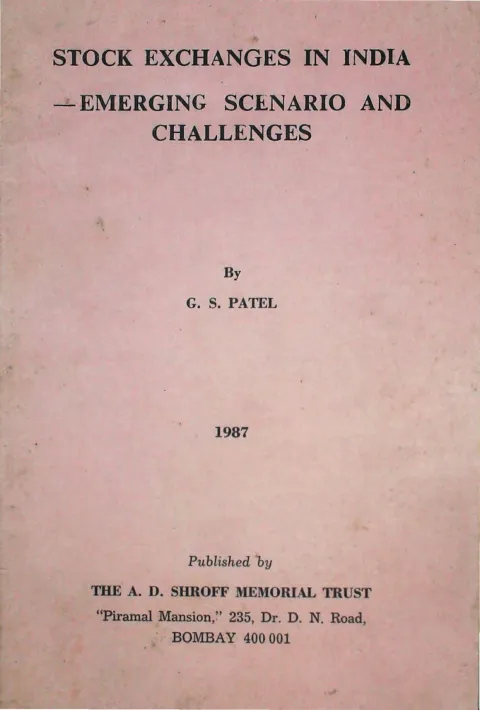
Stock Exchanges in India — Emerging Scenario and Challenges
By G. S. Patel
Published by THE A. D. SHROFF MEMORIAL TRUST, "Piramal Mansion," 235, Dr. D. N. Road, BOMBAY 400 001. Published by M. R. Pai on behalf of The A. D. Shroff Memorial Trust ... and Printed by S. V. Limaye at the India Printing Works, 9, Nagindas Master Road, Fort, Bombay 400 023. · Bombay · 1987
66 pages
Part of A. D. Shroff Memorial Lecture
Stock Exchanges in India — Emerging Scenario and Challenges
By G. S. Patel
Summary
This booklet, published by the A. D. Shroff Memorial Trust, reproduces the text of the Trust’s 1987 annual lecture on Industrial Finance, delivered by G. S. Patel — former Chairman of the Unit Trust of India and Chairman of the Government’s High Powered Committee on Stock Exchange Reforms — under the title ‘Stock Exchanges in India: Emerging Scenario and Challenges’ on 25 February 1987 in Bombay, with an Introduction by N. A. Palkhivala. In the rendered pages, Patel opens by paying homage to A. D. Shroff, recalling Shroff’s role as a co-author of the 1944 Bombay Plan, Chairman of the RBI’s 1954 Committee on Industrial Finance, and an early advocate of unit trusts and consortium underwriting of new capital issues.
In the rendered pages, Patel lays out a five-part structure for the lecture — Introduction; a macro-level view of Indian stock exchanges; the emerging scenario; recent trends abroad; and challenges ahead — and develops the first two heads. He sets the policy backdrop of a resource crunch in which both public- and private-sector enterprises are being pushed toward market discipline and direct capital-market fundraising, against which the role of the stock exchanges takes on added importance. He traces the unprecedented boom in the exchanges since November 1984 under the new Government’s market-oriented policies, the sharp correction and ‘plummeting of prices’ through 1986, and the regulatory interventions — floor prices and even market closures — that, with the investment institutions stepping in at the Prime Minister’s reported instance, averted a collapse.
The rendered pages are dense with data drawn from 1985-86 sources: 14 stock exchanges (five established since 1978), 4,344 listed companies with paid-up capital of Rs. 6,074 crores (90% of non-government public limited companies), and market capitalisation of about Rs. 21,077 crores, with the Bombay Stock Exchange alone accounting for some 70% of listed capital and 80% of market capitalisation. Patel underscores the speculative character of the market — of roughly Rs. 12,000 crores of reported BSE turnover, about Rs. 11,000 crores were forward or speculative ‘budla’ transactions, with genuine investor deliveries only a small fraction.
Key points
-
Text of the A. D. Shroff Memorial Trust’s 1987 Industrial Finance lecture by G. S. Patel, delivered 25 February 1987 in Bombay; introduction by N. A. Palkhivala.
-
Patel honours A. D. Shroff as co-author of the 1944 Bombay Plan, chair of the RBI’s 1954 Committee on Industrial Finance, and early champion of unit trusts and underwriting consortia.
-
He structures the lecture in five heads: introduction; macro view of Indian exchanges; emerging scenario; recent trends abroad; and challenges ahead (heads A-B developed in the rendered pages).
-
He sets a backdrop of resource crunch pushing public and private enterprises toward market discipline and direct capital-market fundraising.
-
He describes the boom in the exchanges since November 1984, the 1986 price collapse, and regulatory interventions (floor prices, market closure) that, with institutional support, averted collapse.
-
In the rendered pages he reports 14 stock exchanges, 4,344 listed companies, paid-up capital of Rs. 6,074 crores (90% of non-government public limited companies), and market capitalisation around Rs. 21,077 crores.
-
The Bombay Stock Exchange alone accounted for roughly 70% of listed capital and 80% of market capitalisation in 1985.
-
He stresses the market’s speculative nature: of ~Rs. 12,000 crores BSE turnover, ~Rs. 11,000 crores were forward/speculative ‘budla’ transactions, with genuine investor deliveries only about 3%.
Generated by the v1.5 extraction pipeline. Awaiting editorial review.
Metadata and summary are AI-extracted from the source PDF and reviewed for editorial accuracy. The original work is available via the Read PDF tab above (where present); paragraph-level citation inside the PDF is deferred to a future engagement.