essay
The Women's Question
Background paper for the Shetkari Sanghatana women's conference, Chandvad, 1986
By Sharad Joshi
Shetkari Sanghatana / Shetkari Prakashan · Maharashtra · 1986
18 pages
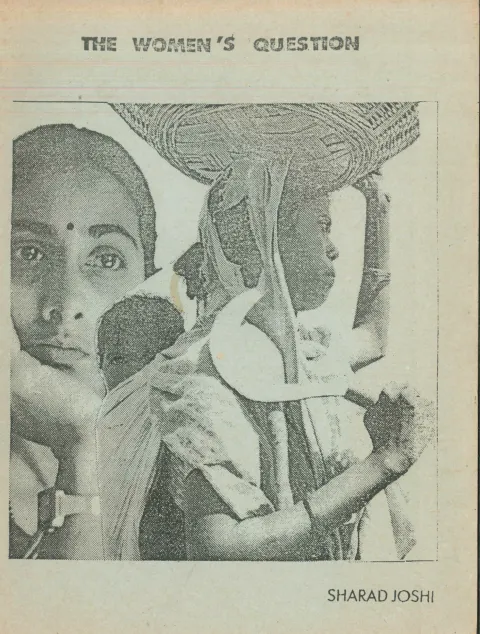
The Women’s Question
Background paper for the Shetkari Sanghatana women’s conference, Chandvad, 9 November 1986 — by Sharad Joshi
Summary
The Women’s Question is Sharad Joshi’s background paper for the deliberations of the women’s conference convened by the Shetkari Sanghatana — the farmers’ movement he founded — at Chandvad in District Nashik, Maharashtra, on 9 November 1986. It is the English statement of the argument that produced the conference’s landmark charter (later published in Marathi as Chandvadchi Shidori).
Writing from within the movement, Joshi observes that although women had taken part in the Shetkari Sanghatana’s agitations from its inception in 1980 — often in unprecedented numbers and at great personal risk — the organisation had until then addressed the problems of the farming household without squarely confronting the specific burdens borne by its women: the crushing double load of domestic and field labour, and their exclusion from the economic and political gains the movement sought. The paper sets out to make the “women’s question” central to the movement’s agenda rather than incidental to it.
NOTE: the source is a scanned booklet whose OCR text layer is poor; this summary reflects the legible framing of the paper and the documented history of the Chandvad conference. A fuller, verified summary awaits editorial review of a clean transcription.
Key points
-
Sharad Joshi’s English background paper for the Shetkari Sanghatana women’s conference at Chandvad, District Nashik, 9 November 1986.
-
The Marathi counterpart of this statement was published as Chandvadchi Shidori, the conference’s charter.
-
Argues that women had participated in the farmers’ movement in large numbers and at real risk since its 1980 inception, yet their specific concerns had gone unaddressed.
-
Highlights the double burden of domestic and field labour carried by women in the farming household.
-
Seeks to move the “women’s question” from the margins to the centre of the Shetkari Sanghatana’s agenda.
Ingested 2026-07-21 from the CCS source archive. AI-drafted summary awaiting editorial review (poor OCR source).
Metadata and summary are AI-extracted from the source PDF and reviewed for editorial accuracy. The original work is available via the Read PDF tab above (where present); paragraph-level citation inside the PDF is deferred to a future engagement.