
periodical issue
Swatantra Newsletter
Issued by the National Headquarters of the Swatantra Party, 143 Mahatma Gandhi Road, Bombay, Telephone No: 251424 · Bombay · 1970
18 pages
Summary
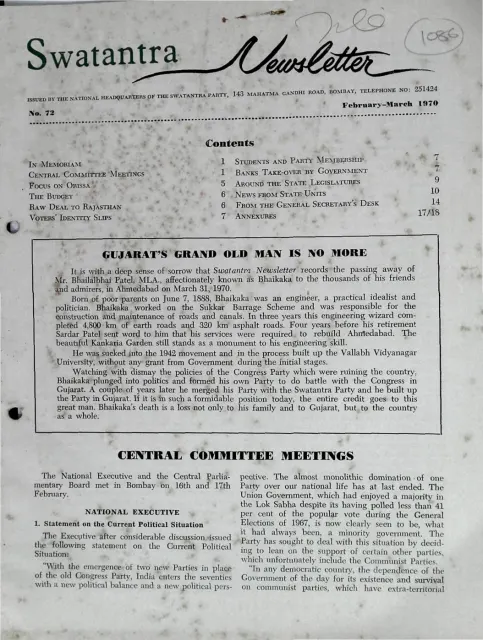
Swatantra Newsletter No. 72 (February–March 1970) is the National Headquarters bulletin of the Swatantra Party under President M. R. Masani, covering the Party’s Central Committee and Central Parliamentary Board meetings held in Bombay on 16–17 February and 19 March. It opens with an obituary of Bhailalbhai Patel (“Bhaikaka”), the engineer-politician who built the Party’s Gujarat unit alongside Sardar Patel’s road-building legacy, then reproduces the National Executive’s formal statement on the political situation following the Congress split, arguing that the Union Government has become a minority regime dependent on Communist support and that Swatantra’s task is to hold policy lines in state assemblies without letting it fall into governments containing communists.
The issue’s polemical centre is fiscal: General Secretary R. C. Cooper characterises the 1970 Union Budget presented by “Socialist” Prime Minister Indira Gandhi as inflationary class warfare, and Masani’s press statement (Annexure A) reprints his “Savage” verdict — direct attacks on the common man’s pocket through duties on sugar, tea, kerosene and cigarettes, deficit financing of Rs. 290 crores rising to Rs. 515 crores, and additional taxation “neither necessary nor justified” without shrinking the socialist establishment. Annexure B collects two National Executive resolutions: welcoming the Supreme Court’s striking-down of the Bank Nationalisation Act as “hostile discrimination” and a violation of fair-compensation guarantees, and denouncing the Kerala Land Reforms (Amendment) Act, 1969 as expropriatory legislation shielded by its inclusion in the Ninth Schedule.
State-by-state reportage covers Orissa (leasing of factory buildings, Chief Minister R. N. Singh Deo’s tourism drive), Rajasthan (Gayatri Devi’s tour of Ganganagar peasant grievances against betterment levies and khatedari cancellations), and the U. P. Assembly where Swatantra group leader Bhanu Pratap Singh attacked Chief Minister Charan Singh’s “India’s Poverty and its Solution” for its incoherence on ceilings and land-revenue abolition. Shorter items track a Supreme Court petition on the Banking Ordinance argued through advocate Nani Palkhivala (implied context of the Cooper case), unofficial voters’ identity slips prohibited by the Election Commission, party-membership rules for students, and state-unit conventions in Andhra, Bombay, Delhi, Gujarat, Kashmir, Mysore, Punjab and Tamil Nadu, closing with the Rajaji 92nd-birthday celebrations in Madras.
The closing “From the General Secretary’s Desk” is a detailed circular from R. C. Cooper on decentralised fund collection, replacing the historic reliance on corporate donations (now barred by legislation) with monthly targets from industrial units, shop-keepers and individual sympathisers, backed by eleven techniques including bank-order collections, flag days and token-priced literature sales.
Key points
- Obituary of Bhailalbhai Patel (“Bhaikaka”), engineer of the Sukkar Barrage and Vallabh Vidyanagar University, credited with building Swatantra in Gujarat after merging his splinter party with Masani’s.
- National Executive frames the post-split Congress as a minority government surviving on Communist support and directs state groups to avoid supporting any Congress-toppling combination that would include Communists.
- Party position on Gujarat, Bihar, U.P. and Mysore Assemblies laid down: vigilant Opposition, no censure votes that would elevate Mrs. Gandhi’s supporters or communist-backed alternatives.
- R. C. Cooper and M. R. Masani attack the 1970 Union Budget and Railway Budget as inflationary, class-warfare instruments producing “neither Growth nor Socialism”, with deficit financing rising from Rs. 290 to Rs. 515 crores.
- National Executive welcomes the Supreme Court’s judgement striking down the Bank Nationalisation Act as hostile discrimination and a violation of the fair-compensation guarantee.
- Kerala Land Reforms (Amendment) Act, 1969 denounced as expropriatory; the Party will oppose its insertion into the Ninth Schedule of the Constitution.
- Bhanu Pratap Singh (UP Swatantra leader) contests Charan Singh’s positions on ceilings, urban-property ceilings, and land-revenue abolition on uneconomic holdings, quoting from Charan Singh’s own book.
- General Secretary’s circular details a decentralised fund-raising blueprint — monthly targets by unit tier, eleven collection methods, and a proposed “Flag Day” — to replace the now-banned corporate contributions.
Metadata and summary are AI-extracted from the source PDF and reviewed for editorial accuracy. The original work is available via the Read PDF tab above (where present); paragraph-level citation inside the PDF is deferred to a future engagement.
Related across the archive
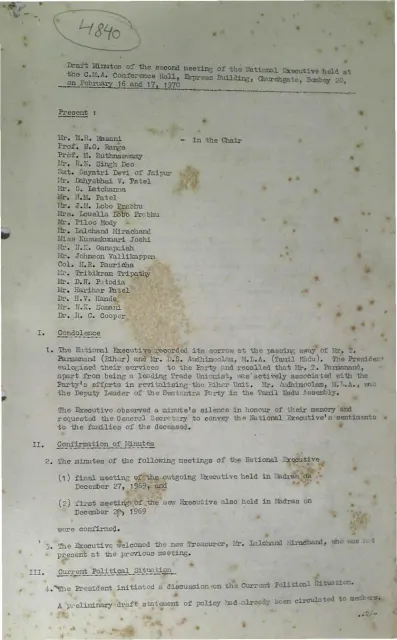 Primary workDraft Minutes of the second meeting of the National Executive held at the C.H.A. Conference Hall, Express Building, Churchgate, Bombay 20, on February 16 and 17, 1970
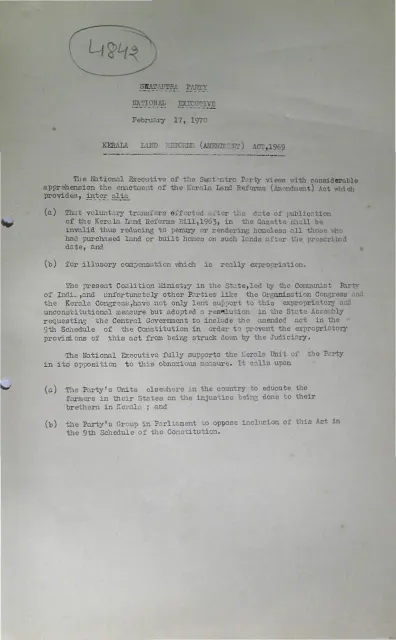 Primary workKERALA LAND REFORMS (AMENDMENT) ACT,1969
 Primary workLetter to N G Ranga
 ExcerptAgricultural Policy of Swatantra Party
 Thinkernani-palkhivala