
minutes
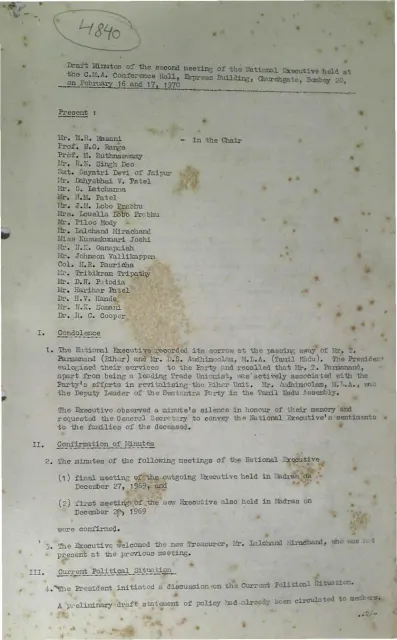
Draft Minutes of the second meeting of the National Executive held at the C.H.A. Conference Hall, Express Building, Churchgate, Bombay 20, on February 16 and 17, 1970
SWATANTRA PARTY · Bombay · 1970
34 pages
Summary
These draft minutes record the Swatantra Party National Executive’s meeting at Bombay’s C.H.A. Conference Hall on 16–17 February 1970. The meeting confirmed earlier minutes, recorded condolences, discussed the current political situation, and adopted a statement criticising the Congress government’s dependence on Communist support, economic policies, restrictions on property rights, and alleged weakening of democratic institutions. The Executive also considered cooperation with the Samyukta Socialist Party, the Party’s position in state assemblies, and opposition strategy in Gujarat, Mysore, Uttar Pradesh, and Bihar. In Gujarat, it affirmed the Swatantra Party’s role as the official opposition while distinguishing opposition to the government from support for motions that might bring a Communist-supported ministry to power.
The minutes then turn to party organisation and administration: training camps, translations, speakers’ panels, inspection tours, state conventions, youth work, finances, fund-raising, publicity, and the improvement of the Swatantra Newsletter and Swatantra in Parliament. They document disciplinary proceedings concerning C. C. Desai, resolutions governing party bank accounts, and plans to revise the Party’s economic-policy statement. The Executive also addressed the abolition of privy purses, Chandigarh, the Kerala Land Reforms (Amendment) Act, fundamental rights, property rights, and corruption among politicians. The rendered annexures include the adopted statement on the current political situation, a resolution welcoming the Supreme Court’s bank-nationalisation judgment, a resolution opposing the Kerala land-reform measure, and material on the Leslie Sawhny Programme of Training for Democracy.
Key points
- The National Executive adopted a statement portraying India’s political crisis as connected to Congress economic policy, Communist support, inflation, and declining living standards.
- The Swatantra Party presented itself as a constitutional and democratic opposition committed to individual property rights and resistance to excessive state power.
- The Executive approved a cautious approach to cooperation with the Samyukta Socialist Party and rejected a general round-table discussion of its 17-point programme.
- State-level strategy focused on preserving the Party’s opposition role while avoiding changes of government that could produce Communist-supported ministries.
- The meeting established organisational priorities including training camps, youth work, state and regional reporting, publicity, fund-raising, and improved parliamentary communications.
- The Party welcomed the Supreme Court decision invalidating the Bank Nationalisation Act and treated it as a safeguard for fundamental rights and constitutional limits.
- The annexed economic-policy draft was referred for further work, with a working group asked to prepare a revised paper for circulation.
- The documents oppose the Kerala Land Reforms (Amendment) Act as expropriatory and call for resistance to its inclusion in the Constitution’s Ninth Schedule.
Metadata and summary are AI-extracted from the source PDF and reviewed for editorial accuracy. The original work is available via the Read PDF tab above (where present); paragraph-level citation inside the PDF is deferred to a future engagement.
Related across the archive
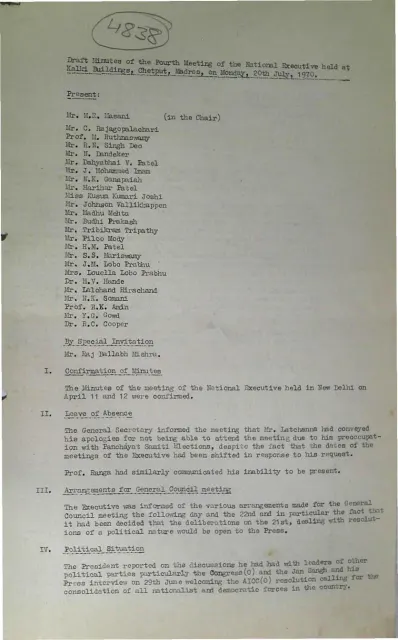 Primary workDraft Minutes of the Fourth Meeting of the National Executive held at Kalla Buildings, Chepauk, Madras, on Monday, 20th July, 1970.
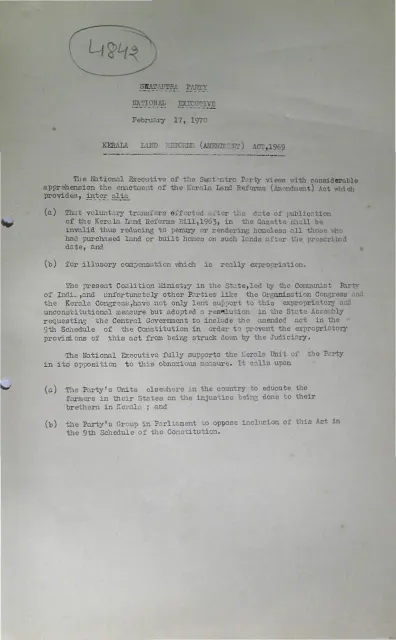 Primary workKERALA LAND REFORMS (AMENDMENT) ACT,1969
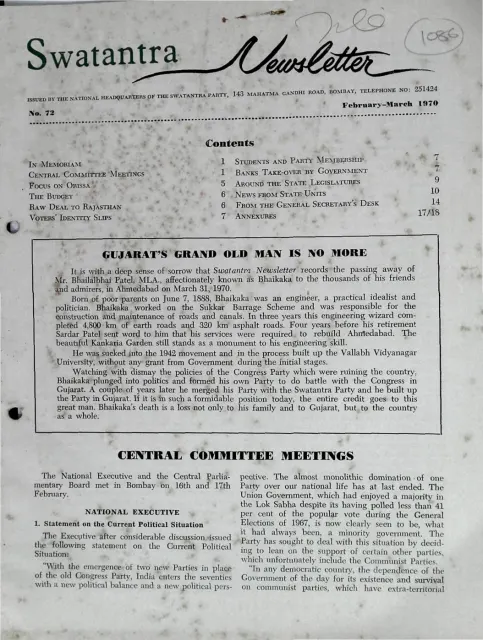 Primary workSwatantra Newsletter
 OpinionIndian Liberals, Quest Magazine and India's First Dictatorship
 ExcerptDemocracy in India