
periodical issue
Swatantra Newsletter
ISSUED BY THE NATIONAL HEADQUARTERS OF THE SWATANTRA PARTY, 143 MAHATMA GANDHI ROAD, BOMBAY, TELEPHONE NO: 251424 · Bombay · 1970
13 pages
Summary
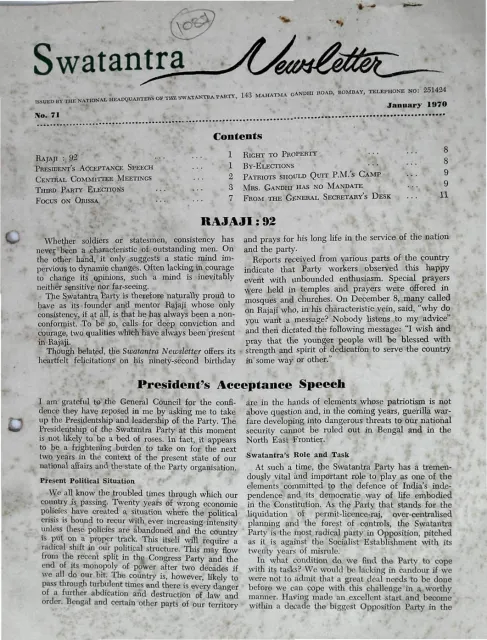
The January 1970 Swatantra Newsletter (No. 71) is an internal party organ that stitches together a birthday tribute to Rajaji, the newly-elected President M. R. Masani’s acceptance speech, a full report on the party’s third national organisational elections, a state focus on Orissa, and shorter items on the Right to Property, by-election results, N. G. Ranga’s Bangalore press conference urging patriotic Congressmen to leave the Prime Minister’s rump, Masani’s Delhi press conference on Mrs. Gandhi’s lack of mandate, and a long signed column by General Secretary R. C. Cooper on the party’s self-understanding.
The political frame throughout is a hardening opposition to the post-split Congress under Indira Gandhi. Masani’s acceptance speech positions the Swatantra Party as “the most radical party in Opposition,” committed to dismantling the permit-licence-raj, over-centralised planning and the “forest of controls,” while warning that guerilla warfare in Bengal and the North-East is turning ordinary insecurity into a national-security problem. On the Right to Property, the newsletter records the Bombay ‘Grab Property’ jamboree, quotes Nehru’s own 1955 assurance that the constitutional amendment on agricultural land would not be misused, and calls Mrs. Gandhi’s move to strip small farmers and shopkeepers of Fundamental Right protection a betrayal that must be “vehemently opposed.”
The elections report is the longest single item: it documents that Masani was elected President unopposed, R. C. Cooper General Secretary, H. P. Nanda and Lalchand Hirachand Treasurers, and lists the Central Parliamentary Board and eleven Vice-Presidents (ballot-elected from a field of eleven for five vacancies) along with Joint Secretaries and the twenty-member National Executive with vote counts. Comparative enrolment tables show total membership rising from 47,151 (1967) to 52,003 (1969), and the report is candid about weakness in Assam, Bihar, Madhya Pradesh and West Bengal, where the party has no functioning organisation.
Cooper’s signed column, “Educate Government and People Spurning Cheap Demagogy,” gives the issue its ideological centre. He argues that Swatantra is “an educating body rather than a power-seeking group,” whose swadharma is to teach economic truth in a Gita-like spirit, refuse to bid for votes with slogans, and stand ready to cooperate with any democratic party that turns away from “the lure of Statism.” The Focus on Orissa piece surveys social services, agriculture, industry, power and administration in the state, arguing that Congress-era planning has under-delivered on health, higher education, irrigation and industrial licensing despite Orissa’s rich bauxite, iron ore and hydro potential.
Key points
- Rajaji turns 92; the party marks the birthday with prayers in temples and mosques on 8 December, and reproduces his message hoping younger people will dedicate themselves to the country.
- M. R. Masani is elected President unopposed on 28 December 1969; Dr. R. C. Cooper becomes General Secretary and H. P. Nanda and Lalchand Hirachand Treasurers.
- Total enrolment rises from 47,151 (1967) to 52,003 (1969), but Assam, Bihar, Madhya Pradesh and West Bengal remain without a functioning organisation.
- The Central Parliamentary Board is constituted with Masani (President), Cooper (General Secretary), and C. Rajagopalachari as member, plus parliamentary leaders from Lok Sabha, Rajya Sabha, Orissa, Rajasthan, Gujarat and Andhra.
- The Swatantra Party launches a campaign against Mrs. Gandhi’s proposed abolition of the Fundamental Right to Property, citing Nehru’s 1955 pledge that the agricultural-land amendment would not be misused.
- N. G. Ranga at Bangalore calls on patriotic Congressmen to quit the Prime Minister’s group and welcomes the Congress split as “long overdue.”
- Masani in Delhi argues that Mrs. Gandhi no longer has the mandate she won in 1967 and that her rule depends on Communist support, and rejects any ‘broad front’ with the Jana Sangh, PSP or SSP as a bigger job than any single party can do.
- General Secretary Cooper frames Swatantra as an educating body whose swadharma is to teach economic truth and spurn cheap demagogy, willing to cooperate with any democratic party that leaves the “lure of Statism.”
Metadata and summary are AI-extracted from the source PDF and reviewed for editorial accuracy. The original work is available via the Read PDF tab above (where present); paragraph-level citation inside the PDF is deferred to a future engagement.
Related across the archive
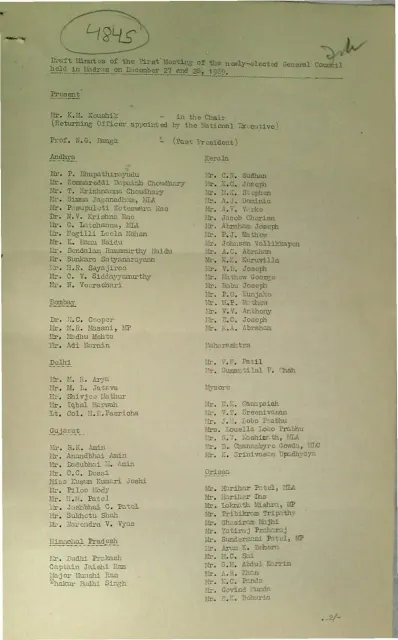 Primary workDraft Minutes of the First Meeting of the newly-elected General Council held in Madras on December 27 and 28, 1969.
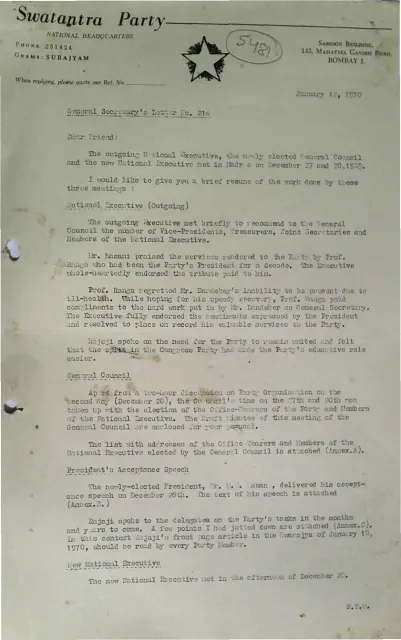 Primary workGeneral Secretary's Letter No. 216
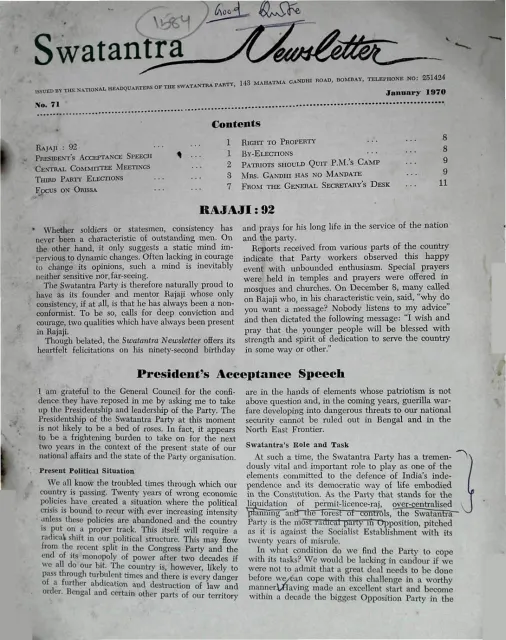 Primary workSwatantra Newsletter
 ExcerptNational Priorities for 1970
 OpinionAcharya N G Ranga: The Farmer’s Friend and Swatantra Party Stalwart