
periodical issue
Swatantra Newsletter
ISSUED BY THE NATIONAL HEADQUARTERS OF THE SWATANTRA PARTY, 143 MAHATMA GANDHI ROAD, BOMBAY, TELEPHONE No. 251434 · Bombay · 1969
12 pages
Summary
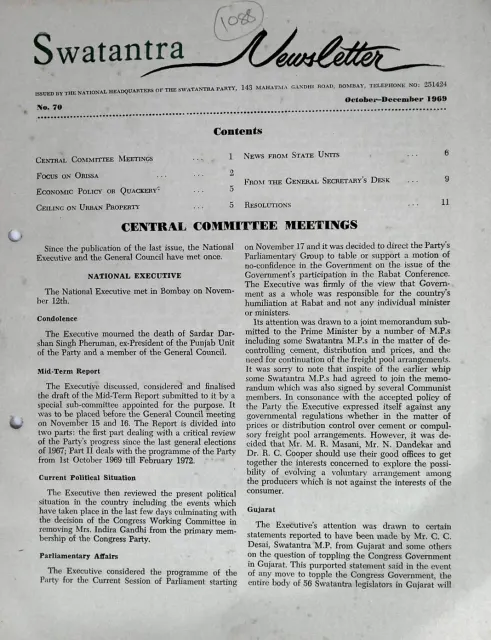
Issue No. 70 of the Swatantra Newsletter (October–December 1969) is a party bulletin issued from the National Headquarters at 143 Mahatma Gandhi Road, Bombay. It opens with a report of the National Executive meeting of 12 November 1969, held against the backdrop of the split in the Congress Party and the expulsion of Mrs. Indira Gandhi from its primary membership. The Executive mourned Sardar Darshan Singh Pheruman, finalised the Party’s Mid-Term Report (to be tabled in Parliament by the Swatantra Parliamentary Group), and coordinated its stance on the Rabat Conference no-confidence motion, freight-pool controls, and prices and distribution regulations. A companion note from Gujarat records the Party’s decision that neither the State Unit nor the Legislature Group would support any move to topple the Congress government there without prior clearance from the Central Parliamentary Board.
The long Orissa section chronicles the Swatantra-led coalition’s troubles: the Pay Commission’s recommendations, flood and cyclone relief, the Union Railway Ministry’s refusal to route Paradip line orders through small-scale industries in the state, the failure of a Communist-supported no-confidence motion moved by Nishamoni Khuntia, and a detailed digest of the Khanna Commission Report on Kalinga Industries and the Patnaik–Mitra affair. It closes with the reshuffle in R. N. Singh Deo’s Cabinet. A separate Bombay speech by M. R. Masani, delivered on 29 September at the Merchants’ Chamber, attacks the Congress economic resolution as “quackery,” ridicules the Government’s inflation-plus-price-control policy, denounces socialism as a national “opiate,” and — quoting Galbraith — argues that democratic socialism suits the USA better than a developing country like India. A joint statement by five Swatantra MPs (Loknath Misra, R. R. Singh Deo, S. K. Tapuriah, C. C. Desai and N. Shivappa) rejects K. K. Shah’s proposed ceiling on urban property, calling for liberalised housing credit and larger LIC allocations instead.
State-unit despatches from Andhra, Bihar, Bombay, Kashmir, Maharashtra, Mysore, Orissa, Pondicherry, Rajasthan and Tamil Nadu record election results, agitations, condolences and organisational activity — including the Agriculturists’ Conference at Saklaspur convened by N. K. Ganapaiah and the Congress-Communist “conspiracy” thesis advanced by K. M. Panigrahy after teachers’ protests in Orissa. “From the General Secretary’s Desk,” signed by R. C. Cooper (with a footnote that N. Dandeker resumed as General Secretary from 1 December), warns members that the newly formed Congress Marxist Party under Indira Gandhi has tabled a resolution to abolish the fundamental right to property, and lays out a nine-point rural-education programme culminating in a “Protect the Small Farmer and Small Shopkeeper Day.” Annexure A prints the resolutions adopted by the General Council on 15–16 November 1969 on the Mid-Term Report, misuse of preventive detention in Gujarat, communal violence in Ahmedabad, breakdown of law and order in West Bengal (demanding immediate President’s rule), Pheruman’s ashes, and famine relief in Rajasthan and elsewhere.
Key points
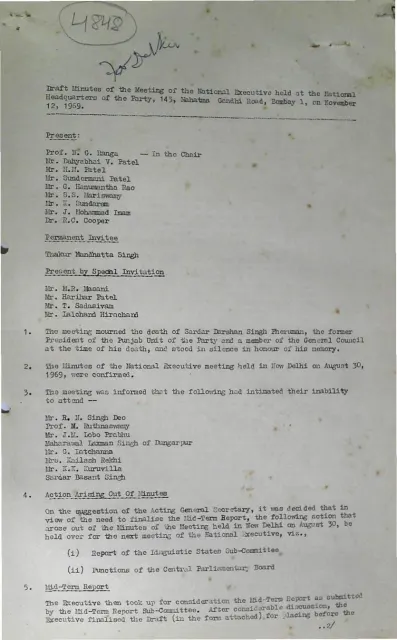
- Newsletter reports the National Executive’s 12 November 1969 meeting: condolences for Sardar Darshan Singh Pheruman, finalisation of the Party’s Mid-Term Report, and coordination of stance on the Rabat Conference no-confidence motion and freight-pool controls.
- Sets out the Party’s position on the Congress split — treating Indira Gandhi’s newly formed Congress Marxist Party as “communist dominated and controlled” and warning of a constitutional move to abolish the fundamental right to property.
- M. R. Masani’s Calcutta Merchants’ Chamber address dismisses the Congress 10-point economic resolution as “quackery” and “a policy of robbing Peter to pay Paul,” quoting Galbraith that democratic socialism suits the USA better than a developing country like India.
- Five Swatantra MPs — Loknath Misra, R. R. Singh Deo, S. K. Tapuriah, C. C. Desai and N. Shivappa — oppose K. K. Shah’s proposed ceiling on urban property, calling instead for liberalised housing credit and larger LIC housing allocations.
- The Orissa section digests the Khanna Commission’s findings on Kalinga Industries and details the survival of R. N. Singh Deo’s Swatantra-led ministry after the collapse of a Communist-backed no-confidence motion.
- R. C. Cooper’s General Secretary letter proposes a rural-education campaign against the property-rights amendment and a “Protect the Small Farmer and Small Shopkeeper Day.”
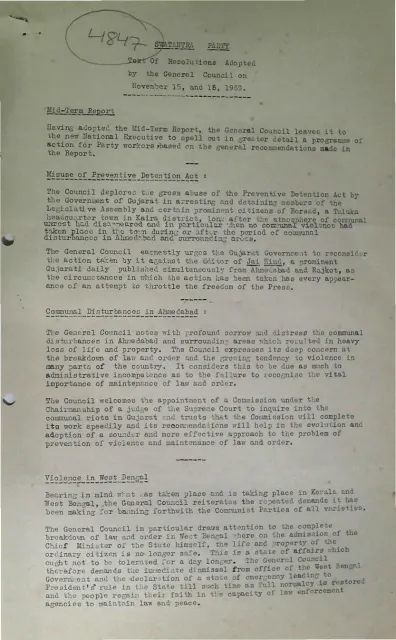
- Annexure A carries General Council resolutions demanding immediate President’s rule in West Bengal, deploring preventive-detention arrests of Jai Hind’s editor in Gujarat, and criticising the Rajasthan and Andhra governments’ famine-relief neglect.
Metadata and summary are AI-extracted from the source PDF and reviewed for editorial accuracy. The original work is available via the Read PDF tab above (where present); paragraph-level citation inside the PDF is deferred to a future engagement.
Related across the archive
 Primary workText Of Resolutions Adopted by the General Council on November 15, and 16, 1969.
 Primary workDraft Minutes of the Meeting of the National Executive held at the National Headquarters of the Party, 143, Mahatma Gandhi Road, Bombay 1, on November 12, 1969.
 Primary workSwatantra Newsletter
 ExcerptNational Priorities for 1970
 OpinionIndian Liberals, Quest Magazine and India's First Dictatorship