
periodical issue
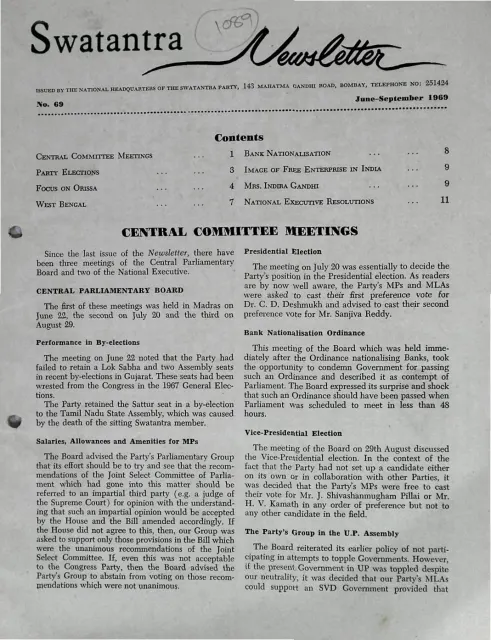
Swatantra Newsletter
ISSUED BY THE NATIONAL HEADQUARTERS OF THE SWATANTRA PARTY, 143 MAHATMA GANDHI ROAD, BOMBAY, TELEPHONE NO: 251424 · Bombay · 1969
16 pages
Summary
Issue No. 69 of the Swatantra Newsletter (June–September 1969) is the National Headquarters’ account to the party membership of three summer meetings of the Central Parliamentary Board and two of the National Executive. The bulk of the number is procedural: the Party’s decision to back Dr. C. D. Deshmukh for the Presidency (with Mr. Sanjiva Reddy as second preference) and the fallout of Deshmukh’s defeat; a stiffly worded protest against Mrs. Indira Gandhi’s Bank Nationalisation Ordinance as “an act of contempt of Parliament” because the House was to meet within 48 hours; a censure of Dr. K. M. Munshi’s public support for a Congress candidate in the Banaskantha by-election; the elaborate calendar of the Party’s internal elections through December 1969; and the ratification of resolutions on Telangana, the “Communist Menace,” West Bengal law and order, Communist infiltration, threats to press freedom, Sardar Darshan Singh Pheruman’s indefinite fast, and the Bihar–Assam floods.
The substantive centre of the issue is a “Focus on Orissa” set-piece built around Prof. B. R. Shenoy’s report to the Swatantra-led R. N. Singh Deo Ministry, extracted from the Amrita Bazar Patrika of 26 March. Shenoy reviews Orissa’s budgets since 1954–55, argues that persistent deficits and grants-in-aid have been financing revenue expenditure rather than capital formation, and calls for denationalising public-sector undertakings that private capital is willing to buy, ending the state monopoly of rice procurement, and constituting a genuine Development Authority for the small-scale sector. A Code for Legislators recommended to the Speaker of the Assembly — barring ministers from posts of profit, disclosing shareholdings, and refusing gifts — is reproduced alongside.
The issue’s most polemical pages carry two addresses by Mr. M. R. Masani, M.P., delivered in Bombay in July 1969. “Image of Free Enterprise in India” (Bombay Junior Chamber, 3 July) charges both politicians and businessmen with hollowing out the reputation of enterprise — the businessman making “a quick rupee out of permits and licences,” the politician sneering at the corporation — and urges managers to enter public life through vehicles such as the Leslie Sawhny Programme of Training for Democracy. “Mrs. Indira Gandhi” (Mid-Town Rotary Club, 16 July) reads the Prime Minister’s manoeuvres — the dismissal of the Deputy Prime Minister, the rubber-stamping of the Vice-President’s election, the bank Ordinance, attacks on the press, appointments of “well-known Communists” to key posts — as a systematic attempt to become “a virtual dictator.” A parallel statement by the acting General Secretary Dr. R. C. Cooper accuses Mrs. Gandhi of being in a “desperate hurry” to eliminate rivals and to govern with a Kitchen Cabinet of fellow-travellers.
Annexure A prints the National Executive Resolutions of 23 June and 30 August 1969 in full: a demand that the Centre invoke President’s Rule in Andhra if necessary to restore order in Telangana; a call to outlaw all Communist parties, “be they of the Left, Right or the Naxalites”; a lengthy statement on the current political situation that ties the bank Ordinance, the flouting of the Congress whip on the Presidential vote, and the West Bengal collapse to a single “basic crisis” of Congress rule; and appeals for effective relief to Bihar and Assam flood victims and for clemency for the fasting Akali leader Sardar Darshan Singh Pheruman.
Key points
- The Central Parliamentary Board met on 22 June, 20 July and 29 August 1969; the National Executive met on 22 June and 30 August, condoling the deaths of Party President Dr. Zakir Hussain and senior members Sir H. P. Mody, Dr. K. C. Baghel, Mr. Ramaseshaiah (Orissa’s Minister for Health), Mr. Ambashankar Trivedi and Sardar Ram Singh.
- The Board directed Swatantra MPs and MLAs to vote first-preference for Dr. C. D. Deshmukh and second-preference for Mr. Sanjiva Reddy in the Presidential election, and denounced the Bank Nationalisation Ordinance issued while Parliament was 48 hours from convening as “an act of contempt of Parliament.”
- The National Executive publicly regretted Vice-President Dr. K. M. Munshi’s support for the Congress candidate Mr. S. K. Patil in the Banaskantha by-election, and after review refused to reopen the case, holding that Munshi’s Kshetra Sanyas did not exempt him from party discipline.
- A detailed timetable was adopted for the Party’s internal elections — from enrolment of new Workers by 31 August 1969 to election of National Executive members by 31 December 1969 — with a five-man National Election Tribunal to hear disputes.
- “Focus on Orissa” reproduces Prof. B. R. Shenoy’s report to the R. N. Singh Deo Ministry: denationalise public-sector units the private sector is willing to buy, end the monopoly procurement of rice, replace grants-in-aid financing of current expenditure with genuine capital formation, and set up a Development Authority for Orissa Small Scale Industries.
- A ten-point Code for Legislators, recommended for the Orissa Assembly, would bar ministers and MLAs from offices of profit, monopoly rights, or discretionary posts under Government contract, and require disclosure of shareholdings and gifts on assumption of office.
- In two Bombay addresses reprinted verbatim, Mr. M. R. Masani argues that the Indian businessman has been “busy trying to oust members of the old Establishment from positions of economic vantage” while making “a quick rupee out of permits and licences,” and that Mrs. Indira Gandhi is systematically undermining Parliament, the press and the judiciary in an attempt to become “a virtual dictator” supported by a Communist-heavy Kitchen Cabinet.
- National Executive Resolutions (Annexure A) demand the imposition of President’s Rule in Andhra if required to restore order in Telangana, call for the outlawing of all Communist parties including the Naxalites, denounce the Government’s intimidation of the press through All India Radio and the Ministry of Information and Broadcasting, back Sardar Darshan Singh Pheruman’s demand on the Punjabi Suba issue while appealing for his life, and urge speedy relief for the Ganga–Kosi flood-stricken kisans of North Bihar and Assam.
Metadata and summary are AI-extracted from the source PDF and reviewed for editorial accuracy. The original work is available via the Read PDF tab above (where present); paragraph-level citation inside the PDF is deferred to a future engagement.
Related across the archive
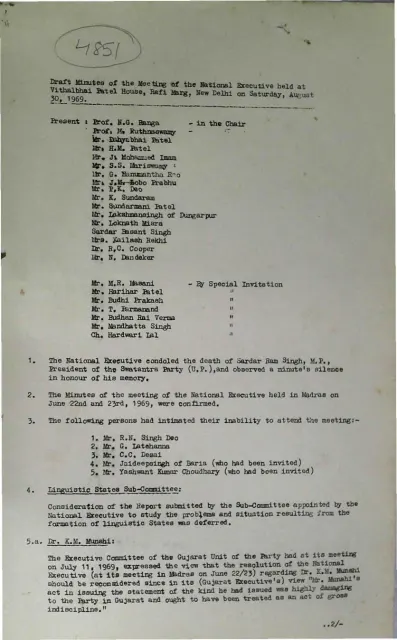 Primary workDraft Minutes of the Meeting of the National Executive held at Vithalbhai Patel House, Rafi Marg, New Delhi on Saturday, August 30, 1969.
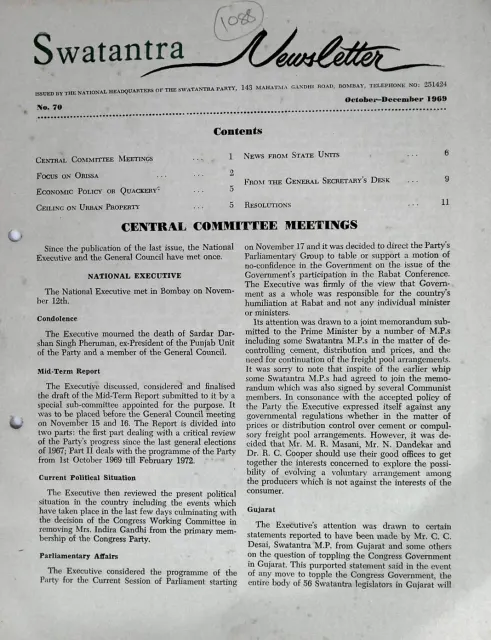 Primary workSwatantra Newsletter
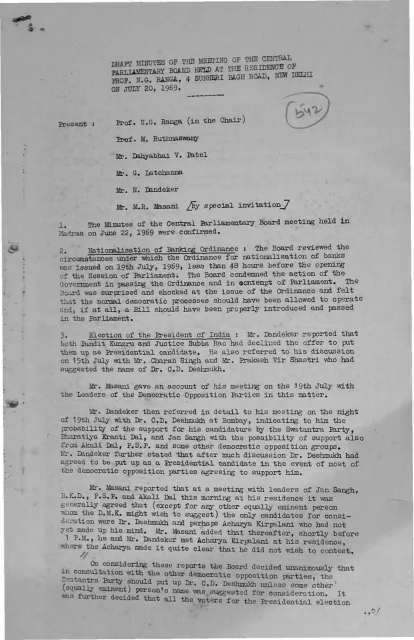 Primary workDRAFT MINUTES OF THE MEETING OF THE CENTRAL PARLIAMENTARY BOARD HELD AT THE RESIDENCE OF PROF. N.G. RANGA, 4 SUNHERI BAGH ROAD, NEW DELHI ON JULY 20, 1969.
 ExcerptThe Liberal Budget: Building an Equitable Society
 ExcerptOur Economic Future