notice · working paper
A Bill to provide for civil and criminal immunity to physicians and surgeons withdrawing life sustaining treatment from patients suffering from terminal illness
L. C. Bill No. XIV of 1984
Maharashtra Legislature Secretariat · Bombay · 1985
2 pages
Summary
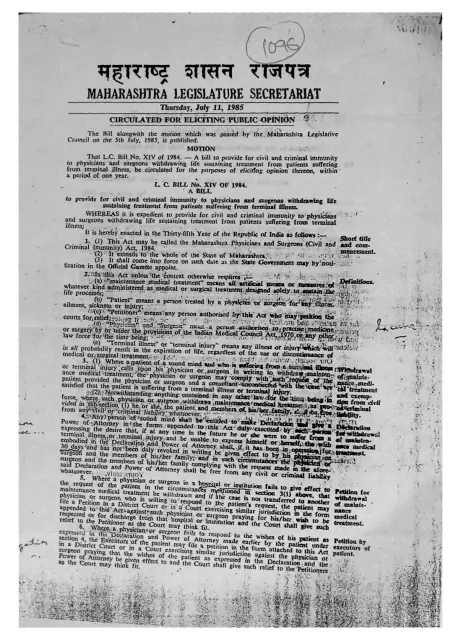
This two-page document is a Maharashtra Legislature Secretariat gazette notice, dated Thursday, 11 July 1985, republishing L.C. Bill No. XIV of 1984 and circulating it for the purpose of eliciting public opinion within a stipulated period. The Bill proposes a legal framework under which physicians treating certain categories of patients — including those in terminal or otherwise irreversible medical states — would be granted civil and criminal immunity when acting on the patient’s expressed refusal of further artificial medical treatment. The gazette page reproduces the Bill’s operative clauses, definitions, and the manner in which such refusals are to be evidenced, signed, and witnessed.
The second page prints the statutory forms attached to the Bill. A “Declaration” (framed under section 4) allows a person of sound mind, after careful consideration, to record in advance that if there is no reasonable prospect of recovery from a physical illness or impairment, or if vital bodily functions can no longer operate independently, he or she should be deemed to decline artificial medical treatment and to ask to be kept free from pain and distress. A separate clause specifies that in the event of heart arrest, resuscitation efforts should be abandoned after three minutes. The Declaration must be signed before two witnesses (who cannot be members of the family) who attest to the declarant’s soundness of mind.
A companion “Draft Special Power of Attorney” appended below authorises named attorneys, acting jointly or severally, to interpret the declaration, take decisions in accordance with its terms, and secure compliance from medical practitioners notwithstanding any contrary views held by any other person. The instrument is expressed to remain in force during the declarant’s lifetime unless notice of revocation is received by the attorneys. The gazette copy is signed off from Bombay on 19 July 1984 by V. M. Subrahmaniyam, Secretary (II), Maharashtra Legislative Council. Taken together, the two pages constitute an early Indian legislative attempt to give statutory recognition to what would later be called a living will and a durable healthcare power of attorney.
Key points
- Maharashtra Legislature Secretariat gazette dated 11 July 1985 recirculates L.C. Bill No. XIV of 1984 for the purpose of eliciting public opinion within one year.
- The Bill provides civil and criminal immunity to physicians who withhold or withdraw artificial medical treatment from patients suffering specified terminal or irreversible conditions, when acting on the patient’s own declaration.
- A statutory Declaration form (under section 4) lets a person of sound mind refuse artificial medical treatment in advance if there is no reasonable prospect of recovery or if vital bodily functions are incapable of independent operation.
- The Declaration specifies that in the event of heart arrest, resuscitation should be abandoned at the end of three minutes.
- Two witnesses, who must not be members of the declarant’s family, are required to attest that the declarant is of sound mind.
- A Draft Special Power of Attorney appended to the Bill empowers named attorneys, jointly or severally, to interpret the declaration and secure compliance from doctors notwithstanding contrary views held by others.
- The Power of Attorney is stated to remain in force during the declarant’s lifetime until notice of revocation is received by the attorneys.
- The circulated draft is issued from Bombay on 19 July 1984 under the signature of V. M. Subrahmaniyam, Secretary (II), Maharashtra Legislative Council.
Metadata and summary are AI-extracted from the source PDF and reviewed for editorial accuracy. The original work is available via the Read PDF tab above (where present); paragraph-level citation inside the PDF is deferred to a future engagement.