minutes
Meeting of the National Executive Committee
All India Swatantra Party · Madras · 1975
4 pages
Summary
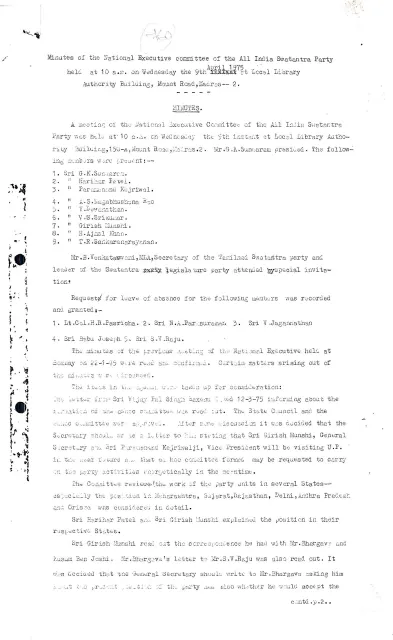
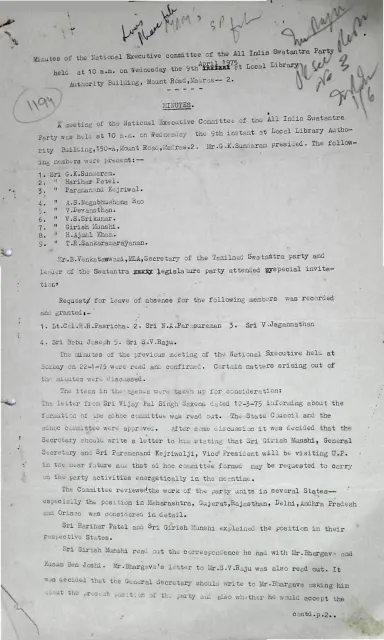
These are the minutes of a meeting of the National Executive Committee of the All India Swatantra Party held on 9 April 1975 at the Local Library Authority Building, Mount Road, Madras. G. K. Sundaram presided over nine members present, with S. V. Raju among those granted leave of absence, and B. Venkateswami MLA (Secretary of the Tamilnad Swatantra party) attending by special invitation. After confirming the minutes of the previous meeting held at Bombay on 22 January 1975, the Committee reviewed party units in Maharashtra, Gujarat, Rajasthan, Delhi, Andhra Pradesh and Orissa, resolved to depute the General Secretary Girish Munshi and Vice President Paramanand Kejriwal to visit Uttar Pradesh, and noted G. K. Sundaram’s appointment to the National Coordinating Committee of the People’s Struggle led by Jayaprakash Narayan.
The body of the minutes records the party’s political posture in the months preceding the Emergency: it welcomes JP’s Charter of Demands (while noting internal contradictions) and endorses the unanimous view that Swatantra should take the lead in forming a democratic front bringing together all non-communist opposition parties against the ruling Congress, recalling that Rajaji had made almost identical suggestions in 1969 and 1971. The Committee also postpones its own party elections until after the 1976 general elections, orders fresh enrolment forms, and appoints S. V. Raju of Bombay as one of the Joint Secretaries subject to General Council approval.
The minutes then reproduce six resolutions adopted unanimously from a draft prepared by V. S. Srikumar. They extend support to Morarji Desai’s indefinite fast and demand immediate revocation of the state of emergency and holding of the overdue Gujarat Assembly elections (Res. 1); condemn the CPI–Ruling Congress “goondaism” that prevented JP from addressing students at the University Institute Hall in Calcutta and call for the dismissal of the West Bengal Chief Minister and Home Minister (Res. 2); denounce the imposition of “outsiders” as leaders in Jammu and Kashmir and declare Article 370 and Kashmir’s special status contrary to the long-run national interest (Res. 3); pledge full support to JP’s National Coordinating Committee and to a common-symbol, common-platform electoral front of democratic non-Congress, non-communist parties (Res. 4); defend a mixed economy as the only sensible long-term policy of economic regeneration while warning that Congress, spurred by the CPI, is drifting toward a totalitarian economy that cannot coexist with democracy (Res. 5); and attack arbitrary paddy levies and below-cost procurement prices as “undemocratic” and “economically unsound,” urging revised procurement policy to incentivise farmers (Res. 6).
Key points
- Minutes of the All India Swatantra Party National Executive meeting, 9 April 1975, Madras; G. K. Sundaram in the chair, nine members present, signed by V. S. Srikumar as Joint Secretary.
- S. V. Raju of Bombay is appointed one of the Joint Secretaries, subject to General Council approval; Girish Munshi (General Secretary) and Paramanand Kejriwal (Vice President) are deputed to visit Uttar Pradesh.
- The Committee endorses Jayaprakash Narayan’s Charter of Demands despite noting internal contradictions, and notes G. K. Sundaram’s appointment to JP’s National Coordinating Committee of the People’s Struggle.
- Unanimous decision that Swatantra should lead the formation of a democratic front of all non-communist opposition parties against the ruling Congress, recalling identical proposals made under Rajaji’s leadership in 1969 and 1971.
- Party elections are postponed until after the 1976 general elections; state units are directed to renew existing cards and enrol members afresh on new forms to be printed by the National Head Quarters.
- Resolution 1 supports Morarji Desai’s indefinite fast and demands immediate revocation of the state of emergency and elections to the Gujarat Assembly.
- Resolution 3 denounces the imposition of “outsiders” as leaders in Kashmir and holds that Article 370 and Kashmir’s special status are contrary to the country’s long-run interests.
- Resolutions 5 and 6 defend a mixed economy against a drift to a “totalitarian economy” driven by CPI-Ruling Congress collusion, and attack arbitrary paddy levies and below-cost procurement prices as undemocratic and economically unsound.
Metadata and summary are AI-extracted from the source PDF and reviewed for editorial accuracy. The original work is available via the Read PDF tab above (where present); paragraph-level citation inside the PDF is deferred to a future engagement.