minutes · report
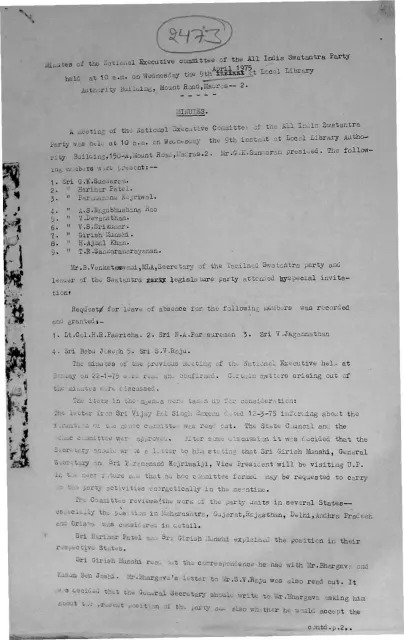
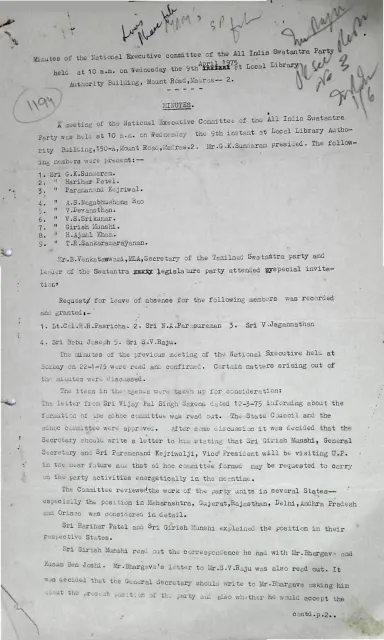
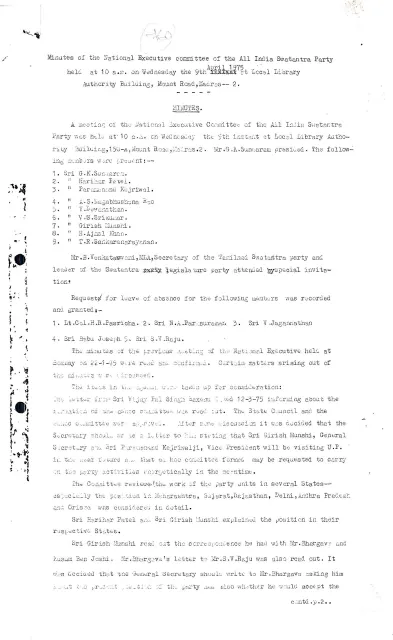
Minutes of the National Executive committee of the All India Swatantra Party
All India Swatantra Party · Madras · 1975
5 pages
Summary
These minutes record the All India Swatantra Party National Executive meeting held in Madras on 9 April 1975 under the chairmanship of G. K. Sundaram. The document lists those present and absent, confirms the previous minutes, reviews party-unit activity in Maharashtra, Gujarat, Rajasthan, Delhi, Andhra Pradesh and Orissa, and discusses correspondence concerning the party’s reorganisation and coordination with democratic opposition forces.
The resolutions adopt a strongly anti-Congress and anti-authoritarian position. They support Morarji Desai’s fast and demand the withdrawal of the Emergency and elections to the Gujarat Assembly; condemn the obstruction of Jayaprakash Narayan’s public appearance in Calcutta; criticise the manner in which Sheikh Abdullah was restored to power in Kashmir and defend elected representation; and endorse a common electoral front of democratic, non-Congress and non-communist parties. The final resolutions turn to economic policy, defending a mixed economy while attacking what the minutes describe as a drift toward a “totalitarian economy,” and opposing low procurement prices and paddy levy rates imposed on farmers.
Key points
- The National Executive met in Madras on 9 April 1975 with G. K. Sundaram presiding.
- The committee reviewed party organisation and political conditions across several Indian states.
- It endorsed cooperation among democratic opposition parties and the formation of common Janata candidates for forthcoming elections.
- It demanded the immediate revocation of the Emergency and elections to the Gujarat Assembly.
- It condemned the treatment of Jayaprakash Narayan and criticised the political handling of Kashmir and Article 370.
- It defended a mixed economy as the basis for long-term economic regeneration while warning against a totalitarian economic direction.
- It opposed agricultural procurement policies that fixed prices below production costs and urged policies encouraging increased farm production.
Metadata and summary are AI-extracted from the source PDF and reviewed for editorial accuracy. The original work is available via the Read PDF tab above (where present); paragraph-level citation inside the PDF is deferred to a future engagement.