letter
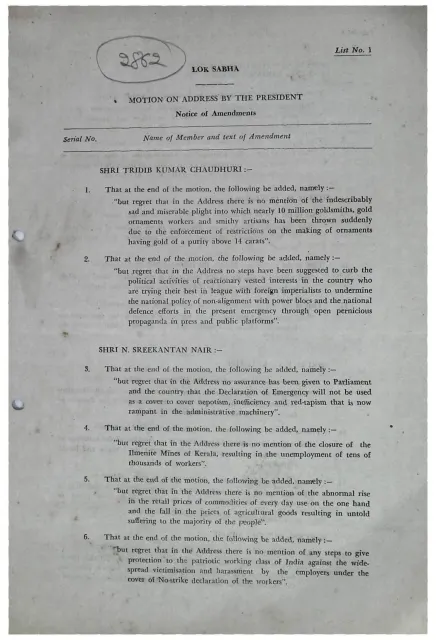
Notice of Amendments to Bills.
New Delhi · 1970
2 pages
Summary
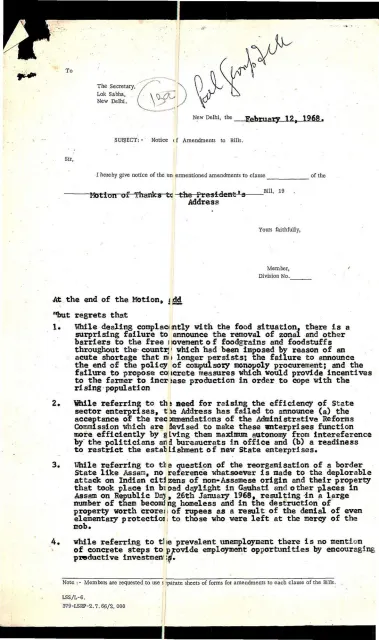
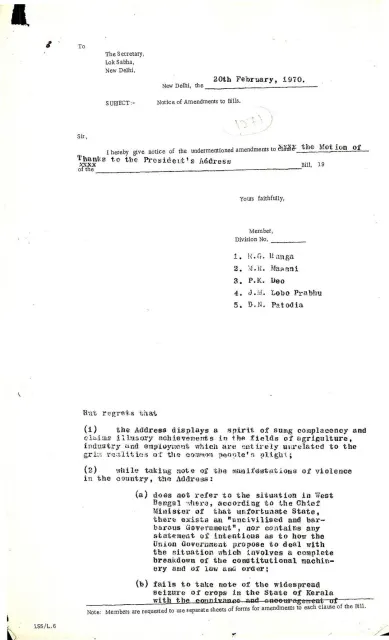
This two-page notice, dated 20 February 1970 and addressed to the Secretary of the Lok Sabha, proposes amendments to the motion of thanks for the President’s Address. Signed by N. G. Ranga, M. R. Masani, P. K. Deo, J. H. Lobo Prabhu, and D. M. Patodia, it argues that the Address presents an overly complacent account of India’s agricultural, industrial, and employment conditions and fails to confront the plight of ordinary people.
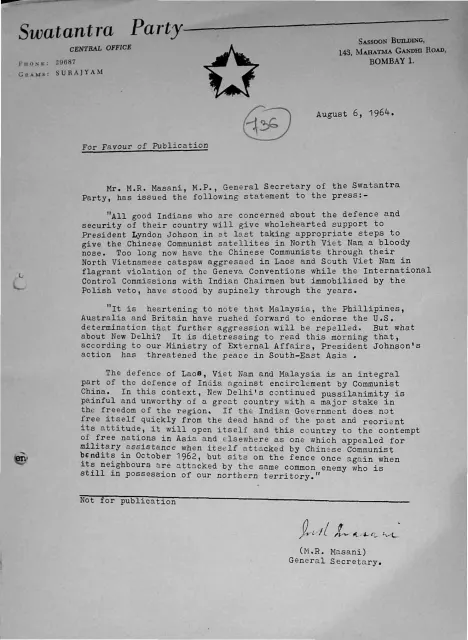
The amendments criticize the government’s treatment of violence and lawlessness, including its omission of West Bengal’s constitutional breakdown, crop seizures in Kerala, and what the signatories describe as increasing disregard for the rule of law, fundamental rights, and the judiciary. They also fault the Address for lacking concrete proposals for regional economic and political cooperation in Asia, for assuming that Communist China would respect India’s sovereignty without addressing the recovery of occupied territory, and for failing to demand the withdrawal of North Vietnamese forces from South Vietnam or Laos.
Key points
- The notice seeks amendments to the Lok Sabha motion of thanks for the President’s Address.
- The signatories reject the Address’s portrayal of agricultural, industrial, and employment achievements as disconnected from popular hardship.
- They argue that the Address inadequately addresses violence, lawlessness, crop seizures, and constitutional disorder in several states.
- The notice links worsening violence to disregard for the rule of law, fundamental rights, and the judiciary.
- It calls for corresponding measures of political and economic cooperation and regional defence in South, South-East, and East Asia.
- It criticizes the government’s expectation that Communist China would respect Indian sovereignty while failing to reaffirm a parliamentary pledge concerning occupied territory.
- It describes the Address’s position on Vietnam and Laos as one-sided because it advocates foreign troop withdrawal without demanding the withdrawal of North Vietnamese forces.
Metadata and summary are AI-extracted from the source PDF and reviewed for editorial accuracy. The original work is available via the Read PDF tab above (where present); paragraph-level citation inside the PDF is deferred to a future engagement.