speech · report
MOTION ON ADDRESS BY THE PRESIDENT
Notice of Amendments
NEW DELHI · 1963
12 pages
Summary
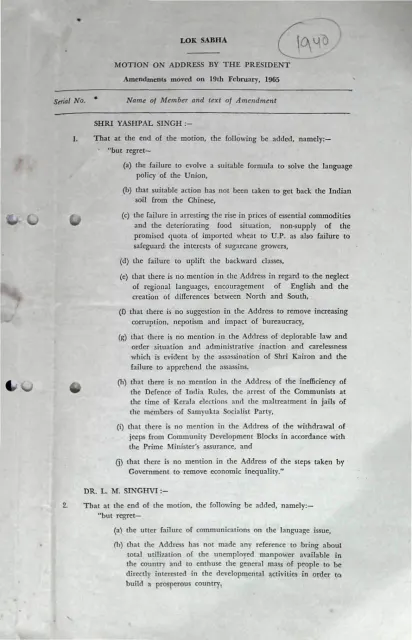
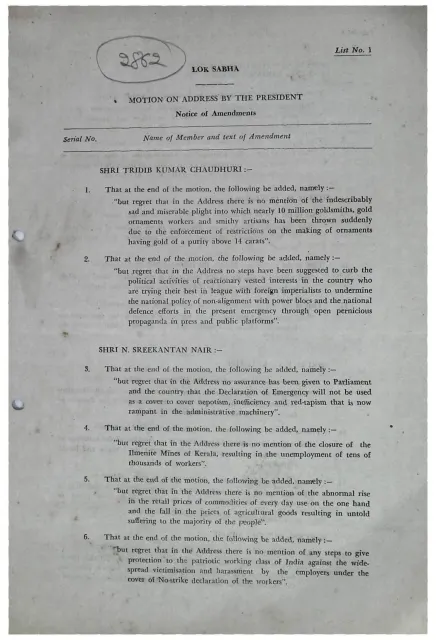
This parliamentary notice, issued by the Lok Sabha on 19 February 1963, lists 82 proposed amendments to the President’s Address under two lists. The amendments repeatedly argue that the Address omits urgent responses to the Chinese occupation of Indian territory, national defence, emergency powers, and the economic and administrative difficulties facing the country.
The proposals also document a broad catalogue of domestic grievances. Members call attention to the Gold Control Order’s effects on goldsmiths, artisans and craftsmen; rising prices, unemployment and economic disparity; declining agricultural and industrial production; labour disputes and alleged employer abuses; inadequate support for displaced persons, tribal communities and agricultural labourers; corruption, nepotism and bureaucracy; and the absence of stronger land, welfare and regional-development measures. Several amendments criticize the use of emergency powers to suppress civil liberties, political opponents, trade-unionists and other groups, while others demand more forceful defence and foreign-policy measures, including the recovery of territory occupied by Communist China and a harder line on Pakistan, Tibet and the Colombo proposals. The notice ends with List No. 2, which adds proposals concerning language policy, NEFA, food production, the Tripartite Agreement, economic and social equality, nomadic tribes and the Defence of India Rules.
Key points
- The document records 82 amendments to the Motion on Address by the President, divided between List No. 1 and List No. 2.
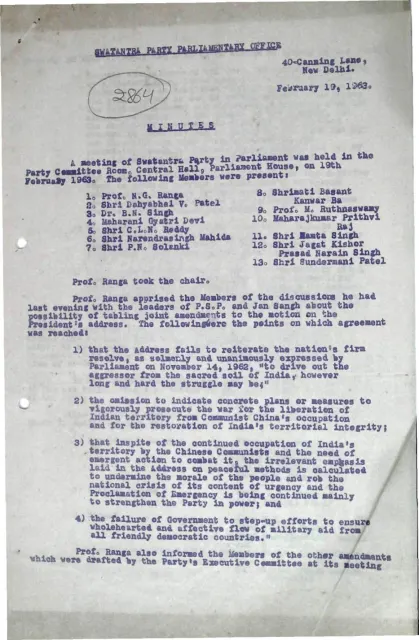
- Many amendments demand concrete measures to remove Chinese forces from Indian territory and restore territorial integrity.
- Gold-control regulations are presented as causing severe unemployment and hardship among goldsmiths, artisans and craftsmen.
- Members raise concerns about inflation, economic stagnation, declining agricultural and industrial production, unemployment and regional inequality.
- Several amendments criticize emergency powers for suppressing democratic liberties and enabling political coercion, employer abuses and bureaucratic overreach.
- The proposals address labour rights, minimum wages, peasant proprietorship, land reform, tribal rehabilitation and welfare for disadvantaged communities.
- Additional foreign-policy and defence concerns include Pakistan, Tibet, NEFA, military preparedness, foreign aid and the Colombo proposals.
Metadata and summary are AI-extracted from the source PDF and reviewed for editorial accuracy. The original work is available via the Read PDF tab above (where present); paragraph-level citation inside the PDF is deferred to a future engagement.