office record · report
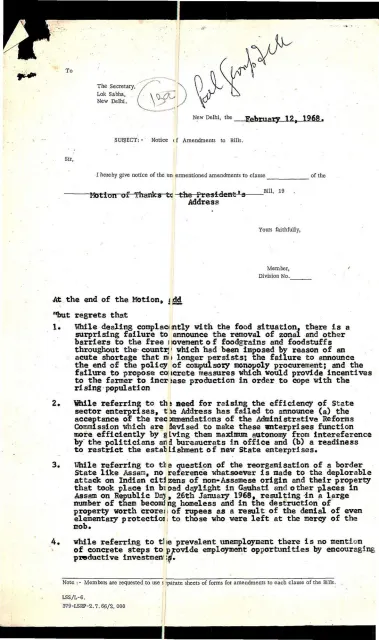
MOTION ON ADDRESS BY THE PRESIDENT
Amendments moved on 19th February, 1965
New Delhi · 1965
7 pages
Summary
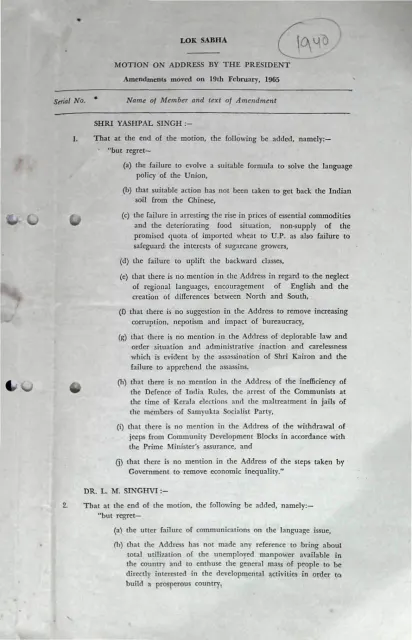
This seven-page Lok Sabha document records twelve amendments moved on 19 February 1965 to the Motion on the Address by the President. The amendments are framed as expressions of regret over omissions or failures in the Address, rather than as a single unified statement. Across the proposals, members raise the unresolved Union language policy, the status of regional languages and Hindi, food shortages and rising prices, unemployment, economic inequality, inflation, corruption, nepotism, administrative weakness, and the treatment of political detainees.
The amendments also connect domestic governance to national security and constitutional concerns. They call for firmer action regarding Chinese and Pakistani territorial claims, the Chinese nuclear threat, border security, Malaysia and South-East Asia, and relations with neighbouring States. Several proposals demand stronger democratic safeguards, including release of detainees, fair procedures, Lokayukta institutions, voter councils, minority representation, recognition of Urdu, and protection of citizens’ rights. The document ends with the Secretary’s certification from New Delhi; no debate, voting result, or subsequent governmental response is included in the rendered pages.
Key points
- Twelve amendments criticise the President’s Address for failing to address major political, economic, social, and security concerns.
- Language policy is a central issue, including the transition to Hindi, the position of English, regional-language recognition, and unrest in South India.
- Members repeatedly identify food shortages, high prices, inflation, unemployment, falling real wages, and economic inequality as urgent failures of government policy.
- Several amendments condemn corruption, nepotism, bureaucratic inaction, administrative carelessness, and the absence of effective accountability mechanisms.
- The proposals demand stronger responses to Chinese and Pakistani territorial claims, Chinese nuclear pressure, border insecurity, and instability in South-East Asia.
- Civil-liberty concerns include arrests and detention under the Defence of India Rules, alleged mistreatment of political workers, and inadequate protection of minorities.
- The document is an administrative record of amendments and does not show the ensuing parliamentary debate, disposition of the amendments, or the response to the President’s Address.
Metadata and summary are AI-extracted from the source PDF and reviewed for editorial accuracy. The original work is available via the Read PDF tab above (where present); paragraph-level citation inside the PDF is deferred to a future engagement.