essay
Has India's Foreign Policy Failed?
1966
2 pages
Summary
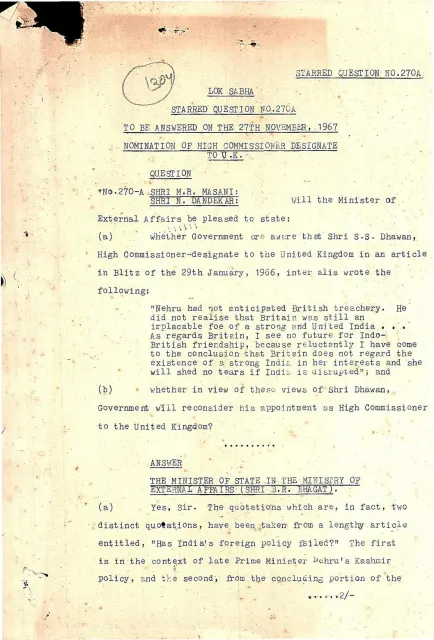
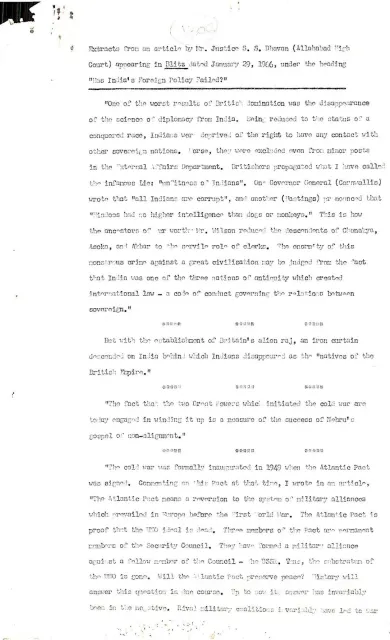
This two-page extract, identified as passages from Justice S. S. Dhavan’s article “Has India’s Foreign Policy Failed?” published in Blitz on January 29, 1966, presents a sharply critical account of India’s diplomatic position. It argues that British rule destroyed India’s earlier diplomatic standing, reduced Indians to subordinate roles, and propagated racial stereotypes, despite India’s historical contribution to international law and political civilization.
The extract then defends Jawaharlal Nehru’s policy of non-alignment as a successful response to the Cold War, while attributing later difficulties in Kashmir to American involvement and Pakistan’s expectations of British support. It concludes with a pessimistic assessment of Indo-British relations, asserting that Britain did not welcome a strong India and would not regret India’s disruption.
Key points
- British colonial rule is presented as having eliminated India’s independent diplomatic role and excluded Indians from the External Affairs Department.
- The extract condemns colonial claims that Indians were inherently corrupt or intellectually inferior.
- India’s ancient role in creating international law is invoked as evidence of the scale of the colonial degradation described.
- Nehru’s doctrine of non-alignment is credited with helping prevent a third world war.
- The Cold War and the military alliance system are criticized as threats to peace.
- The Kashmir dispute is linked to American diplomatic interventions and Pakistan’s misreading of British policy.
- The extract expresses distrust of future Indo-British friendship and argues that Britain opposed a strong, united India.
Metadata and summary are AI-extracted from the source PDF and reviewed for editorial accuracy. The original work is available via the Read PDF tab above (where present); paragraph-level citation inside the PDF is deferred to a future engagement.