Summary
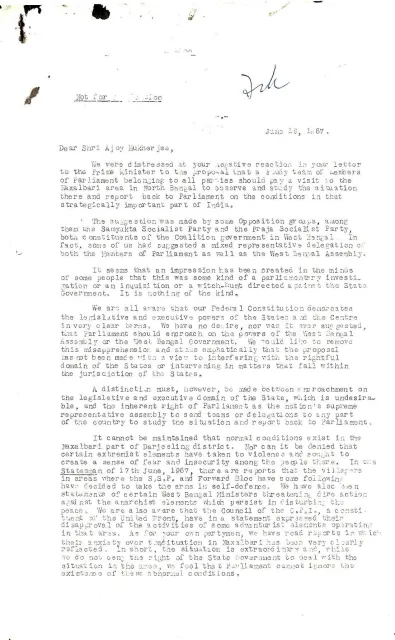
This two-page letter, dated June 19, 1967, is addressed to West Bengal Chief Minister Ajoy Mukherjee and signed by a cross-party group of Members of Parliament. The signatories ask Mukherjee to reconsider his opposition to a representative parliamentary mission to Naxalbari in North Bengal, explaining that the proposal was intended as a fact-finding visit rather than an inquiry, investigation, or political intervention. They stress that Parliament has no intention of encroaching on the legislative or executive powers of the state government and that the mission would operate with the state’s cooperation.
The letter nevertheless argues that Parliament cannot ignore reports of abnormal conditions in Naxalbari, including violence, fear, deaths among Adivasis, and the involvement of landless people, tea-garden workers, peasants, and share-croppers. It presents the area as both socially troubled and strategically important because it links northeastern India to the rest of the country. The proposed delegation would report its findings to Parliament, help the state government initiate corrective action, and potentially reduce pressure for intervention under the Constitution’s Emergency provisions.
Key points
- The signatories ask Ajoy Mukherjee to permit a representative parliamentary fact-finding mission to Naxalbari.
- They distinguish the proposed visit from a parliamentary investigation, inquisition, or political witch-hunt against the West Bengal Government.
- The letter affirms the constitutional division of legislative and executive powers between the states and the Centre.
- It argues that Parliament retains a legitimate role in studying national conditions and reporting its findings.
- The signatories cite violence, insecurity, deaths among Adivasis, and unrest involving extremists in the Naxalbari area.
- The mission is presented as a cooperative alternative to possible Central intervention under the Constitution’s Emergency provisions.
- The letter links Naxalbari’s social crisis to questions of landlessness, tea-garden labour, peasant poverty, and share-cropping.
- The area’s strategic importance for India’s security and its connection to northeastern India are invoked as additional reasons for parliamentary attention.
Metadata and summary are AI-extracted from the source PDF and reviewed for editorial accuracy. The original work is available via the Read PDF tab above (where present); paragraph-level citation inside the PDF is deferred to a future engagement.