
pamphlet
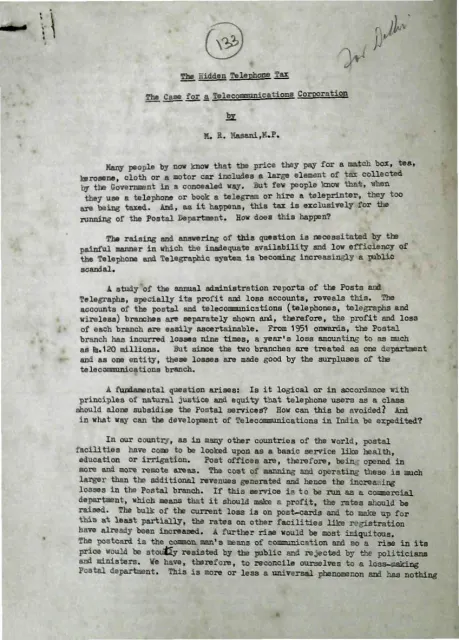
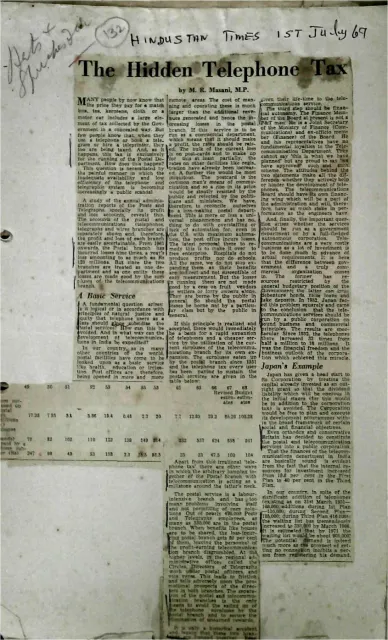
The Hidden Telephone Tax
The Case for a Telecommunications Corporation
4 pages
Summary
In this four-page pamphlet, M. R. Masani argues that telephone users are being subjected to a concealed tax because surpluses from telecommunications are used to cover persistent losses in the Postal branch. He presents the arrangement as inequitable, noting that postal services are a basic public service whose indirect social benefits cannot be measured like commercial profits. A table of figures shows the Postal branch using telecommunications surpluses while telephone numbers expand and the tax paid by subscribers fluctuates.
Masani proposes separating the Postal and Telecommunications branches, granting telecommunications financial autonomy, abolishing the post of Director-General, and replacing the existing administration with a technically led Telecommunications Board. He ultimately advocates a full-fledged autonomous public corporation able to issue bonds, raise loans, and invest ahead of demand. Japan’s experience is offered as evidence that corporatisation and financial freedom can produce rapid expansion, while the pamphlet also notes that Britain has decided to constitute its postal and telecommunications services as a public corporation.
Key points
- Telephone users indirectly subsidise the loss-making Postal branch through telecommunications surpluses and a concealed telephone tax.
- The author treats postal services as a basic public service whose wider benefits should be borne by the public rather than by telecommunications users.
- A table records Postal-branch use of Telecom surpluses from 1949 onward, alongside growth in telephone connections and subscriber tax payments.
- Separating the Postal and Telecommunications branches is presented as the first step toward faster telephone development and cheaper service.
- The proposed institutional reforms include abolishing the Director-General’s post and creating a Telecommunications Board led by a senior technical member.
- Financial autonomy would allow telecommunications administration to plan investment, issue debentures, raise loans, and take deposits.
- Japan’s corporatised telecommunications system is cited as an example of rapid growth achieved through financial freedom and commercial management.
- The large and growing telephone waiting list is presented as evidence that India requires fundamental reorganisation and a telecommunications corporation.
Metadata and summary are AI-extracted from the source PDF and reviewed for editorial accuracy. The original work is available via the Read PDF tab above (where present); paragraph-level citation inside the PDF is deferred to a future engagement.
Related across the archive
 Primary workThe Hidden Telephone Tax
 Primary workThe National Telecom Policy and Its Implementation
 Primary workTelephone Communication and Urban Development In India
 ExcerptEconomic Reforms In India: Where Are We And Where Do We Go?
 ExcerptTHE APPLICATION OF SCIENCE AND TECHNOLOGY TO SOCIO-ECONOMIC DEVELOPMENT