Summary
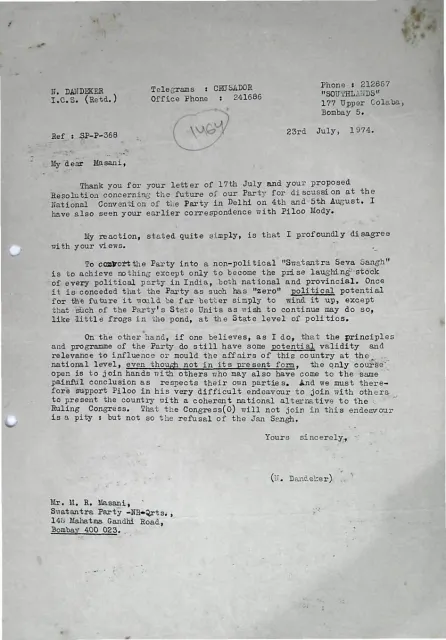
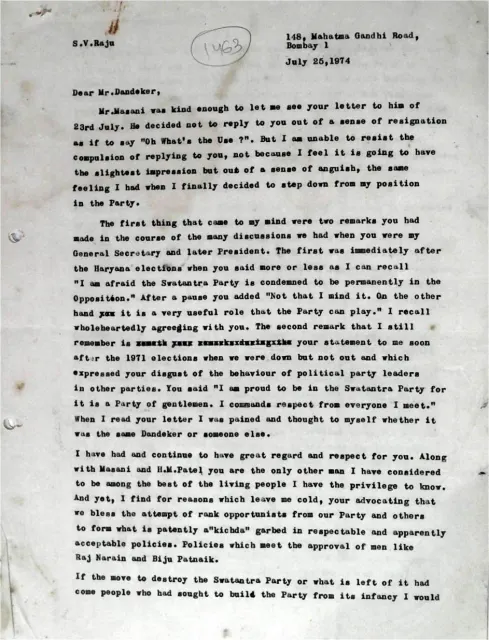
In this three-page letter dated July 25, 1974, S. V. Raju writes to N. Dandekar out of “anguish” after reading Dandekar’s letter to Minoo Masani. Raju recalls Dandekar’s earlier belief that the Swatantra Party might be condemned to permanent opposition, but also his view that this could be a useful political role, and contrasts that position with Dandekar’s current support for efforts to reorganise or dissolve the party.
Raju argues that the Swatantra Party is being destroyed not because its policies have failed, but because of the conduct and ambitions of its leaders. He attacks Piloo Mody and M. N. A. [?]ersey as opportunists whose motives are power rather than ideology, questions whether the proposed “Kichda” coalition would perform better than the previously denounced SVDs, and doubts that the coalition represents a genuine national alternative. He closes by defending the continued existence of the Swatantra Party, invoking C. Rajagopalachari’s integrity and expressing the conviction that the party’s distinctive policies alone offer hope to India’s “unfortunate people.”
Key points
- Raju explains that he is replying to Dandekar from anguish over the threatened destruction of the Swatantra Party.
- He contrasts Dandekar’s earlier acceptance of permanent opposition with his later support for a broader political coalition.
- He attributes the party’s crisis to opportunistic leadership and internal mismanagement rather than to the failure of its policies.
- He questions whether the proposed “Kichda” coalition would be more effective than the SVDs previously criticised by Dandekar.
- He argues that the coalition would not substantially reduce India’s political fragmentation because its constituent parties are divided or politically weak.
- He praises the Maharashtra, Tamil Nadu, and Delhi units that refused to join the proposed arrangement.
- He invokes Rajaji as a continuing symbol of integrity and urges that the Swatantra Party be allowed to survive in attenuated form.
Metadata and summary are AI-extracted from the source PDF and reviewed for editorial accuracy. The original work is available via the Read PDF tab above (where present); paragraph-level citation inside the PDF is deferred to a future engagement.