essay
Some Points
1974
2 pages
Summary
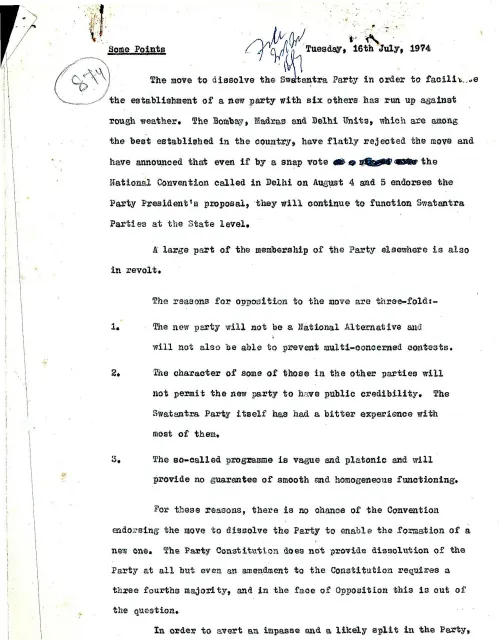
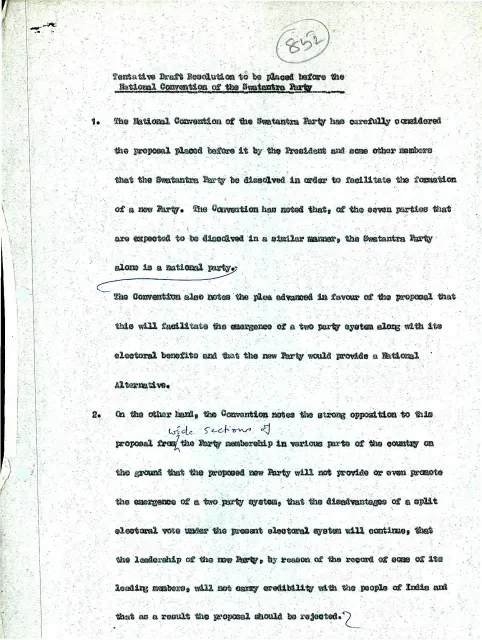
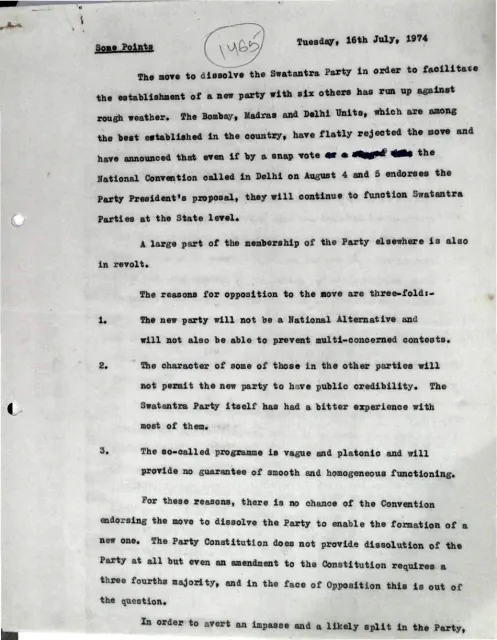
This two-page paper, dated 16 July 1974, argues against dissolving the Swatantra Party to facilitate the creation of a new party with six other organisations. It reports that the Bombay, Madras, and Delhi units have rejected the proposal, while a substantial part of the membership elsewhere is also in revolt. The paper identifies three objections: the proposed party would not constitute a national alternative, the character of some participating parties would damage its public credibility, and its vague programme would not ensure coherent functioning.
The paper maintains that the Swatantra Party cannot be dissolved under its constitution, since even constitutional amendment requires a three-fourths majority. It presents M. R. Masani’s compromise proposal as a way to avoid a split: the party would become a non-party organisation, tentatively called the Swatantra Seva Sangh, devoted to educating the public about Swatantra principles and policies and to constructive public service. The document warns that failure to reach agreement could reproduce the divisions previously experienced by the Socialist Party.
Key points
- The paper records strong opposition within the Swatantra Party to a proposal for dissolution and merger with six other parties.
- The Bombay, Madras, and Delhi units are described as having rejected the proposed reorganisation.
- It gives three reasons for opposition: lack of national credibility, doubts about the character of partner parties, and an overly vague programme.
- It argues that the party constitution does not provide for dissolution and that constitutional amendment requires a three-fourths majority.
- M. R. Masani’s compromise would preserve Swatantra’s educational and organisational work while ending its electoral and party-political activity.
- The proposed successor organisation would likely be called the Swatantra Seva Sangh.
- The paper presents compromise as the means of preventing an internal split and a repetition of divisions in the Socialist Party.
Metadata and summary are AI-extracted from the source PDF and reviewed for editorial accuracy. The original work is available via the Read PDF tab above (where present); paragraph-level citation inside the PDF is deferred to a future engagement.