essay
Some Points
PRESS TRUST OF INDIA · BOMBAY · 1974
5 pages
Summary
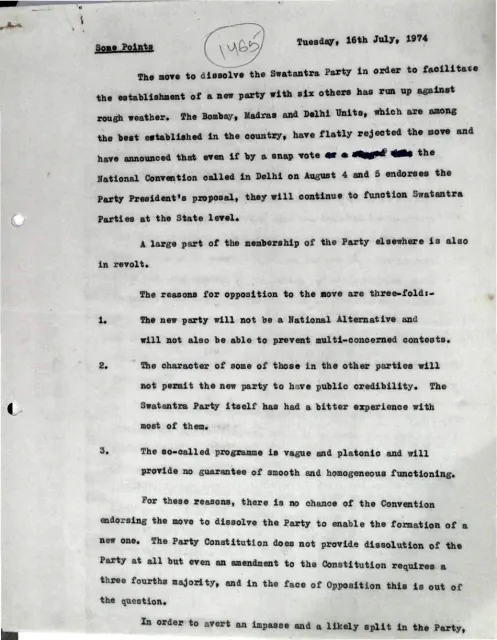
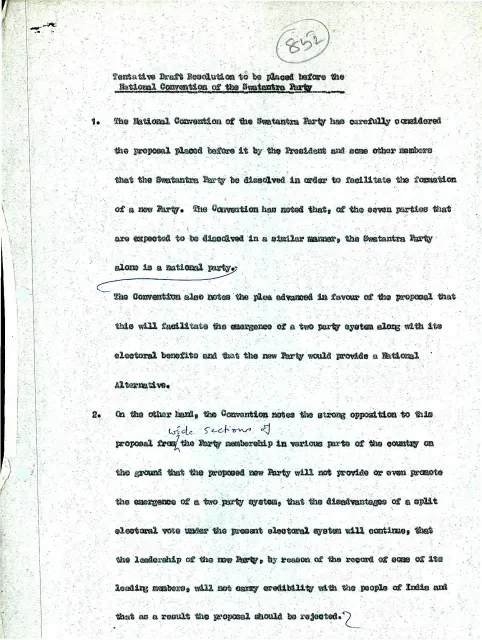
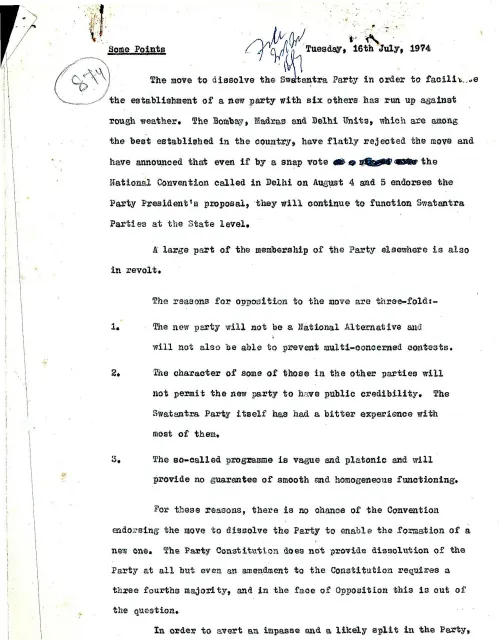
“Some Points,” dated 16 July 1974, addresses the proposal to dissolve the Swatantra Party in order to facilitate the creation of a new party with six other political groups. The document reports strong resistance from the Bombay, Madras, and Delhi units, as well as wider membership opposition. It argues that the proposed party would not constitute a genuine national alternative, would inherit credibility problems from some participating parties, and would be held together by a vague programme incapable of ensuring coherent functioning.
The paper also stresses the constitutional and organisational obstacles to dissolution: the Swatantra Party constitution does not provide for dissolution, while constitutional amendment requires a three-fourths majority. As a compromise, M. R. Masani proposes converting the party into a non-party organisation, provisionally called the Swatantra Seva Sangh, which would withdraw from electoral politics while continuing public education on Swatantra principles and policies. The document presents this proposal as a possible way to avoid bitterness and a split, while warning that failure could reproduce the damaging factional experiences of the Socialist Party.
Key points
- The proposed dissolution of the Swatantra Party faces opposition from major state units and a large part of the wider membership.
- Opponents argue that the proposed successor would not be a genuine national alternative and would not prevent multi-cornered electoral contests.
- The character of some prospective partners is presented as a threat to the new party’s public credibility.
- The proposed programme is criticised as vague, platonic, and unable to guarantee smooth and homogeneous functioning.
- The party constitution contains no dissolution procedure, and constitutional amendment requires a three-fourths majority.
- M. R. Masani’s compromise would transform the Swatantra Party into a non-party organisation called, possibly, the Swatantra Seva Sangh.
- The proposed organisation would abandon electoral and party politics while continuing educational propaganda and constructive public service.
Metadata and summary are AI-extracted from the source PDF and reviewed for editorial accuracy. The original work is available via the Read PDF tab above (where present); paragraph-level citation inside the PDF is deferred to a future engagement.