speech
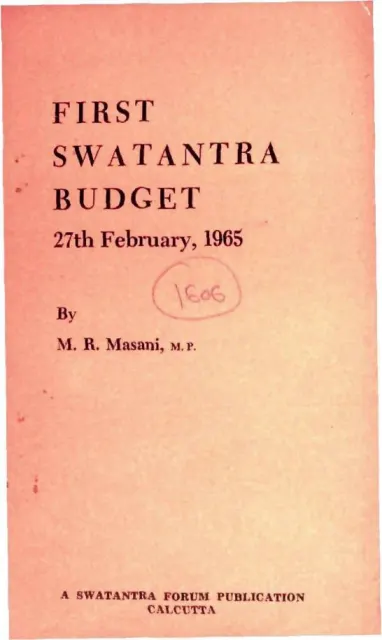
First Swatantra Budget
By Minoo Masani
A SWATANTRA FORUM PUBLICATION CALCUTTA · Calcutta · 1965
29 pages
Summary
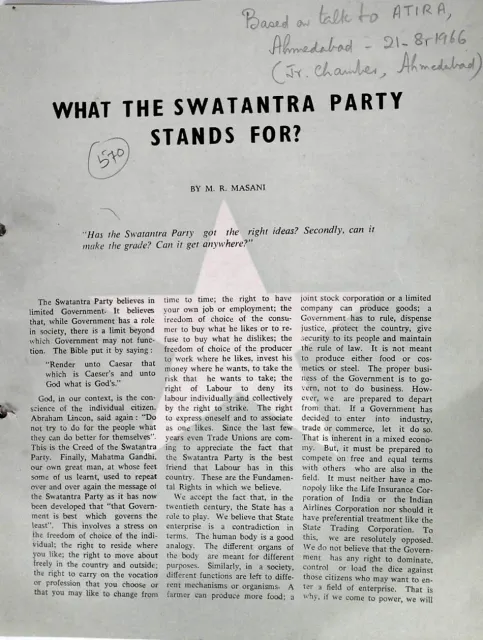
In this 27 February 1965 address, M. R. Masani presents the Swatantra Party as an alternative to Congress socialism, combining Western liberalism with Gandhi’s thinking. He argues that the individual should remain at the centre of political and economic life, that government should be a limited instrument, and that free choice for investors, producers, workers, and consumers is the basis of a free society. The speech opposes monopoly, permits and licences, excessive state ownership, and command-style planning, while allowing a mixed economy in which the state provides infrastructure and competes on equal terms.
Key points
- Masani identifies Swatantra philosophy with both Western liberalism and Gandhi’s thinking.
- The speech defends individual choice and a limited government while retaining a role for the state in infrastructure and fair competition.
- Masani distinguishes indicative or market-based planning from India’s command-style Five-Year Plans.
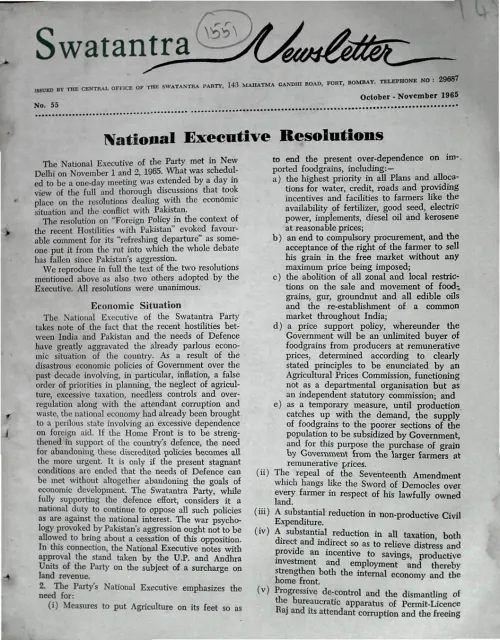
- His proposed Swatantra programme would suspend the Five-Year Plans, remove controls and licensing, restore freer markets, and revise foreign policy toward interdependence and cooperation with friendly democracies.
- He predicts that lower taxation, reduced defence burdens, decontrol, and greater private investment would increase production, employment, wages, and growth.
- The address links food shortages and inflation to price controls and distorted incentives for farmers.
- Masani sets short-term electoral goals for Swatantra or Swatantra-led governments in selected states and for denying Congress a parliamentary majority in 1967.
- The concluding questions and answers address the limits of free markets, foreign assistance, and the possibility of opposition unity without a formal united front.
Metadata and summary are AI-extracted from the source PDF and reviewed for editorial accuracy. The original work is available via the Read PDF tab above (where present); paragraph-level citation inside the PDF is deferred to a future engagement.