Summary
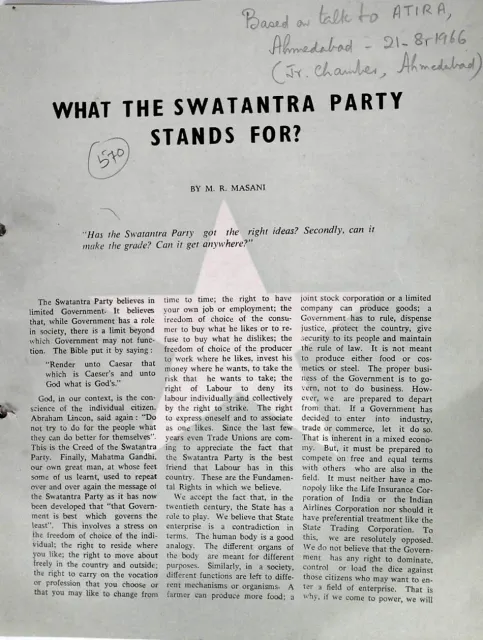
In this pamphlet, M. R. Masani presents the Swatantra Party as a defender of limited government, individual choice, private enterprise, labour rights, and the rule of law. The party accepts a role for the state in justice, security, and public order, but rejects government domination of economic life, state monopolies, and preferential treatment for public corporations. Masani distinguishes democratic, indicative planning from Soviet-style command planning and argues that India’s Planning Commission, industrial priorities, and controls have harmed agriculture, consumer welfare, and economic freedom. He advocates agricultural priority, free competition, and a mixed economy in which the state may participate but must compete on equal terms.
The pamphlet also sets out the party’s political and international position. Masani attacks Congress government for economic mismanagement, devaluation, excessive central control, and dependence on a distorted first-past-the-post electoral system. He describes Swatantra as a national, democratic, non-denominational, agrarian party whose immediate objective is to end Congress’s political monopoly while refusing alliances with Communist parties. Internationally, the pamphlet supports regional security cooperation involving India, Japan, and Australia; criticises non-alignment as a “Himalayan blunder”; supports the war in Vietnam and the liberation of Tibet; and favours recognition of Israel and Taiwan. It closes by urging citizens, including businesspeople and other professional groups, to help replace the Congress government through constitutional political action.
Key points
- The Swatantra Party advocates limited government and extensive freedom of individual choice in residence, employment, enterprise, consumption, association, and labour.
- The pamphlet defends private enterprise and competition while allowing a constrained role for the state in a mixed economy.
- Masani distinguishes coercive Soviet planning from democratic indicative planning and attacks India’s Planning Commission and industrial priorities.
- The party gives agriculture and rural welfare priority over heavy industrialisation and urban interests.
- Swatantra is presented as a national, democratic, non-denominational alternative to Congress and as an opponent of both Congress statism and Communist dictatorship.
- Masani argues that India’s electoral system converts minority popular support into disproportionate parliamentary majorities and calls for cooperation among democratic opposition parties.
- The pamphlet supports regional security alliances, a strong anti-Communist foreign policy, the war in Vietnam, Tibetan liberation, and recognition of Israel and Taiwan.
- The closing appeal calls on citizens to contest elections, contribute resources, and join an open movement seeking to remove Congress through constitutional methods.
Metadata and summary are AI-extracted from the source PDF and reviewed for editorial accuracy. The original work is available via the Read PDF tab above (where present); paragraph-level citation inside the PDF is deferred to a future engagement.