speech
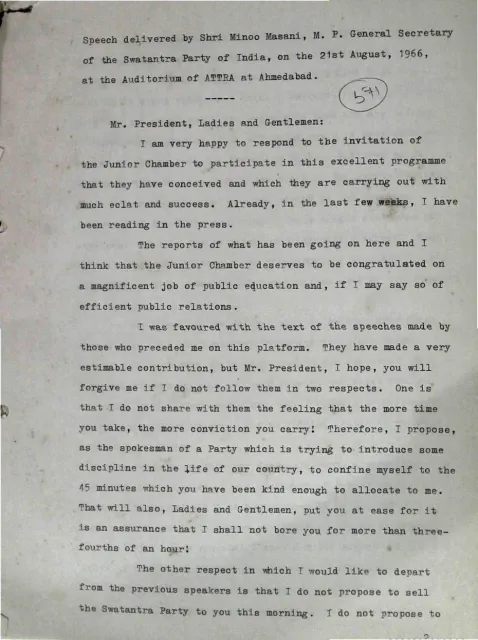
Speech of Mr Minoo Masani
Ahmedabad · 1966
58 pages
Summary
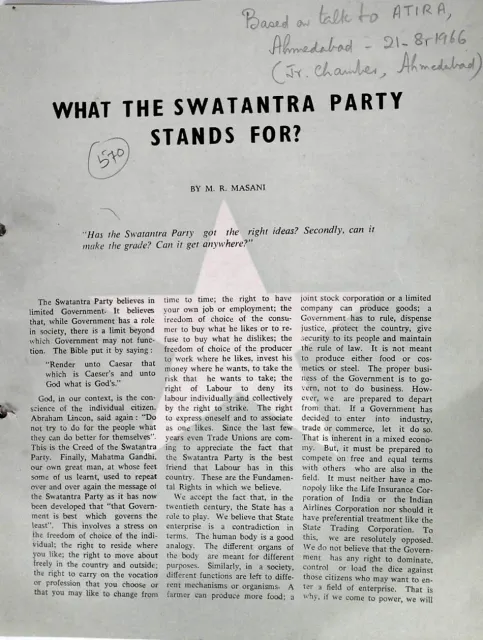
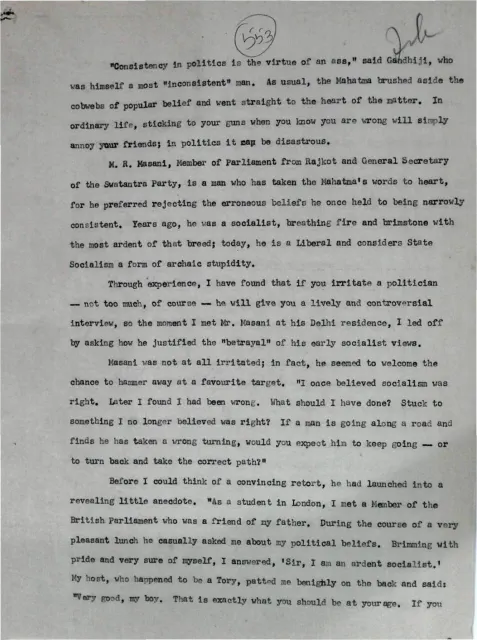
In the rendered pages, Minoo Masani presents the Swatantra Party as a disciplined, constitutional and liberal alternative to Congress. He defines its central principle as limited government: the state has legitimate functions in ruling, administering justice, protecting the country, maintaining security and upholding the rule of law, but should not displace individual choice or private enterprise. The speech links this position to freedom of residence, movement, occupation, employment, consumption, investment, association, expression and collective bargaining, while also defending the right to strike.
In the rendered pages, Masani attacks India’s state-enterprise model and the Planning Commission, contrasting coercive Soviet-style planning with democratic indicative planning in France, Britain, Holland, Belgium and Sweden. He argues that Indian planning has imposed Stalinist priorities, heavy industry and austerity at the expense of agriculture, consumer goods and present welfare. The speech then moves to foreign policy, supporting closer regional security cooperation with Japan and Australia, American military action in Vietnam, recognition of Taiwan and the liberation of Tibet. Domestically, Masani calls for a functioning opposition capable of replacing Congress, appeals to rural voters and argues that the party’s electoral strength lies in the peasantry rather than urban business interests. The speech continues beyond the rendered pages, so its later arguments and conclusion are not covered here.
Key points
- Masani frames the Swatantra Party as a limited-government alternative to Congress and rejects the idea that longer speeches necessarily carry greater conviction.
- The party’s programme is presented as protecting individual choice, occupational freedom, consumer choice, producer freedom, labour rights, expression and association.
- The state should govern and uphold justice, security and law, but state enterprise is described as a contradiction unless it competes on free and equal terms.
- Masani distinguishes voluntary democratic indicative planning from coercive Soviet planning and attacks India’s Planning Commission as a super-government.
- He criticises Stalinist planning priorities, austerity and heavy-industry emphasis for neglecting agriculture, consumer goods and the welfare of the present generation.
- The speech advocates regional security cooperation with India, Japan and Australia, supports the Vietnam War, and calls for recognition of Taiwan and liberation of Tibet.
- Masani argues that India needs a functioning opposition and a second party capable of defeating Congress democratically.
- He presents Swatantra as an agrarian and peasants’ party whose principal electoral base is rural India, while urging urban professionals and businesspeople to support its organisational work.
Metadata and summary are AI-extracted from the source PDF and reviewed for editorial accuracy. The original work is available via the Read PDF tab above (where present); paragraph-level citation inside the PDF is deferred to a future engagement.