essay
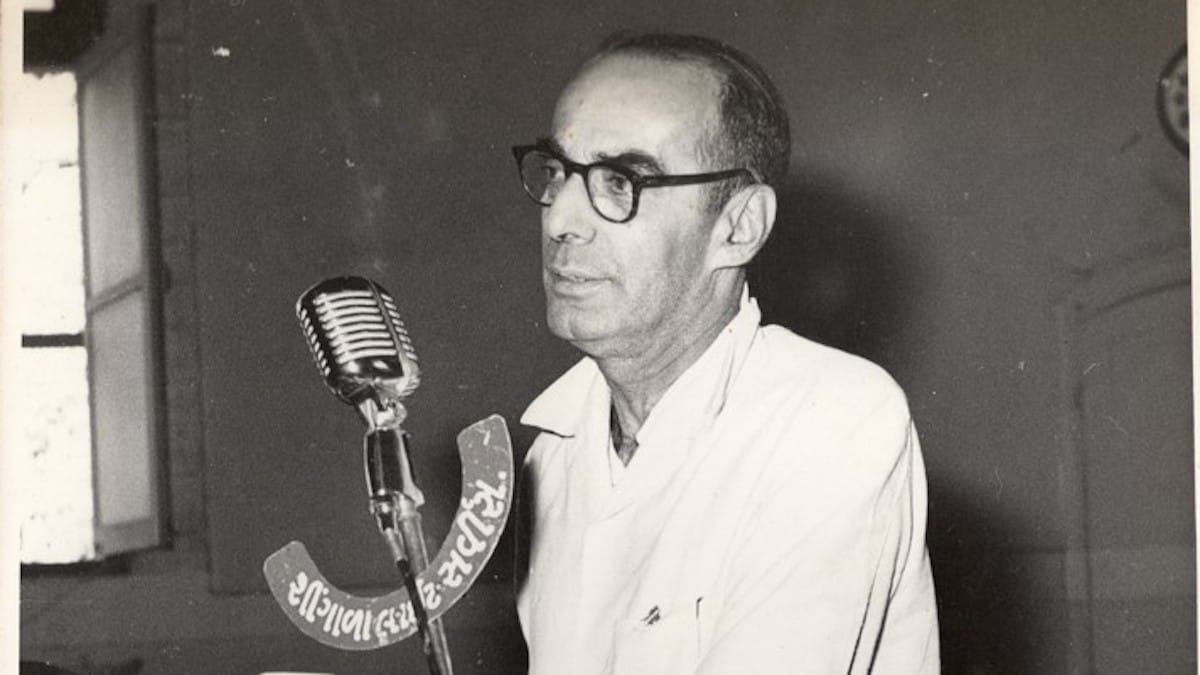
Speech of Mr Minoo Masani
23 pages
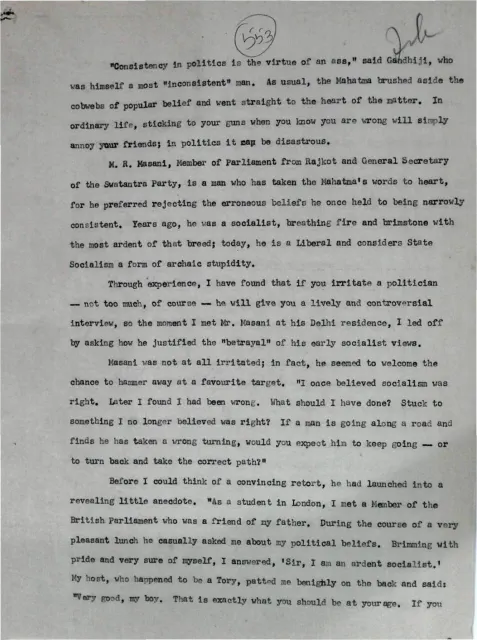
Summary
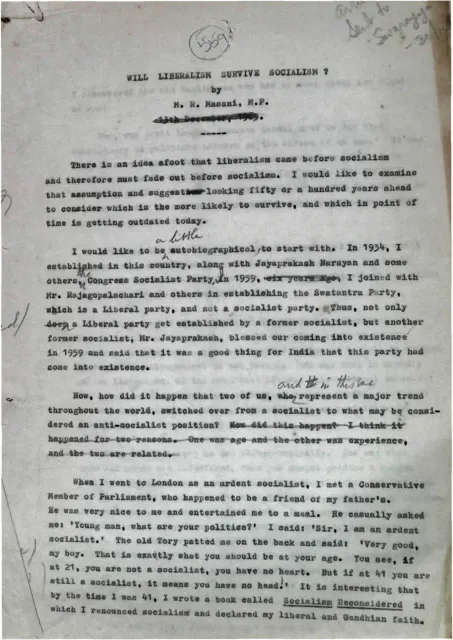
The rendered pages present a question-and-answer interview with M. R. Masani, identified in the text as a former socialist who became a Liberal and a member of Parliament from Rajkot and general secretary of the Swatantra Party. Masani explains his political change as a willingness to abandon beliefs he had come to regard as mistaken. He attributes his break with socialism chiefly to the failure of the Soviet experiment and says that he and Jayaprakash Narayan found an alternative in liberalism and the thought of Mahatma Gandhi.
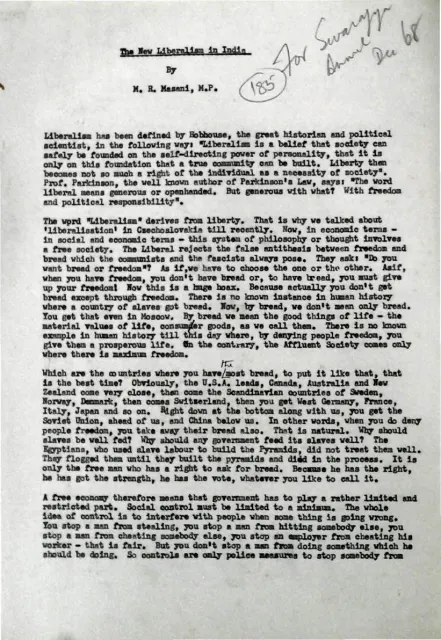
In the rendered pages, Masani distinguishes socialist goals—removing poverty and creating a free and equal society—from the methods used to pursue them. He argues that coercive means, centralised state power, collectivised agriculture, doctrinaire planning, and restrictions on trade and enterprise defeat those ends. His examples include Soviet inequality, shortages, agricultural failure, and political repression, as well as what he presents as socialist experiments in India, Ghana, Ceylon, and Indonesia. In contrast, he defines liberalism as trust in the self-directing capacity of individuals, a market-oriented economy responsive to consumer demand, limited government, social welfare, and indicative rather than Soviet-style central planning. The visible text ends with his appeal to Gandhi’s principle that the best government governs least.
Key points
- M. R. Masani presents his move from socialism to liberalism as a correction of mistaken political beliefs rather than a betrayal of principle.
- He links his disillusionment with socialism to the failure of the Soviet experiment and its inability to deliver prosperity, equality, and freedom.
- The interview argues that socialist ends cannot be separated from socialist means: coercion and state control corrupt the goals they claim to serve.
- Masani uses Soviet agriculture, consumer shortages, inequality, taxation, and elite privilege as evidence against centralised socialism.
- He extends the critique to Indian planning, especially the prioritisation of heavy industry over fertilisers and consumer necessities.
- The interview presents concentrated state power as a threat to civil liberties, political accountability, and the possibility of peaceful government change.
- Masani’s alternative is liberalism: individual freedom, market coordination, limited government, social welfare, social justice, and indicative planning.
Metadata and summary are AI-extracted from the source PDF and reviewed for editorial accuracy. The original work is available via the Read PDF tab above (where present); paragraph-level citation inside the PDF is deferred to a future engagement.