Summary
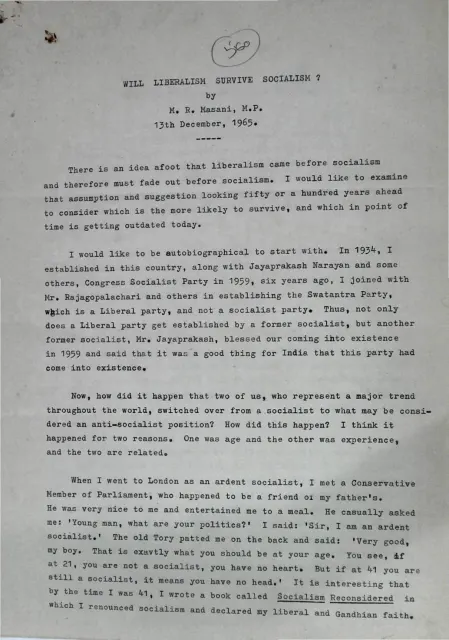
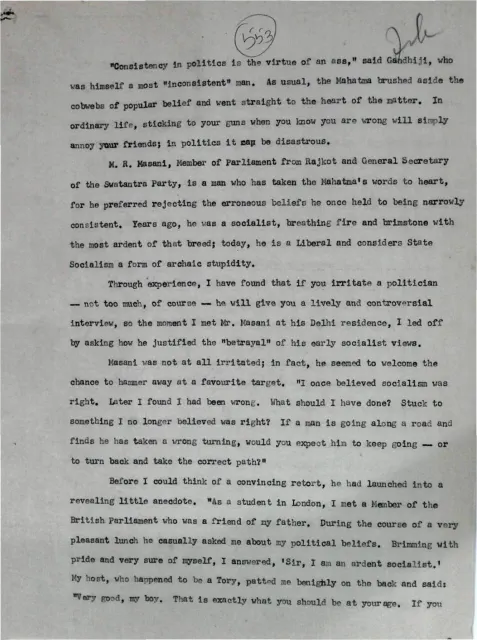
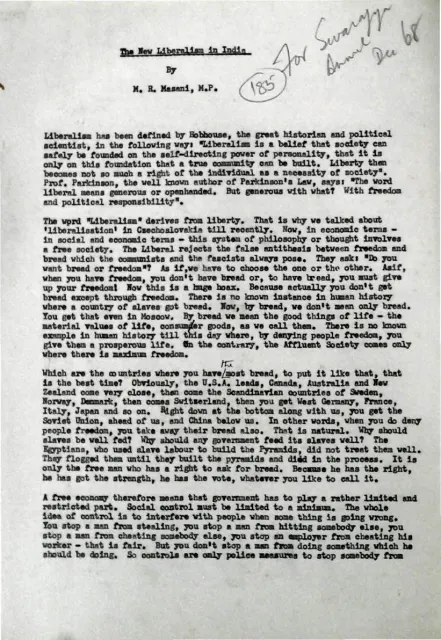
In this eight-page pamphlet, M. R. Masani defines liberalism as a social order grounded in individual personality, freedom, responsibility, and the self-directing power of citizens. He rejects the supposed opposition between freedom and material well-being, arguing instead that prosperity depends on liberty. A free economy, in his account, requires limited government and minimal social control, while consumer choice directs production: purchasing decisions function as votes that tell producers what goods to make.
Masani contrasts this model with socialism, which he presents as subordinating individual liberty to the collective and as producing poor results in agriculture, industry, and public enterprise. He cites the Soviet Union’s low living standards and collectivised agriculture, and argues that state-owned enterprises in India are inefficient and financially damaging. The pamphlet also criticises state planning and nationalisation as inappropriate extensions of governmental power, insisting that governments exist primarily to maintain law and order, administer justice, protect people, and defend the country.
The pamphlet presents the “new liberalism” as a synthesis of Western liberalism and Mahatma Gandhi’s teachings. Masani retains socialism’s stated goals of freedom and equality but rejects its methods, especially state planning, nationalisation, and collectivised farming. He emphasises the relationship between ends and means, limited government, trusteeship, voluntary social obligation, democracy, and a less doctrinaire form of patriotism. The final pages argue that liberalism must mean both freedom and democracy, and conclude with Carlos Romulo’s formulation that liberalism moves “neither left nor right, but right ahead.”
Key points
- Liberalism is defined through freedom, individual responsibility, and the self-directing power of personality.
- Masani argues that liberty and material prosperity are complementary rather than opposing goals.
- Consumer purchasing power is presented as the mechanism that determines production in a free economy.
- The pamphlet criticises socialism, nationalisation, state planning, and collectivised agriculture.
- Soviet economic performance and Indian public-sector losses are used as evidence against extensive state ownership.
- Government should be limited chiefly to maintaining law and order, administering justice, protecting citizens, and defending the country.
- The new Indian liberalism combines Western liberalism with Gandhian ideas of means and ends, limited government, trusteeship, and social obligation.
- Masani supports democracy while acknowledging its limitations and rejects nationalism as a continuing political necessity after independence.
Metadata and summary are AI-extracted from the source PDF and reviewed for editorial accuracy. The original work is available via the Read PDF tab above (where present); paragraph-level citation inside the PDF is deferred to a future engagement.