
Summary
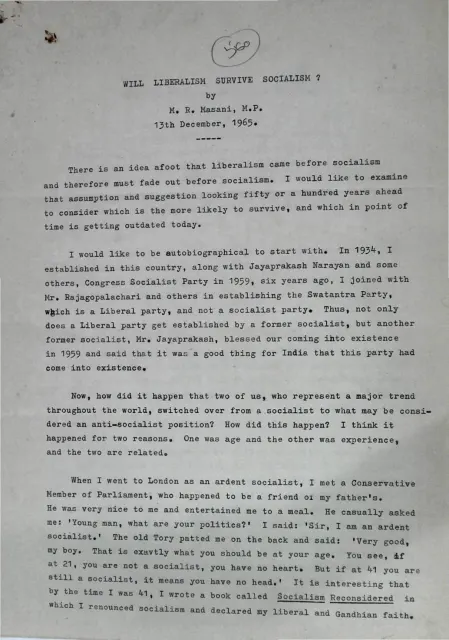
In this essay dated 13 December 1965, M. R. Masani challenges the assumption that liberalism is historically superseded by socialism. Drawing on his own movement from the Congress Socialist Party to the Swatantra Party, and on Jayaprakash Narayan’s similar evolution, he attributes their break with socialism to age, experience, and the Soviet experiment’s failure to achieve a free and equal society. He presents liberalism and Gandhi’s thought as the principal alternatives, emphasizing that political methods must be judged by their moral consequences, that ends and means are inseparable, and that concentrated state power is a threat to freedom.
Masani then compares socialist objectives with their practical results in the Soviet Union and India. He argues that state ownership and central planning have failed to deliver prosperity, equality, agricultural productivity, or liberty, citing shortages, poor housing and consumer goods, low Soviet farm yields, entrenched privilege, and India’s stagnant living standards. Against this, he defines liberalism as limited government, private ownership, individual enterprise, consumer choice, and a free market in which production responds to public demand. The essay concludes that liberal methods reach the socialist ideals of prosperity, social justice, equality, and freedom more quickly, and that the contemporary movement away from collectivism toward liberal democracy confirms this judgment.
Key points
- Masani recounts his transition from socialism to liberalism and links it to experience of Soviet communism and Gandhi’s influence.
- The essay treats state violence, coercion, and the subordination of individual liberty as central defects of socialism.
- Masani argues that Soviet socialism failed to produce prosperity, equality, agricultural productivity, or political freedom.
- The Indian planning experience is presented as producing stagnant living standards, a weakened lower middle class, and a politically connected new class.
- Small, intensively cultivated farms are contrasted with large collectivised farms, which Masani presents as less productive.
- Liberalism is defined through limited government, private property, individual enterprise, consumer sovereignty, and economic freedom.
- Masani argues that market choice and competition coordinate production more effectively than state planning.
- The essay closes by claiming that liberal methods advance social justice, equality, prosperity, and freedom faster than socialist methods.
Metadata and summary are AI-extracted from the source PDF and reviewed for editorial accuracy. The original work is available via the Read PDF tab above (where present); paragraph-level citation inside the PDF is deferred to a future engagement.
People in this work
Related across the archive
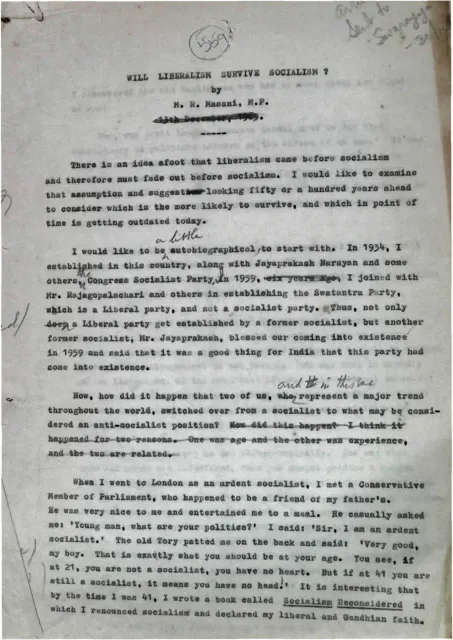 Primary workWILL LIBERALISM SURVIVE SOCIALISM ?
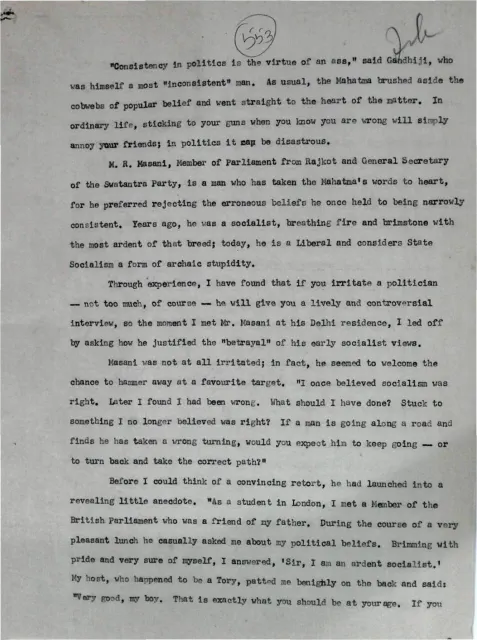 Primary workSpeech of Mr Minoo Masani
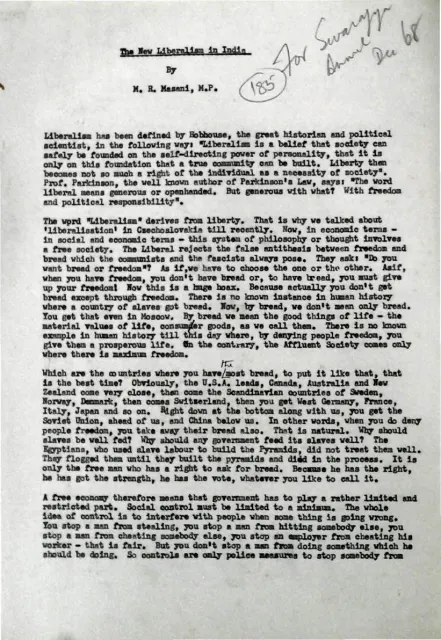 Primary workThe New Liberalism in India
 ThePrintSocialism doesn’t deliver prosperity or produce equality. Does it give freedom? Of course not
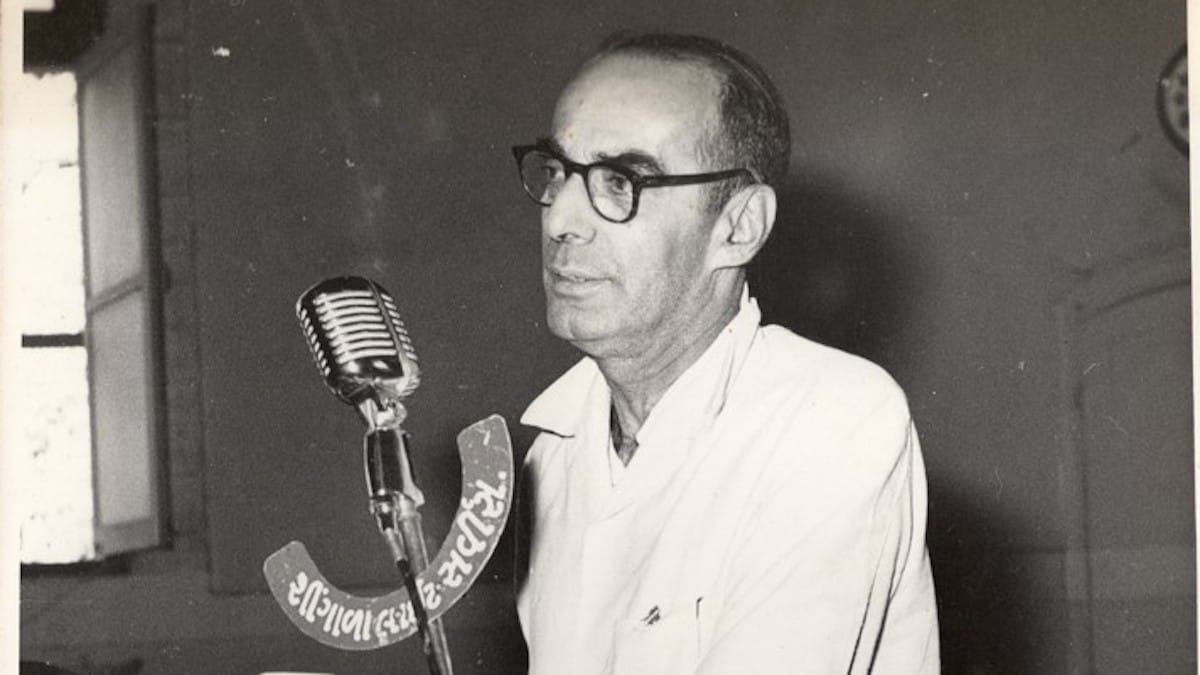 ThePrintLiberal methods reach social justice faster than socialism: Minoo Masani