
essay
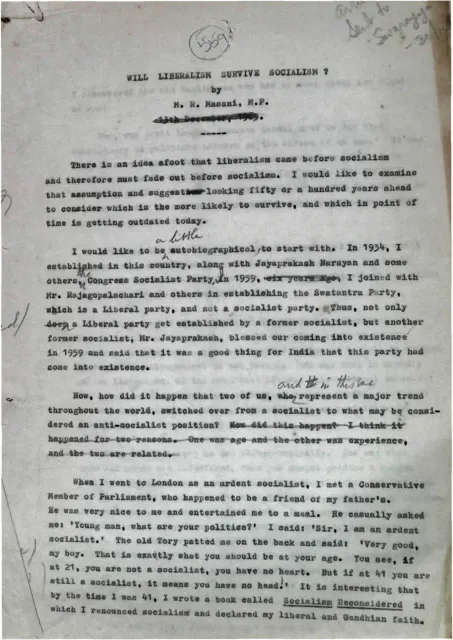
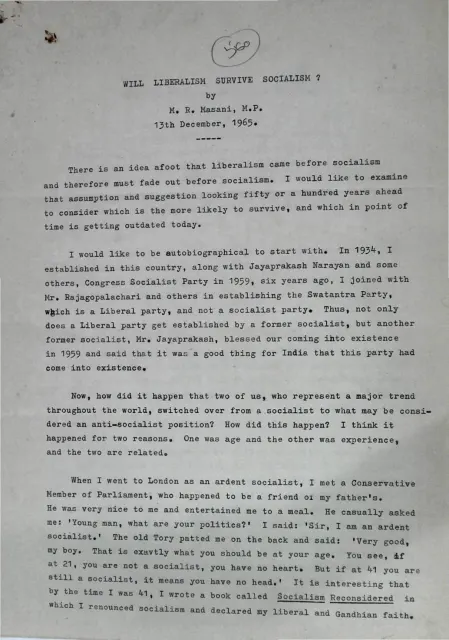
WILL LIBERALISM SURVIVE SOCIALISM ?
1965
18 pages
Summary
In this 18-page essay, M. R. Masani argues that liberalism is more likely than socialism to survive because socialist methods have failed to achieve the goals of prosperity, equality, freedom, and fraternity. He begins autobiographically, recalling his movement from the Congress Socialist Party to the Swatantra Party and describing Jayaprakash Narayan’s parallel departure from socialism. He attributes this change to age, experience, and the failure of the Soviet experiment, while presenting Mahatma Gandhi’s insistence on the unity of ends and means, and his distrust of coercive state power, as an important influence on liberal thinking.
Masani then examines the Soviet Union’s record in living standards, housing, consumer goods, agriculture, equality, and political freedom, arguing that state ownership has produced poor material outcomes and a privileged ruling class rather than a free and equal society. He extends the critique to India’s mixed socialist economy, claiming that planning and political patronage have harmed agricultural labourers, workers, and the lower middle class while enriching a small protected group. In the final pages, he contrasts this with a liberal economy based on limited government, private property, individual enterprise, consumer choice, and economic freedom. The essay presents market choice as a continually responsive alternative to political planning and concludes that liberal methods reach the ostensible socialist objectives of social justice, equality, prosperity, and freedom more effectively.
Key points
- Masani presents his own shift from socialism to liberalism, alongside Jayaprakash Narayan’s, as a response to political experience and the failure of Soviet communism.
- Mahatma Gandhi’s views on means and ends and on the dangers of concentrated state power are treated as compatible with liberalism.
- The Soviet Union is criticised for low living standards, poor housing and consumer goods, weak agricultural productivity, inequality, and the suppression of liberty.
- Masani argues that socialist states produce a ruling class of officials, managers, and political beneficiaries rather than genuine equality.
- India’s planning regime is portrayed as having generated stagnation, declining real incomes for agricultural labourers, and pressure on the lower middle class.
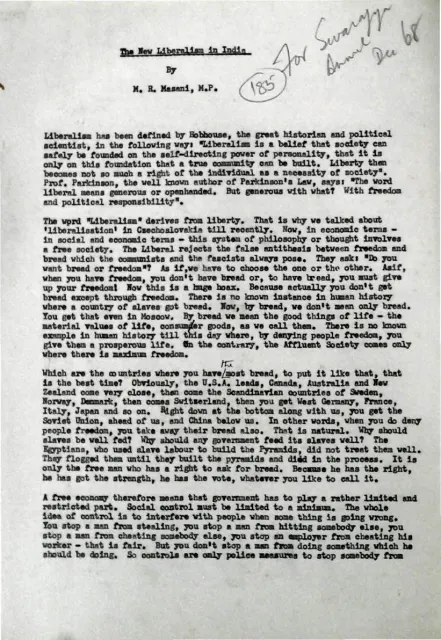
- Liberalism is defined through limited government, private ownership, individual enterprise, consumer choice, and economic freedom.
- The market is presented as a more responsive form of collective decision-making than political or bureaucratic planning.
- Masani concludes that liberal methods advance prosperity, equality, social justice, and freedom faster than state capitalism or socialism.
Metadata and summary are AI-extracted from the source PDF and reviewed for editorial accuracy. The original work is available via the Read PDF tab above (where present); paragraph-level citation inside the PDF is deferred to a future engagement.
Related across the archive
 Primary workWILL LIBERALISM SURVIVE SOCIALISM ?
 Primary workSpeech of Mr Minoo Masani
 Primary workThe New Liberalism in India
 ThePrintSocialism doesn’t deliver prosperity or produce equality. Does it give freedom? Of course not
 ThePrintLiberal methods reach social justice faster than socialism: Minoo Masani