speech · convention address
Welcome Speech
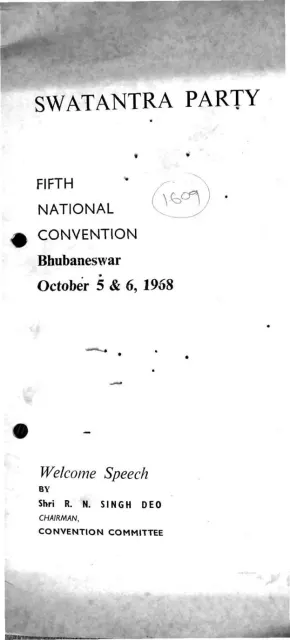
SWATANTRA PARTY · Bhubaneswar · 1968
9 pages
Summary
In this welcome speech to the Swatantra Party’s Fifth National Convention in Bhubaneswar on 5–6 October 1968, Sri R. N. Singh Deo welcomes Rajaji, party delegates, and supporters while presenting the recent elections as a repudiation of two decades of Congress rule. He argues that the public wanted a genuine, programme-based alternative rather than an improvised coalition of non-Congress parties, and credits the Swatantra Party with having fought the election on a definite programme whether in office or opposition.
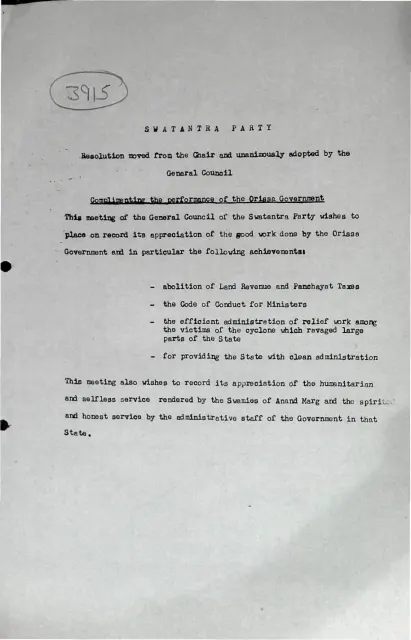
The speech then reviews the Swatantra-led government’s record in Orissa. Singh Deo highlights the abolition of land revenue and Panchayat taxes, efforts to reorganise Panchayats, relief for small traders, scrutiny of public undertakings and ministerial corruption, a ministerial code of conduct, separation of the judiciary from the executive, and measures to expand agricultural production and industrialisation. He contrasts the government’s relatively quiet administration with the publicity generated by political crises elsewhere, thanks the people of Orissa for renewing their confidence, and closes by invoking Rajaji as the elder statesman whose call for a programme-based alternative should inspire political work across India.
Key points
- The address welcomes delegates to Bhubaneswar and celebrates the presence of C. Rajagopalachari at the convention.
- The 1967 elections are presented as a popular demand for change after twenty years of Congress rule.
- Singh Deo criticises non-Congress parties for lacking a common programme and distinguishes Swatantra’s platform from alliances of convenience.
- The Orissa government’s reported reforms include abolishing land revenue and Panchayat taxes and reorganising Panchayats.
- The government claims to have promoted accountability through corruption inquiries, public-undertaking review, a ministerial code of conduct, and judicial–executive separation.
- Agricultural and industrial policy is framed around cooperation, high-yielding varieties, irrigation, mineral and forest resources, and concessions to entrepreneurs.
- The speech concludes with an appeal for a programme-based political alternative and praise for Rajaji’s leadership.
Metadata and summary are AI-extracted from the source PDF and reviewed for editorial accuracy. The original work is available via the Read PDF tab above (where present); paragraph-level citation inside the PDF is deferred to a future engagement.