agreement · statement of principles
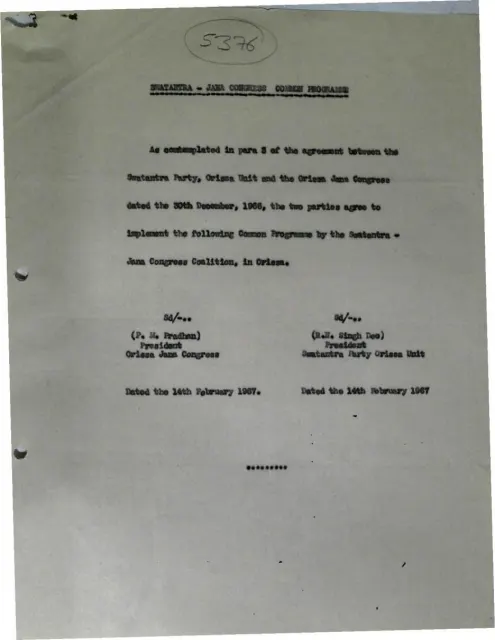
SWATANTRA - JANA CONGRESS COMMON PROGRAMME
1967
2 pages
Summary
The two-page “SWATANTRA - JANA CONGRESS COMMON PROGRAMME” records an agreement between the Swatantra Party and the Orissa Jana Congress, dated 30 December 1966, and signed by P. M. Pradhan and R.N. Singh Deo on 14 February 1967. It presents a 21-point programme for a coalition government in Orissa, centered on clean and efficient administration, the rule of law, impartial public service, and the reduction of political interference and bureaucratic delay.
The programme combines anti-corruption and administrative reforms with a critique of excessive controls, permits, licences, quotas, and wasteful expenditure. It calls for abolition of land revenue, reduction of tax burdens, university expansion, wider technical and general education, development of agriculture and infrastructure, support for Scheduled Castes and Tribes and backward areas, decentralization through Panchayats, introduction of Oriya as the state language in administration, and a commission of inquiry into all aspects of Orissa’s finances. The document is a concise institutional statement of coalition policy rather than a discursive argument.
Key points
- The programme implements an agreement between the Swatantra Party and the Orissa Jana Congress for a coalition in Orissa.
- It prioritizes clean government, anti-corruption measures, administrative efficiency, and the establishment of the rule of law.
- It proposes freeing administration from political pressure and ensuring impartiality and fair treatment for employees.
- It advocates reducing or removing controls, permits, licences, quotas, land revenue, and excessive tax burdens.
- It links economic development to agricultural development, expanded infrastructure, and increased opportunities for business and industry.
- It proposes expanded education, including universities, technical education, general education, and primary education freed from Panchayat Samitis’ control.
- It calls for decentralization through financially empowered Panchayats and special attention to Scheduled Castes, Scheduled Tribes, backward classes, and backward areas.
Metadata and summary are AI-extracted from the source PDF and reviewed for editorial accuracy. The original work is available via the Read PDF tab above (where present); paragraph-level citation inside the PDF is deferred to a future engagement.