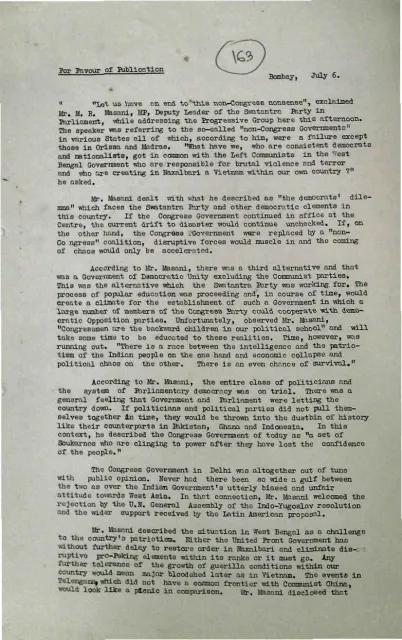
speech
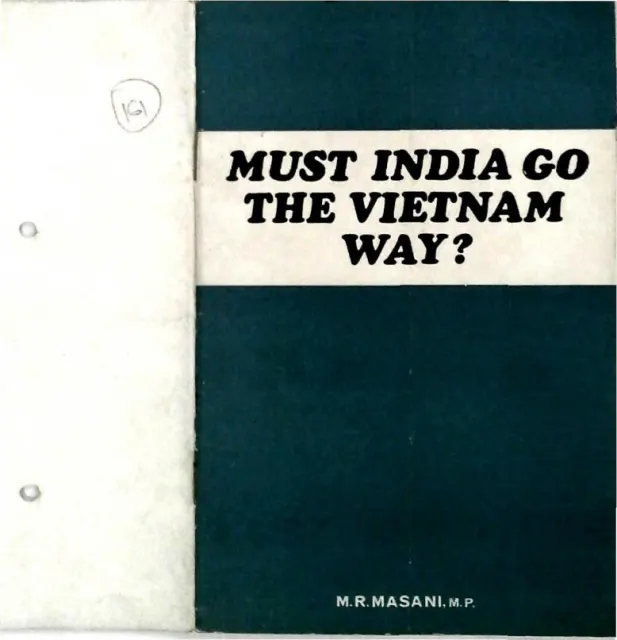
MUST INDIA GO THE VIETNAM WAY?
By Minoo Masani
PUBLISHED BY THE SWATANTRA PARTY, NEW DELHI AND PRINTED AT CHANANA PRINTING HOUSE, DELHI-6 (INDIA) · New Delhi · 1967
17 pages
Summary
In this speech, delivered at Sapru House, New Delhi, on 27 July 1967, M. R. Masani argues that India is facing a democratic, economic, and security crisis. He describes declining public standards, parliamentary indiscipline, corruption, party defections, economic nationalism, taxation, inflation, and an expanding state role as symptoms of political failure. The Congress Party is presented as exhausted and unwilling to learn from its electoral setbacks, while the opposition is criticized for inconsistency and for allowing party calculations to override constitutional responsibility.
Masani’s central warning is that India could follow the path of Vietnam if communist forces are allowed to establish guerrilla bases and exploit political disorder, especially in Bengal and Assam. He links the Naxalbari uprising to a longer Communist strategy associated with Moscow and Peking, and warns against both Communist infiltration and indiscriminate anti-Communist alliances. His proposed alternative is a “Government of Democratic Unity”: a coalition of democratic parties, excluding the Communists and totalitarians, united around nationalism, constitutional democracy, and a pragmatic programme of administration. The speech closes with a warning that unless political leaders act quickly, parliamentary democracy may give way to military or other authoritarian rule.
Key points
- Masani portrays India’s economic condition, public morality, international position, and parliamentary conduct as seriously deteriorated.
- He attacks the Congress Party for repeating failed policies, expanding nationalisation and taxation, and tolerating opportunistic defections.
- He argues that the Socialist parties are too close to Congress policy to offer a reliable democratic alternative, while the Jan Sangh is vulnerable to Communist outreach.
- The Naxalbari uprising is interpreted as part of a Communist strategy involving guerrilla organisation, coercion, and cross-border support.
- Vietnam is used as a warning about the combination of guerrilla bases, foreign direction, and the absence of a broad-based democratic government.
- Masani rejects both Moscow-aligned and Peking-aligned Communist politics as threats to India’s democratic system.
- He proposes a Government of Democratic Unity joining Congress dissidents, Swatantra, Jan Sangh, and Socialist parties while excluding Communists and totalitarians.
- The speech warns that political paralysis could create the conditions for military dictatorship or another form of authoritarian rule.
Metadata and summary are AI-extracted from the source PDF and reviewed for editorial accuracy. The original work is available via the Read PDF tab above (where present); paragraph-level citation inside the PDF is deferred to a future engagement.