Summary
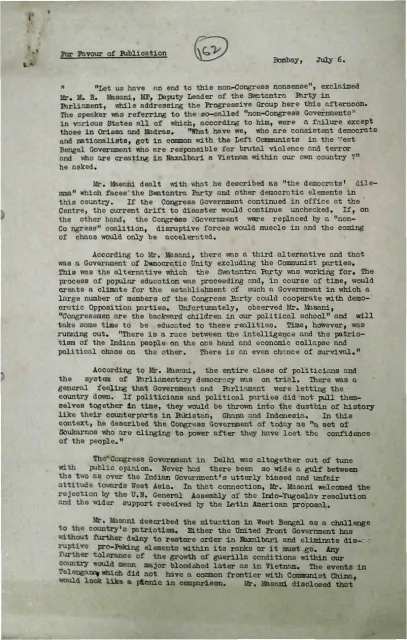
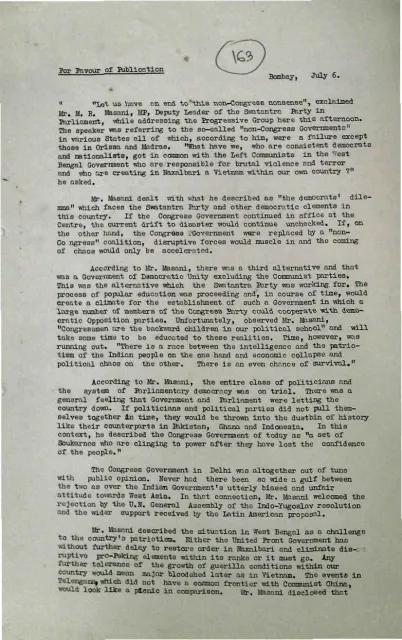
This two-page press statement, issued from Bombay on July 6 and attributed to M. R. Masani, attacks the Congress-backed and non-Congress coalition governments in several Indian states. Masani argues that Congress’s continued rule would allow political drift and disorder to continue, while a coalition excluding the Communists could bring together Congress members and democratic opposition parties. He presents this as a race between political reform and the combined dangers of economic collapse and political chaos.
The statement treats the political class and parliamentary democracy as being on trial. It criticizes the Delhi government’s alleged loss of public confidence, its position on West Asia, and its handling of Communist influence and insurgency in West Bengal. Masani warns that Naxalbari could become an Indian Vietnam, proposes an on-the-spot study team, and concludes by portraying both Peking- and Moscow-aligned Communist forces as threats. The document does not print a substantive title, year, publisher, or issuer.
Key points
- Masani calls for an end to what he describes as “non-Congress Governments” and criticizes the Congress government’s political record.
- He proposes a Government of Democratic Unity that would exclude Communist parties while enabling cooperation between Congress members and democratic opposition parties.
- The statement frames the crisis as a race between political intelligence and patriotism on one side and economic collapse and political chaos on the other.
- Masani argues that parliamentary democracy and the political class are being judged by their inability to restore public confidence.
- He condemns the United Front government in West Bengal for failing to restore order in Naxalbari and for tolerating disruptive pro-Peking elements.
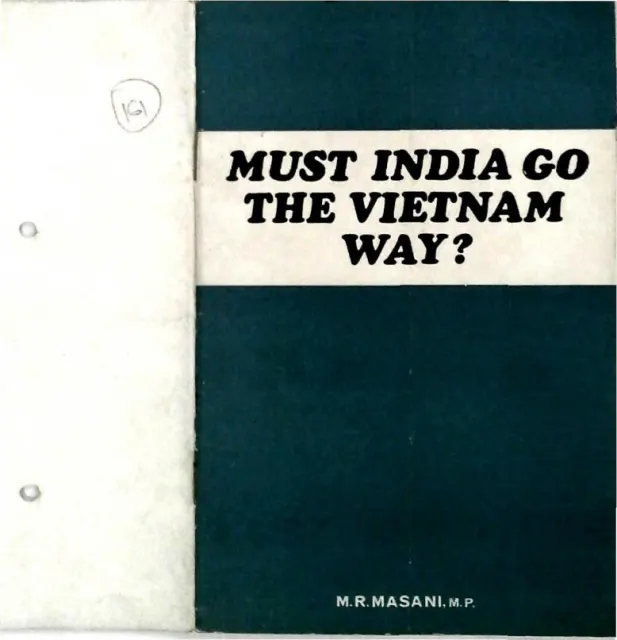
- The statement links Naxalbari to the danger of a Vietnam-like insurgency within India and records the Swatantra Party’s proposal to send a study team.
- Masani alleges Soviet infiltration of the Indian press and diplomatic violations by the Soviet Embassy, while criticizing the Congress government for failing to resist such activity.
Metadata and summary are AI-extracted from the source PDF and reviewed for editorial accuracy. The original work is available via the Read PDF tab above (where present); paragraph-level citation inside the PDF is deferred to a future engagement.