pamphlet · manifesto
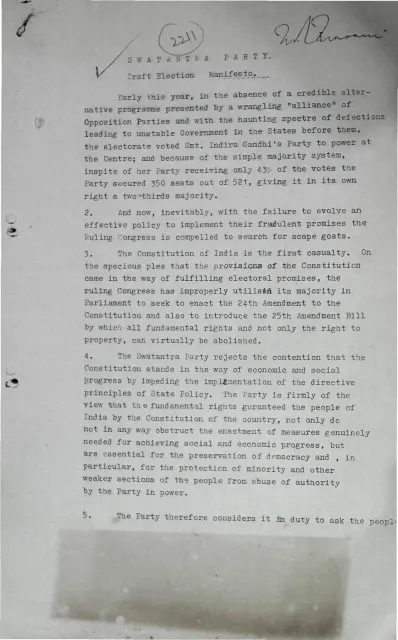
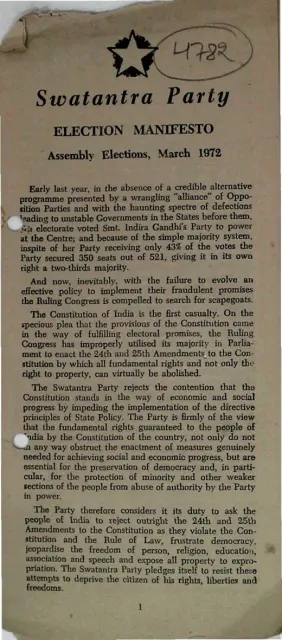
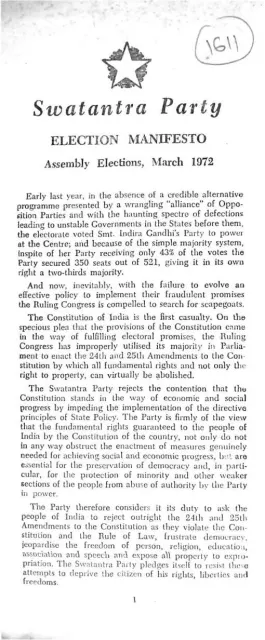
ELECTION MANIFESTO
Assembly Elections, March 1972
Published by S. V. Raju, Executive Secretary, Swatantra Party, National Headquarters, 143 Mahatma Gandhi Road, Bombay 1 and printed by him at Inland Printers, 55 Gamdevi Road, Bombay 7. · Bombay · 1972
6 pages
Summary
The Swatantra Party’s March 1972 Assembly Election Manifesto presents the party as an alternative to the ruling Congress, arguing that Congress majorities have been used to weaken constitutional protections, particularly through the 24th and 25th Amendments. It defends fundamental rights, private property, freedom of speech and expression, an independent press, and the protection of minorities and weaker sections. The manifesto also criticises what it describes as the drift toward one-party rule through state control of radio, television, imported publications, and other mass media.
Key points
- The manifesto attributes Congress’s electoral success to the first-past-the-post system and the absence of a credible alternative programme.
- It opposes the 24th and 25th Constitutional Amendments as threats to fundamental rights, property, democracy, and the Rule of Law.
- It defends press freedom and condemns proposed press legislation and government control of mass communication.
- It criticises inflation, unemployment, stagnant growth, excessive state control, and the dominance of the public sector.
- It argues that government should concentrate on essential public utilities, infrastructure, water management, research, and regulation rather than indiscriminate nationalisation or commercial activity.
- It supports a mixed economy, private enterprise, agricultural incentives, farmer security, fair labour practices, and restrictions on state enterprise where private initiative can operate.
- It calls for clean, impartial, competent administration, reduced corruption, Lokpal and Lokayukt institutions, moderate taxation, and a restoration of the Rule of Law.
- It grounds the party’s political programme in individual self-interest, service at the state level, and what it calls the Gandhian principle of giving first priority to the rule of Dharma.
Metadata and summary are AI-extracted from the source PDF and reviewed for editorial accuracy. The original work is available via the Read PDF tab above (where present); paragraph-level citation inside the PDF is deferred to a future engagement.