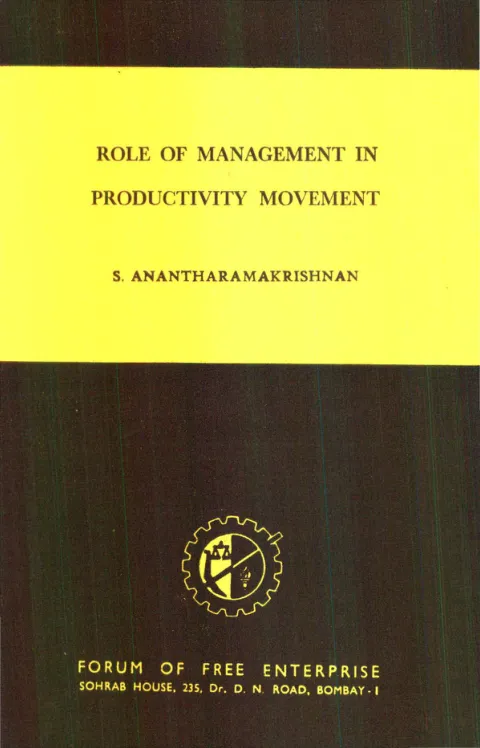
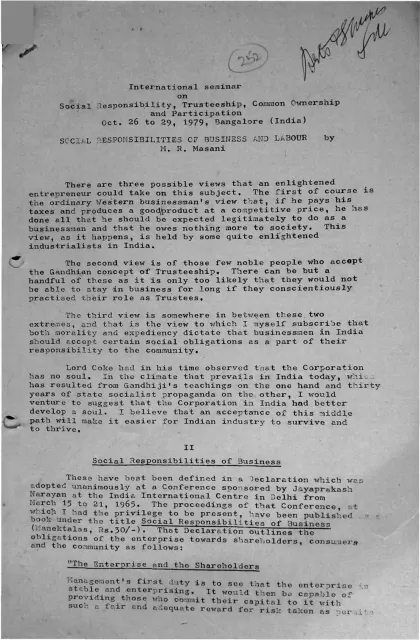
speech · convention address
PHILOSOPHIES OF INDUSTRIAL WELFARE
By Minoo Masani
BOMBAY · 1953
15 pages

Summary
In this conference address, M. R. Masani classifies industrial welfare into three approaches: utilitarian, democratic, and humanitarian. The utilitarian approach treats welfare as a means of improving efficiency and productivity by reducing friction, waste, and labour misallocation. The democratic approach extends political equality into the workplace through participation, collective bargaining, fair wages, advancement opportunities, and recognition of workers as members of an industrial community. The humanitarian approach begins from the ethical principle that workers are ends in themselves and should receive dignity, fair treatment, and concern for their physical and social needs.
Masani argues that these philosophies need not be mutually exclusive, particularly in India’s early stage of industrial development. He discusses the limits of treating personnel management as an exact science, stresses the importance of human relations and employee cooperation, and cautions against reducing industrial difficulties to psychological problems. The address concludes with a detailed personnel-policy model covering selection, training, remuneration, employment security, merit-based promotion, health and safety, trade-union freedom, consultation, representation, and benefit schemes. Masani presents industrial welfare as both a matter of justice and a practical prerequisite for higher productivity, and calls for continuing cooperation between employers and democratic trade unionists.
Key points
- Masani organizes industrial-welfare thinking around utilitarian, democratic, and humanitarian philosophies.
- The utilitarian case links worker welfare to efficiency, productivity, reduced friction, and better labour utilization.
- The democratic case calls for extending equality and participation from the political sphere into the factory.
- The humanitarian case insists that workers must be treated as persons with dignity, rights, interests, and social needs.
- Masani argues that the three approaches can support a common practical programme in India.
- He distinguishes scientific methods of management from the human and creative dimensions of employee cooperation.
- The proposed personnel policy includes fair remuneration, training, promotion, health and safety, union freedom, consultation, representation, and social benefits.
- The address closes by presenting better human relations in industry as essential to the productivity India requires.
Metadata and summary are AI-extracted from the source PDF and reviewed for editorial accuracy. The original work is available via the Read PDF tab above (where present); paragraph-level citation inside the PDF is deferred to a future engagement.