speech · convention address
SOCIAL RESPONSIBILITIES OF BUSINESS AND LABOUR
By Minoo Masani
Bangalore (India) · 1979
13 pages
Summary
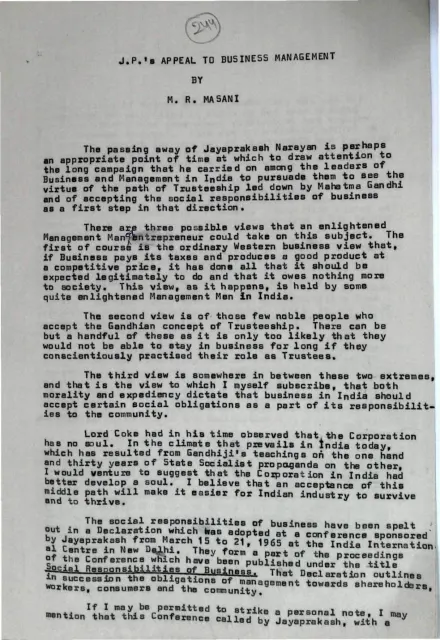
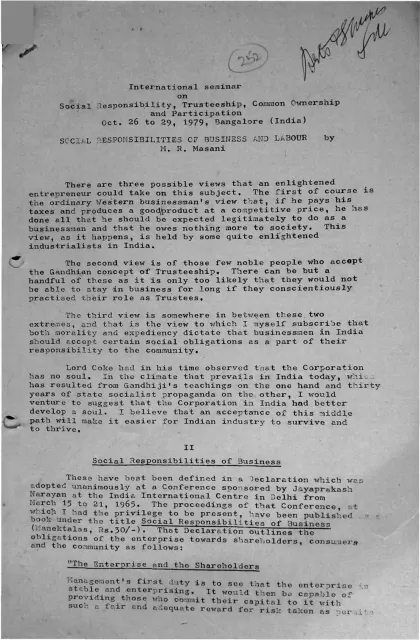
In this seminar paper, M. R. Masani argues that business in India cannot define its responsibilities narrowly as paying taxes and producing competitively priced goods. He rejects both a purely Western business view that assigns the entrepreneur no further obligations and an uncompromising version of Gandhian trusteeship that could make commercial survival impossible. Instead, he advocates a middle path in which businesses accept social obligations to shareholders, workers, consumers and the wider community while retaining freedom for enterprise, competition and innovation. The paper presents these obligations through a declaration adopted at a 1965 Delhi conference sponsored by Jayaprakash Narayan, covering corporate governance, worker participation, consumer protection, community relations and the need for stable law and taxation.
Masani extends the same framework to trade unions. He endorses better wages and working conditions, union democracy, training, unity, support for unorganised labour, opposition to caste and untouchability, and cooperation in raising productivity, but criticises the failure to implement these objectives. The paper then reviews progress among Indian companies, especially proposals for social objectives in company articles and independent social audits. Its annexure develops social audit as an impartial public assessment of a company’s labour, consumer and community policies, illustrated by proposed arrangements involving professional observers, universities, trade unions and community participation. The pages end with an example of TISCO’s community-development work in Jamshedpur; no material beyond that concluding annexure page was present.
Key points
- Masani distinguishes a narrow profit-and-compliance view of business from both full Gandhian trusteeship and his preferred intermediate position.
- Business responsibility is presented as extending to shareholders, workers, consumers, the community and society generally.
- The paper supports worker participation, fair wages, collective bargaining, training, profit-sharing and opportunities for leadership.
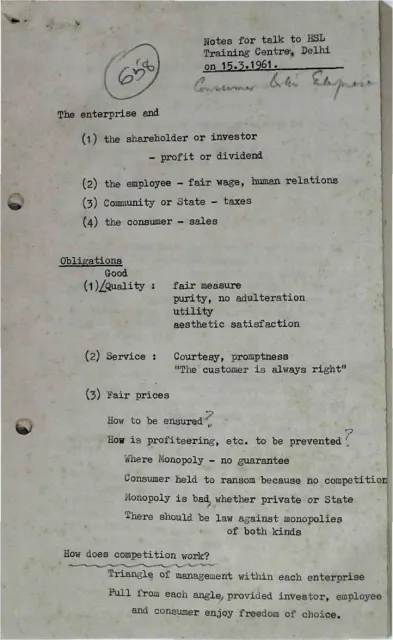
- Consumer protection requires competition, anti-monopoly measures, fair prices, quality, honest advertising and accountable management.
- Companies owe reciprocal duties to the community, including honest taxation, respect for law, environmental amenities, worker housing and civic cooperation.
- Masani proposes local public meetings and social audits as institutional mechanisms for making corporate responsibility visible and accountable.
- Trade unions are criticised for failing to implement commitments concerning democracy, unity, unorganised labour, productivity and social development.
- The annexure links social audit to impartial reporting on corporate pricing, labour and community policies, including examples from TISCO and Tata charitable work.
Metadata and summary are AI-extracted from the source PDF and reviewed for editorial accuracy. The original work is available via the Read PDF tab above (where present); paragraph-level citation inside the PDF is deferred to a future engagement.