
speech
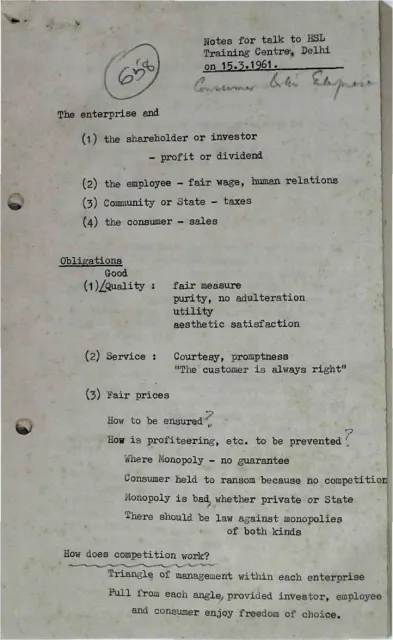
Notes for talk to HSL Training Centre, Delhi
Delhi · 1961
5 pages
Summary
These five pages are typed notes for a talk delivered at the HSL Training Centre, Delhi, on 15 March 1961. They outline the obligations of an enterprise to four constituencies: shareholders, employees, the community or State, and consumers. The notes emphasize product quality, fair measurement, purity, utility, courteous service, promptness, and fair prices. They argue that competition protects consumers from profiteering and monopoly, whether private or state-owned, and propose a “triangle of management” in which investors, employees, and consumers retain freedom of choice.
The notes present competitive markets as a form of economic democracy, with consumer preferences influencing production through a “daily ballot” in the marketplace. They acknowledge inequalities in purchasing capacity but treat them as potentially necessary to economic progress, drawing on Friedrich Hayek’s argument that early luxury consumption can help make new goods broadly available later. The notes then contrast communist command planning with West Germany’s consumer prosperity, using examples from Soviet criticism and West German production and ownership figures. The final page applies the argument to HSL: as a private limited company competing with TISCO and ISCO, it should serve consumers by providing the finest products at the cheapest prices.
Key points
- An enterprise has obligations to investors, employees, the community or State, and consumers.
- Good quality, fair measurement, purity, utility, aesthetic satisfaction, courtesy, and promptness are presented as duties to consumers.
- Competition is described as the chief protection against profiteering and monopoly, including state monopoly.
- Consumer choice is characterized as a continuing form of economic democracy that shapes production.
- The notes defend some inequality in purchasing power as a possible condition of innovation and progress.
- Communist command planning is criticized for claiming omniscience and producing state capitalism and monopoly.
- West Germany is offered as an example of the consumer benefits associated with competitive enterprise.
- HSL is urged to compete with TISCO and ISCO and provide the best products at the lowest prices.
Metadata and summary are AI-extracted from the source PDF and reviewed for editorial accuracy. The original work is available via the Read PDF tab above (where present); paragraph-level citation inside the PDF is deferred to a future engagement.
Related across the archive
 Primary workSOCIAL RESPONSIBILITIES OF BUSINESS AND LABOUR
 Primary workThe Conscience of Free Enterprise
 Primary workLectures Notes for talk at the Tata Staff College on November 11, 1960.
 ExcerptB.R. Shenoy on Economic Growth with Social Justice
 ThePrintLiberal methods reach social justice faster than socialism: Minoo Masani