lecture · working paper
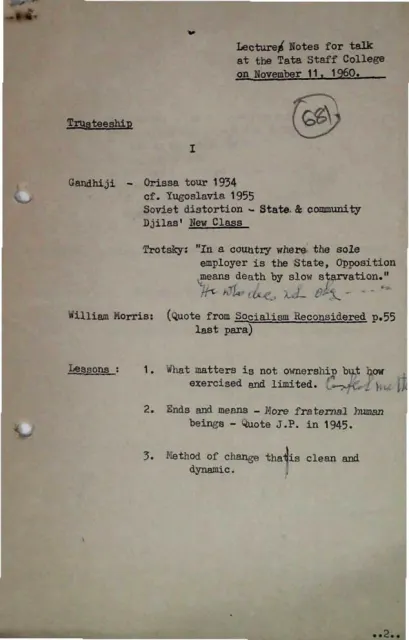
Lectures Notes for talk at the Tata Staff College on November 11, 1960.
Forum of Free Enterprise · BOMBAY 1 · 1960
11 pages
Summary
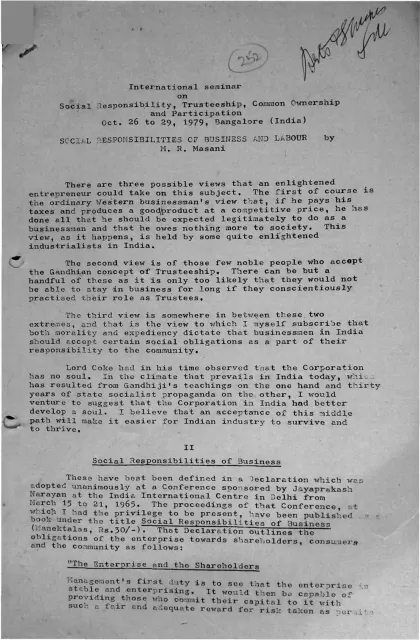
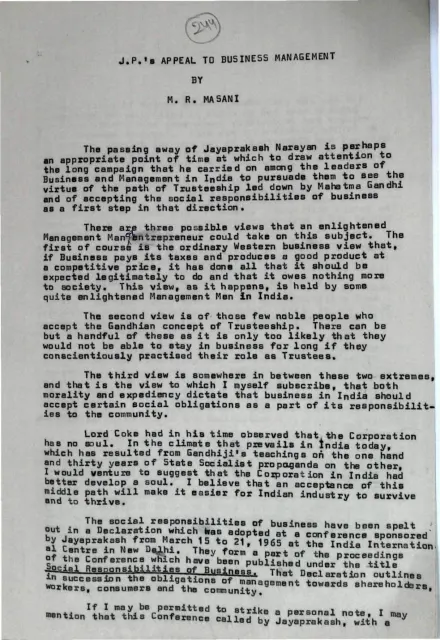
The document begins with three pages of typed notes for a talk on trusteeship at the Tata Staff College on November 11, 1960. The notes contrast state ownership with trusteeship, arguing that the central issue is not ownership itself but how ownership is exercised and limited. Trusteeship is described as a moral obligation to use property for the benefit of others, binding the conscience rather than enforced by law. The notes point to Gandhi's 1934 Orissa tour, Yugoslavia, Soviet state and community relations, Trotsky's warning about state employment, William Morris, Vinoba Bhave's Bhoodan and Sampattidan movements, and Jayaprakash Narayan's views on ends and means. They conclude with three practical lessons: institutional arrangements matter less than the manner in which power is exercised, humane ends require appropriate means, and social change should proceed through a clean and dynamic method.
The third lecture-note page turns to implementation in business. It asks businesses to consider their responsibilities to consumers, employees, investors, customers, and the community, while acknowledging the gap between such principles and actual practice. The remainder of the PDF is a separately paginated Forum of Free Enterprise booklet, published in 1956. Its manifesto defends free enterprise as compatible with democracy, social obligation, fair wages, consumer protection, worker participation, honest management, and service to the community. It rejects both laissez-faire capitalism and state monopoly, endorses a mixed economy in which state and private enterprise coexist, and criticises authoritarian planning when it subordinates individual freedom. The booklet also includes a code of conduct, membership information, the Forum's centres, a statement of its position, and an excerpt from M. A. Sreenivasan's 1959 speech.
Transcript
Summary
The document begins with three pages of typed notes for a talk on trusteeship at the Tata Staff College on November 11, 1960. The notes contrast state ownership with trusteeship, arguing that the central issue is not ownership itself but how ownership is exercised and limited. Trusteeship is described as a moral obligation to use property for the benefit of others, binding the conscience rather than enforced by law. The notes point to Gandhi’s 1934 Orissa tour, Yugoslavia, Soviet state and community relations, Trotsky’s warning about state employment, William Morris, Vinoba Bhave’s Bhoodan and Sampattidan movements, and Jayaprakash Narayan’s views on ends and means. They conclude with three practical lessons: institutional arrangements matter less than the manner in which power is exercised, humane ends require appropriate means, and social change should proceed through a clean and dynamic method.
The third lecture-note page turns to implementation in business. It asks businesses to consider their responsibilities to consumers, employees, investors, customers, and the community, while acknowledging the gap between such principles and actual practice. The remainder of the PDF is a separately paginated Forum of Free Enterprise booklet, published in 1956. Its manifesto defends free enterprise as compatible with democracy, social obligation, fair wages, consumer protection, worker participation, honest management, and service to the community. It rejects both laissez-faire capitalism and state monopoly, endorses a mixed economy in which state and private enterprise coexist, and criticises authoritarian planning when it subordinates individual freedom. The booklet also includes a code of conduct, membership information, the Forum’s centres, a statement of its position, and an excerpt from M. A. Sreenivasan’s 1959 speech.
Key points
- The lecture notes present trusteeship as a moral obligation attached to legal ownership.
- They distinguish the fact of ownership from the manner in which property and power are exercised and limited.
- The notes connect trusteeship with Gandhi, Vinoba Bhave’s Bhoodan and Sampattidan, Jayaprakash Narayan, Trotsky, and William Morris.
- They frame business responsibility in relation to consumers, employees, investors, customers, and the community.
- The appended Forum manifesto defends free enterprise as an essential element of Indian democracy and social life.
- The Forum rejects both laissez-faire capitalism and state monopoly, favouring coexistence between state and private enterprise.
- The code of conduct assigns obligations to producers, employers, management, professional people, and citizens.
- The booklet presents free enterprise as disciplined by honesty, fair dealing, social responsibility, and democratic government.
Metadata and summary are AI-extracted from the source PDF and reviewed for editorial accuracy. The original work is available via the Read PDF tab above (where present); paragraph-level citation inside the PDF is deferred to a future engagement.