speech · parliamentary
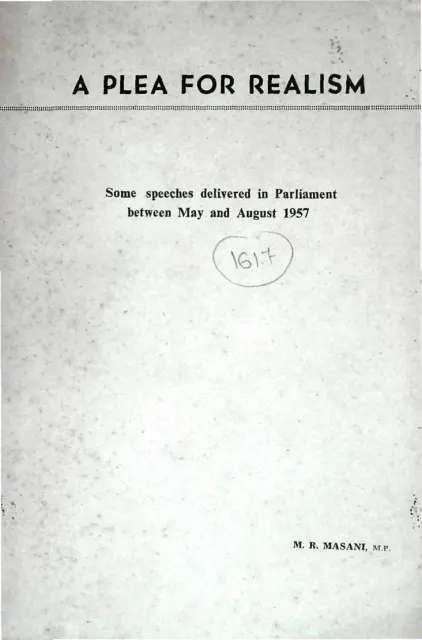
A PLEA FOR REALISM
Some speeches delivered in Parliament between May and August 1957
By Minoo Masani
POPULAR BOOK DEPOT · Bombay-7 · 1957
70 pages
Summary
In the rendered pages, M. R. Masani argues that India’s Second Five Year Plan should be treated as a revisable instrument rather than an untouchable doctrine. In the rendered pages, he connects planning to inflation, taxation, middle-class purchasing power, transport bottlenecks, and the need to shift resources from heavy industry toward consumer goods, agriculture, and other necessities. His criticism is not of planning itself, but of excessive expenditure, unrealistic assumptions, bureaucratic expansion, and the belief that an adopted plan must be carried out regardless of changing circumstances.
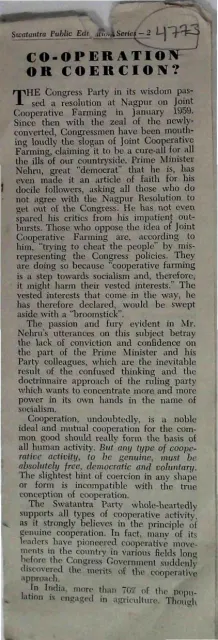
In the rendered pages, Masani also challenges the proposed model of co-operative farming. He distinguishes service co-operatives, in which farmers retain their holdings while sharing inputs and marketing, from collective farming based on pooled land. In the rendered pages, he tests land pooling against production, social desirability, and voluntariness, citing comparative evidence from Japan, Denmark, Switzerland, Yugoslavia, Poland, China, Russia, and India to argue for intensive cultivation by individual peasant families rather than compulsory collectivisation. The rendered pages end partway through this second speech; the later speeches and appendices listed in the contents were not seen.
Key points
- In the rendered pages, Masani presents the Second Five Year Plan as a means to social welfare, not an end in itself.
- In the rendered pages, he warns that taxation combined with continued deficit finance could intensify inflation through rising prices, wages, and costs.
- In the rendered pages, he argues that the Plan should redirect resources from heavy industry toward consumer goods, food, agriculture, and light industry.
- In the rendered pages, he links middle-class economic pressure to the health of democratic institutions.
- In the rendered pages, he distinguishes co-operative services from collective farming based on pooled land.
- In the rendered pages, he proposes testing agricultural collectivisation by its effects on production, social desirability, and voluntariness.
- In the rendered pages, comparative agricultural evidence is used to challenge the assumption that large or collective farms are necessarily more productive.
Metadata and summary are AI-extracted from the source PDF and reviewed for editorial accuracy. The original work is available via the Read PDF tab above (where present); paragraph-level citation inside the PDF is deferred to a future engagement.