pamphlet
THE DANGERS OF JOINT CO-OPERATIVE FARMING
FORUM OF FREE ENTERPRISE · Bombay · 1959
10 pages
THE DANGERS OF JOINT CO-OPERATIVE FARMING
By M. R. MASANI M.P.
Summary
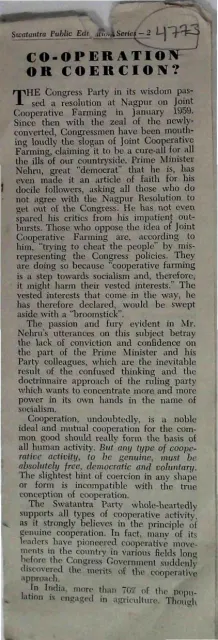
M. R. Masani, M.P., addresses the Forum of Free Enterprise with a polemic distinguishing genuine co-operation from the joint co-operative farming pattern endorsed by the Nagpur Resolution of the Congress Party. Masani opens by establishing his own credentials as a life-long supporter of co-operative credit, marketing and multipurpose societies, then draws a sharp line: true co-operation rests on peasants who own and cultivate their own land, while the Soviet-Chinese model of collective farming pools the land itself and turns owners into wage labour on what was once theirs. He argues the Nagpur programme is being smuggled in by the back door under the language of co-operation and must be opposed by every democrat.
The pamphlet marshals comparative data to attack the productivity claim behind collectivisation. Drawing on figures for wheat and rice yields in the USA, USSR, UK, Denmark, Japan and an Indian Agricultural Research Institute study on bullock vs. tractor ploughing, Masani argues small farms with better seed, water, credit and know-how out-produce large collectives. He cites the retreat from collective farming in Poland under Gomulka (where 80 per cent of co-operatives and collectives were liquidated), Yugoslavia under Tito (where the Yugoslav Parliament abandoned collective farming in 1957), and the negative results reported by the Polish Communist Party — all to argue that ‘countries which have tried collective or co-operative farming have always failed’.
The second half turns on administrative feasibility and political economy. Masani argues India lacks the senior agricultural officers to staff three thousand co-operative farms; he quotes Sir Malcolm Darling’s verdict that ‘in every State the path of co-operation is strewn with wreckage’, and notes that the Registrar of Co-operative Societies will, under the Co-operative Law Committee’s recommendations, possess sweeping powers to audit, supersede, dissolve and arbitrate without appeal — what Prof. Chandrasekhar has called, of the Chinese communes, ‘a new form of colonialism’. Citing Gandhi, Charan Singh, Jaya Prakash Narayan, Rajagopalachari and K. M. Munshi as opponents of the joint pattern, Masani warns that pooling land voluntarily will require coercion in practice, will increase rural unemployment, and will set landless against landed in class war.
The booklet closes with a defence of the cultivator-owner pattern as both more productive and more humane — the Japanese path of better fertilisers, seed and instruction to the peasant who already farms his own plot — and invokes Gandhi’s formula that the urban doctrinaires propose joint co-operative farming as ‘another attempt in a roundabout way to keep on the backs of our peasantry’.
Key points
-
Masani distinguishes genuine co-operation (credit, marketing, multipurpose societies for owner-cultivators) from joint co-operative farming, which pools land itself on the Soviet-Chinese collectivist model.
-
He argues the Nagpur Resolution of the Congress Party introduces collectivisation through the back door of ‘service co-operatives’ followed by joint cultivation.
-
Comparative yield data from the USA, USSR, UK, Denmark, Japan and an Indian Agricultural Research Institute study are deployed to refute the claim that larger farms are more productive.
-
He documents the retreat from collectivisation in Poland under Gomulka, Yugoslavia under Tito, and the negative production results admitted by the Polish Communist Party in April 1957.
-
India lacks the senior agricultural officers to staff three thousand co-operative farms; the Co-operative Law Committee would give the Registrar of Co-operative Societies near-unappealable powers to audit, supersede and dissolve societies.
-
Mahatma Gandhi’s village industries and the Japanese model of better seed, fertiliser and instruction for the owner-cultivator are offered as the genuine alternative.
-
Masani names Jaya Prakash Narayan, C. Rajagopalachari, K. M. Munshi, Charan Singh and Vinobha Bhave as critics of the joint pattern; he warns that voluntary pooling will collapse into coercion.
-
He frames joint co-operative farming as an invention of urban, doctrinaire planners that will take land away from the peasantry and provoke civil war and class conflict in the villages.
Generated by the v1.5 extraction pipeline. Awaiting editorial review.
Metadata and summary are AI-extracted from the source PDF and reviewed for editorial accuracy. The original work is available via the Read PDF tab above (where present); paragraph-level citation inside the PDF is deferred to a future engagement.