classical liberal
Eugene R. Black Sr.
1898–1992
Also known as: Eugene Black
How Eugene R. Black Sr. is discussed in this archive
Authored 1 work in the archive.
Referenced in 32 other works , including HOW CONTROLLED INDUSTRIES WORK IN INDIA—A CASE STUDY , An Analysis of Dutt Committee Report on Industrial Licensing , and Identity, Markets and Social Welfare .
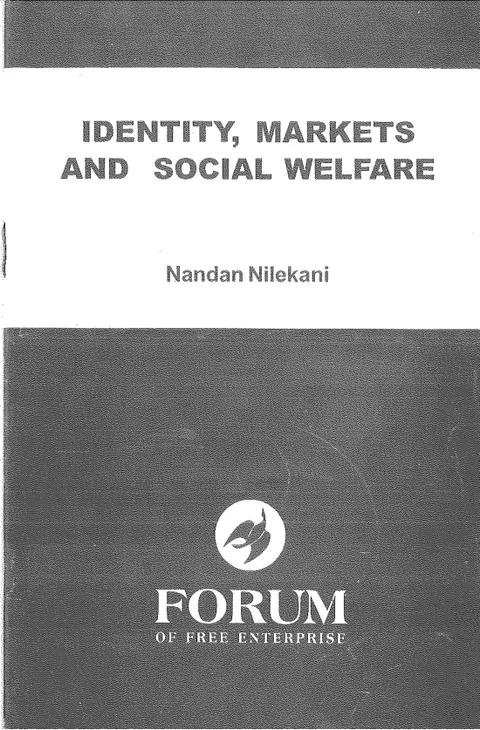
In Identity, Markets and Social Welfare : Eugene Black supplies the closing epigraph of the booklet, recast by the Forum to argue that private enterprise is 'an affirmative good'.
In MOVING TOWARDS AN EMPOWERED CUSTOMER : Black appears alongside Shroff in the booklet's closing epigraphs, his exhortation that private enterprise be accepted as 'an affirmative good' invoked as a complementary endorsement of the Forum's free-enterprise creed.
In India: Seeing the Future in its Past : Rajan's lecture booklet carries an Eugene Black epigraph on the back cover — 'People must come to accept private enterprise not as a necessary evil, but as an affirmative good' — which the summary treats as distilling the polemical purpose of the publication.
In Leading in Turbulent Times : Black's closing quote — that private enterprise is an 'affirmative good' — is the booklet's editorial bookend, used to lift Premji's Values-based corporate ethic into the FFE classical-liberal canon.
In CENTRAL SALES TAX AMENDMENTS : A quotation from Eugene Black closes Mehta's pamphlet — paired with Shroff's opening aphorism — as one of the Forum of Free Enterprise's customary ideological book-ends framing technical policy commentary inside its free-enterprise mission.
By Eugene R. Black Sr. (1)
Nothing here matches. Clear the search or remove some filters.
Matches inside Eugene R. Black Sr.'s works and pages
Mentioned in (82)
Primary works (82)
- Identity, Markets and Social Welfare · 2009
- "a closing Eugene Black epigraph that recasts private enterprise as 'an affirmative good'." · Black's epigraph anchors the booklet's concluding rhetorical move from defence of enterprise to its positive valorisation
- MOVING TOWARDS AN EMPOWERED CUSTOMER · 2007
- "Eugene Black's exhortation that private enterprise be accepted 'not as a necessary evil, but as an affirmative good.'" · closing pairing with Shroff's epigraph; positions Black's words as a complementary endorsement of private enterprise
- India: Seeing the Future in its Past · 2006
- "The Eugene Black epigraph on the rear inside cover — 'People must come to accept private enterprise not as a necessary evil, but as an affirmative good' — distils the booklet's polemical purpose." · Eugene Black quote is the polemical signoff of the booklet
- Leading in Turbulent Times · 2003
- "a closing Eugene Black quote that "people must come to accept private enterprise not as a necessary evil, but as an affirmative good,"" · back-matter dedication; Black supplies the philosophical wrap on Premji's lectures
- CENTRAL SALES TAX AMENDMENTS · 2002
- "a Eugene Black quotation at the back" · Black's quotation closes the pamphlet as the Forum's standard back-cover ideological frame
Show all 82
- EXCELLENCE IN INDUSTRY THROUGH LEADERSHIP · 2001
- "the Forum's customary Eugene Black epigraph that private enterprise must be accepted not as a necessary evil but as an affirmative good" · the lecture ends on Black's affirmative-good formulation, treating it as the Forum's foundational creed
- Challenges Before Insurance Industry · 2000
- "a Eugene Black epigraph urging that private enterprise be embraced not as a necessary evil but as an affirmative good" · Black's dictum is used as a closing philosophical frame for the insurance-liberalisation argument
- CORPORATE GOVERNANCE – INDIAN EXPERIENCE · 2000
- "an Eugene Black epigraph asking that private enterprise be accepted 'not as a necessary evil, but as an affirmative good.'" · closing flourish; Black's voice supplies the booklet's normative anchor for free enterprise
- E-Commerce and Sales Tax · 2000
- "bracketed by the Forum's signature inspirational quotes from A. D. Shroff and Eugene Black" · publication apparatus; Black supplies the universal-respectability bookend the Forum reuses across its pamphlet series
- A VISION OF INDIA IN 2020 · 1998
- "An A. D. Shroff epigraph at the front and a Eugene Black epigraph at the back frame the booklet within the Forum's classical-liberal advocacy of private enterprise as an affirmative good." · closing note — Eugene Black's epigraph closes the booklet, framing its argument in classical-liberal terms
- Ethics in Business and Management · 1998
- "Front-matter pairs the lecture with an A.D. Shroff aphorism on free enterprise, and the back cover with a Eugene Black quotation framing private enterprise as 'an affirmative good'" · Black's aphorism used as the booklet's closing ideological statement
- LIFE AFTER LIBERALISATION · 1992
- "a back-cover epigraph from Eugene Black that private enterprise must be embraced as an "affirmative good"" · booklet apparatus; Black supplies the ideological wrap around Ganguly's reform argument
- INTERNATIONALISATION OF INDIAN BUSINESS · 1980
- "a reminder, via a Eugene Black epigraph on the back cover, that private enterprise must be embraced 'not as a necessary evil, but as an affirmative good.'" · Black's line is deployed as the booklet's ideological coda
- MANAGING A BUSINESS IN INDIA · 1980
- "An epigraph from Eugene Black — "People must come to accept private enterprise not as a necessary evil, but as an affirmative good" — sets the polemical key." · opening editorial framing; Black's quotation is foregrounded as the booklet's organising motto
- MANAGEMENT PHILOSOPHY OF PETER DRUCKER · 1979
- "The Forum frames the reprint with epigraphs from A. D. Shroff and Eugene Black insisting that free enterprise is 'an affirmative good'" · editorial apparatus; Black's epigraph is paired with Shroff's at the booklet's threshold
- Inflation & Economic Growth · 1973
- "prefaced with a Eugene Black epigraph that private enterprise must be accepted "not as a necessary evil but as an affirmative good."" · opening framing device positioning Black as the booklet's ideological anchor
- HOW BIG ARE BIG ENTERPRISES IN INDIA? · 1971
- "is framed by paratext quotes from A. D. Shroff and Eugene Black affirming free enterprise as a positive good" · closing sentence; Black's pro-private-enterprise authority brackets the pamphlet's argument
- An Analysis of Dutt Committee Report on Industrial Licensing · 1969
- "Eugene Black on accepting private enterprise as an "affirmative good"" · Black's epigraph frames the booklet's defence of large industrial houses inside an explicitly pro-private-enterprise philosophy
- "book-ended by Eugene Black's epigraph defending private enterprise as an "affirmative good"" · the key-points summary names Black's epigraph as one of the two ideological book-ends of the polemic
- Economic Growth · 1969
- "sidebar quotes from Eugene Black and the Forum's founder A. D. Shroff frame the volume in the Forum's classical-liberal idiom" · editorial framing alongside Shroff's epigraph
- Industrial Licensing and Economic Growth in India · 1969
- "and the contrary cautions of Eugene Black and J. R. D. Tata." · Black appears as one of the early contrary cautions against the planning architecture Mehta indicts
- Deficit Financing and Inflation · 1967
- "citing Eugene Black and A. D. Shroff in sidebar quotations" · the booklet's framing apparatus; Black and Shroff are deployed as the institutional moral chorus
- INDIA REQUIRES INDICATIVE PLANNING · 1967
- "The closing section is a defence of private enterprise as 'an affirmative goad' (echoing Eugene Black)" · Khatau frames his peroration around Black's affirmative-good formulation
- INDIAN PLANNING —PAST & FUTURE · 1966
- "The frontispiece frames the volume's ideological stance with a Eugene Black epigraph insisting that private enterprise be embraced as "an affirmative good" rather than a tolerated evil." · Eugene Black's epigraph opens the booklet and supplies its anti-dirigiste motto
- Indian Planning at the Cross-Roads · 1965
- "The booklet is framed by sidebar pull-quotes from Eugene Black and A. D. Shroff defending private enterprise as an affirmative good." · Black supplies one of the two pull-quotes that frame the Dandeker-Mehta-Santhanam compilation
- Are There Monopolies and Concentration of Economic Power in India? · 1964
- "Shroff and Eugene Black aphorisms tie the booklet's particular Indian arguments into the Forum's broader classical-liberal frame of free enterprise as an 'affirmative good'." · Black's aphorism is explicitly the source of the booklet's 'affirmative good' framing of private enterprise
- Financing Under Planned Economy · 1964
- "Quoting Sir A. Ramaswami Mudaliar and Eugene Black on the exhaustion of the capital market and the mortgaging of future export earnings" · Black cited as an international financial authority corroborating Master's diagnosis of India's financing crisis
- Compulsory Deposit Scheme · 1963
- "captured in the cover-leaf epigraphs from Eugene Black and A. D. Shroff — that compulsory saving on the poor is a contradiction in terms" · Black's epigraph is one of the two cover-leaf framings that mark the booklet's classical-liberal verdict on the C.D.S.
- FOREIGN EXCHANGE CRISIS — THE WAY OUT · 1963
- "more IDA (50-year, near-interest-free) loans from the World Bank, citing Eugene Black" · Murthy cites Black on IDA lending as part of his survey of remedial financing mechanisms
- HOW CONTROLLED INDUSTRIES WORK IN INDIA—A CASE STUDY · 1963
- "He revisits the 1952–53 negotiations with Eugene R. Black's World Bank mission" · middle of the summary; Black's mission is invoked as the institutional witness to the original profit-margin commitment that the Government is now breaking
- "The pamphlet is bracketed by inset epigraphs from Eugene Black ('People must come to accept private enterprise not as a necessary evil, but as an affirmative good')" · closing paragraph; Black's epigraph is mobilised as ideological framing for the technical case
- Impact of Taxation on Small & Medium Scale Industries · 1958
- "The pamphlet carries Forum of Free Enterprise pull-quotes from Eugene Black of the World Bank on the inside-front cover and from A. D. Shroff on the back panel." · closing paratext sentence; Black's pull-quote is part of the Forum's standard ideological bracket around the policy argument
- INDIAN ADMINISTRATION · 1958
- "The booklet carries marginalia quotes from Eugene Black and A. D. Shroff, signalling the Forum's classical-liberal framing of Menon's bureaucratic critique." · Black is one of the two pull-quote authorities that frame the booklet
- FINANCE AND INDUSTRY IN INDIA · n.d.
- "crediting Eugene Black and George Woods for sympathetic stewardship" · Shroff credits Black for unusually sympathetic terms in World Bank lending to India