speech
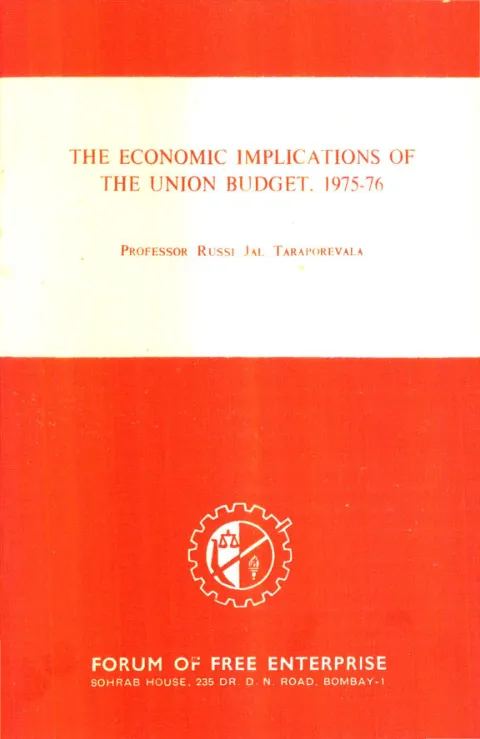
The Economic Implications of the Union Budget, 1975-76
FORUM OF FREE ENTERPRISE, SOHRAB HOUSE, 235 DR. D. N. ROAD, BOMBAY-1 · Bombay · 1975
27 pages
The Economic Implications of the Union Budget, 1975-76
By Professor Russi Jal Taraporevala
Summary
Delivered as a public lecture in Bombay on 3rd March 1975 under the joint auspices of the Forum of Free Enterprise and other organisations, Professor Russi Jal Taraporevala’s pamphlet dissects Yashwantrao Chavan’s Union Budget for 1975-76 against the backdrop of what Taraporevala calls a year of unprecedented economic strain — a failed Kharif monsoon, double-digit international price shocks, a collapse in industrial growth, and a balance of payments crisis. The opening sections marshal the official statistics from the Government’s own “Economic Survey” to argue that the Fourth Five-Year Plan has comprehensively failed: national income grew at 2.8% per annum against a 5.7% target, per capita income at constant prices has been stagnant for more than a decade and has actually declined since 1971-72, industrial production grew at 3.9% against a target of 8-10%, total private-sector employment was “completely stagnant”, and wholesale prices rose 27.3% in 1974 alone.
Taraporevala then turns to the budget itself. He accepts the Finance Minister’s rhetorical framework — that growth, not price-line holding, is the only durable answer to poverty — but argues that the budget does “very little to reach the goals outlined in the first part of the budget speech”. He recomputes the 1974-75 deficit (originally estimated at Rs. 126 crores, now Rs. 625 crores), shows that the headline 1975-76 deficit of Rs. 464 crores is itself a gross underestimate once dearness-allowance escalation, optimistic oil-credit assumptions, and a piece of Reserve Bank “window-dressing” are corrected, and predicts an actual deficit in excess of Rs. 500 crores. He then walks through the revenue side — a heavy reliance on excise duties (sugar, petroleum, tobacco, paper, cement, electrical goods, air-conditioners, plus a new 1% omnibus excise on all unspecified goods), an increase in central sales tax from 3% to 4%, and customs hikes on copper and zinc — and argues that all of these will be passed straight on to the consumer, leading to a price rise of at least 15% in the coming year and 25% if the monsoon fails.
A classical-liberal thread runs through the analysis. Taraporevala repeatedly blames the country’s “inexorable” money-supply growth (which rose 15.3% in 1973-74 against negligible real growth), the MRTP Act and licensing regime, and the obstruction of “good big houses like Tatas” from setting up fertiliser capacity for the structural shortfalls behind the inflation. He flags the withdrawal of the Section 80K dividend exemption as silently negating other concessions intended to encourage new industrial floatation, welcomes the marginal direct-tax reliefs for the salaried middle class, and concludes — in the chunk seen — by noting that the budget’s wide reliance on excise revenue “fuels further price rises and fans the fires of inflation as has happened during the past many years”. The pamphlet is published as Forum of Free Enterprise’s contribution to public economic education, with Eugene Black’s epigraph — “People must come to accept private enterprise not as a necessary evil, but as an affirmative good.” — set on the facing page as the publisher’s framing.
Key points
-
Frames the 1975-76 Budget against a year of acute crisis: failed Kharif monsoon, severe balance-of-payments strain, and international price shocks.
-
Shows the Fourth Five-Year Plan missed its growth target sharply — national income grew at 2.8% (target 5.7%) and per capita income has been stagnant for over a decade and declining since 1971-72.
-
Documents the collapse of industrial growth (3.9% achieved against an 8-10% target), inadequate capacity creation in both public and private sectors, and large shortfalls in power, coal, steel and cement.
-
Argues private-sector employment was “completely stagnant” while educated unemployment on the live registers rose from 26.11 lakhs in 1972 to 40.32 lakhs in 1974.
-
Identifies inexorable money-supply growth (15.3% in 1973-74) without matching production as the principal source of inflation, alongside MRTP and licensing as constraints on supply.
-
Recomputes the 1974-75 deficit at Rs. 625 crores (vs. Rs. 126 crores originally budgeted) and dismisses the 1975-76 headline deficit of Rs. 464 crores as a gross under-estimate, projecting an eventual figure above Rs. 500 crores.
-
Singles out a Rs. 100 crore special borrowing from the RBI — drawn from frozen dearness allowance and compulsory deposit balances — as “window-dressing” that defeats the original purpose of those immobilisation schemes.
-
Predicts a 15% general price rise in 1975-76, rising to 25% if the monsoon fails, driven by a heavy excise-and-CST-led revenue package whose burden will be passed on to consumers.
Generated by the v1.5 extraction pipeline. Awaiting editorial review.
Metadata and summary are AI-extracted from the source PDF and reviewed for editorial accuracy. The original work is available via the Read PDF tab above (where present); paragraph-level citation inside the PDF is deferred to a future engagement.