pamphlet
THE ECONOMIC IMPLICATIONS OF THE UNION BUDGET FOR 1966-67
CHANGES RECOMMENDED TO SPUR GROWTH
FORUM OF FREE ENTERPRISE, "SOHRAB HOUSE", 235 DR. D. N. ROAD, BOMBAY-1 · Bombay · 1966
43 pages
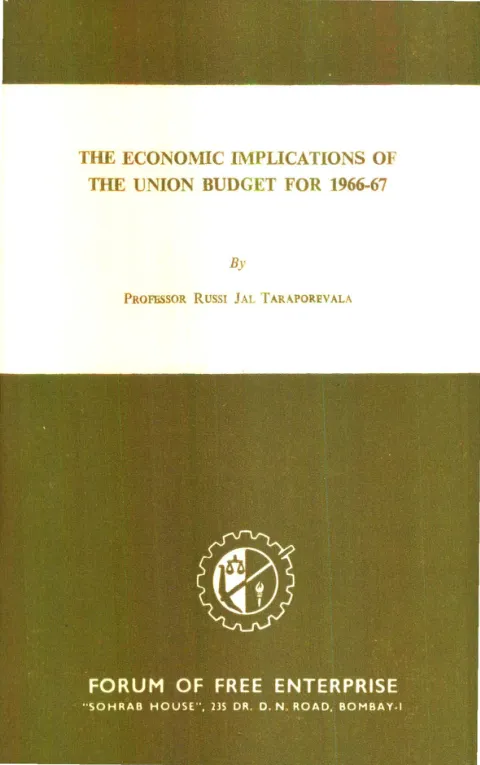
THE ECONOMIC IMPLICATIONS OF THE UNION BUDGET FOR 1966-67
By Professor Russi Jal Taraporevala
Summary
This Forum of Free Enterprise pamphlet reprints Professor Russi Jal Taraporevala’s review of the Union Budget for 1966-67, framed as a verdict on the Third Five-Year Plan as it drew to a close. Taraporevala opens by cataloguing the Third Plan’s failures: national income grew at roughly 3 per cent per year against a 6 per cent target, agricultural output crawled at 2.6 per cent compared to 4 per cent in the preceding decade, industrial growth slumped from 11 per cent to 7.5 per cent and prices rose unabated as money supply expanded at 9-14 per cent a year. He documents a capital market in ruins — equity prices falling 6.9 per cent annually, new-issue discounts of 50-60 per cent, foreign exchange reserves down by Rs. 70 crores, and devaluation rumours that the Government was forced to deny.
Against this backdrop he argues that the Finance Minister has compounded rather than corrected the crisis. While the Budget Speech rhetorically embraces price stability, export promotion and broader equity participation, the operative proposals levy an additional Rs. 101 crores in central taxes plus Rs. 45 crores by the States. Taraporevala contends that a modest 2-4 per cent cut in government expenditure, or even leaving the deficit untouched while reducing some taxes, would have spurred growth and converted the projected Rs. 117 crore deficit into a near-surplus by widening the yield base.
The heart of the critique is the shift in the mix of taxation. For the first time in many years, over 58 per cent of new taxation is being raised through direct taxes — Rs. 59 crores on individuals and corporations — reversing the long-standing official position that the limits of direct taxation had been reached. Combined with higher excise duties on sugar, cigarettes, light diesel oil, cloth and synthetics, and an increase in the Central Sales Tax ceiling from 2 to 3 per cent, Taraporevala argues the budget will simultaneously stoke inflation for the common man and squeeze the private savings on which the capital market depends.
The rendered pages also walk through the budget’s treatment of personal taxation, the Annuity Deposit Scheme (which the author argues should be abolished outright rather than tinkered with), the welcome abolition of the Expenditure Tax — a Kaldor-inspired levy that Taraporevala had long criticised — and partial reforms to gift tax and estate duty. Throughout, the polemical thrust is that the budget is in “direct opposition to the avowed goal of the budget of maintaining price stability and curbing inflation” and that India’s growth requires reversing, not extending, the regime of confiscatory direct taxation and unproductive public expenditure.
Key points
-
Third Plan targets were systematically missed: national income grew at ~3% against a 6% target; agriculture at 2.6% annually; industrial growth slumped from 11% to 7.5% per year.
-
Money supply rose 9-14% annually, chasing inadequate goods; the Reserve Bank’s tight money policy hurt industry without arresting price rises (~8% annual inflation).
-
The capital market collapsed: equity prices fell 6.9% per year (15.8% in the last calendar year), new issues sold at 50-60% discounts, and underwriters became effective ‘undertakers’.
-
Foreign exchange reserves declined by Rs. 70 crores over the first four Plan years; devaluation rumours circulated before the Government denied them.
-
The 1966-67 Budget proposes Rs. 101 crores in fresh central taxes plus Rs. 45 crores at the State level — Taraporevala argues a 2-4% expenditure cut would have spurred growth and largely eliminated the projected Rs. 117 crore deficit.
-
Over 58% of new taxation is direct (Rs. 59 crores), reversing earlier Finance Ministers’ position that the limits of direct taxation had been reached.
-
Excise duties on sugar, cigarettes, light diesel oil, cotton cloth, rayon, synthetics and the Central Sales Tax hike from 2% to 3% will be inflationary and contradict the budget’s own stated goal of price stability.
-
Taraporevala welcomes the abolition of the Expenditure Tax (which he had long opposed as a Kaldor-inspired error) but argues the Annuity Deposit Scheme should also be abolished outright, since it diverts ~Rs. 35 crores per year of private savings from productive investment.
Generated by the v1.5 extraction pipeline. Awaiting editorial review.
Metadata and summary are AI-extracted from the source PDF and reviewed for editorial accuracy. The original work is available via the Read PDF tab above (where present); paragraph-level citation inside the PDF is deferred to a future engagement.