non liberal
T. T. Krishnamachari
Also known as: TTK, टी. टी. कृष्णमाचारी, कृष्णमाचारी
How T. T. Krishnamachari is discussed in this archive
Referenced in 21 other works , including Minoo Shroff on His Uncle A D Shroff , MUTUAL FUNDS AND OFFSHORE FUNDS IN INDIA , and Discrimination Between the Two Sectors .
In Minoo Shroff on His Uncle A D Shroff : The transcript's 'Krishnamurti' rebuking Shroff over 'free enterprise' as 'exploitation' matches the well-known T.
In MUTUAL FUNDS AND OFFSHORE FUNDS IN INDIA : Dave traces UTI's institutional lineage to T.
In समस्याएँ भारत की : T.
In Discrimination Between the Two Sectors : Master pairs T.
In Is Socialism Outdated? : Palkhivala marshals Krishnamachari's 5 June 1964 reversal — following Nehru's May 1964 reassurance against bank nationalisation — as evidence of Cabinet drift on the question and a sign that 'the Cabinet alone should speak as a body'.
Mentioned in (54)
Primary works (46)
- Minoo Shroff on His Uncle A D Shroff · 2015
- "when he was rebuked by Krishnamurti that this is all no freedom, all enterprise, what he meant was exploitation" · Public clash over free enterprise
- "Who are the chaps who got in through the STC? Who are the chaps who got the licenses for coal mining? Who are the licenses who got for aircraft?" · Shroff's retort about who actually benefited from the licensing regime
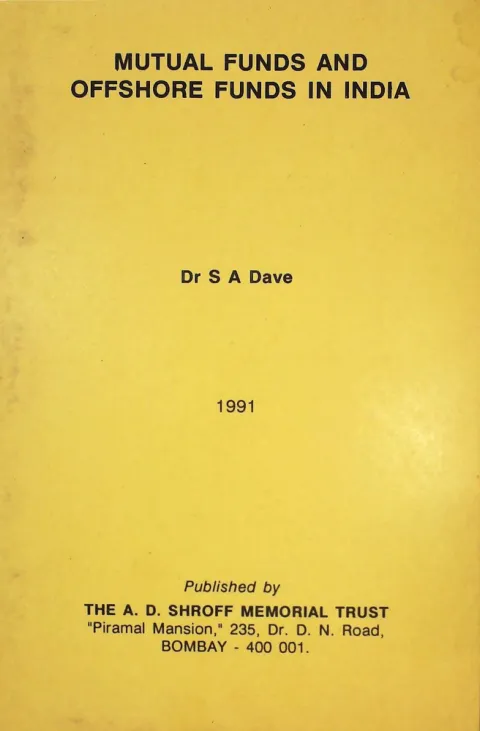
- MUTUAL FUNDS AND OFFSHORE FUNDS IN INDIA · 1991
- "He traces UTI from Shri T. T. Krishnamachari's 1963 pitch to Pandit Jawaharlal Nehru" · Krishnamachari credited as the political originator of UTI
- "UTI's lineage is traced from T. T. Krishnamachari's letter to Nehru to Krishnamachari's later piloting of the UTI Bill" · extends Krishnamachari's role from idea to legislation
- समस्याएँ भारत की · 1988
- "the Agricultural Price Commission (established partly on the recommendations of a 1965 committee chaired by T.T. Krishnamachari) is structurally incapable of ensuring remunerative prices" · Essay 3 names Krishnamachari's 1965 committee as the institutional ancestor of the price-suppression mechanism Joshi treats as the engine of rural distress

Show all 46
- Discrimination Between the Two Sectors · 1966
- "Finance Ministers Morarji R. Desai (1962-63) and T. T. Krishnamachari (1964-65) to show that even the Government now concedes that public-sector units must earn 'adequate' profits and build reserves for future expansion" · Krishnamachari's statement is used alongside Desai's to establish cross-ministerial admission of the principle that public enterprises must be financially accountable
- "Uses speeches of Finance Ministers Morarji R. Desai and T. T. Krishnamachari to show the Government concedes the Public Sector must earn 'adequate returns'" · Krishnamachari is one of two Finance Ministers whose own words are deployed against the discriminatory treatment of the private sector
- Is Socialism Outdated? · 1966
- "Records Nehru's 22 May 1964 reassurance against bank nationalisation and T. T. Krishnamachari's 5 June 1964 reversal as evidence of Cabinet drift." · key-points restatement of the Krishnamachari reversal as Palkhivala's chief evidence of policy incoherence
- "citing Nehru's May 1964 reassurance and T. T. Krishnamachari's June 1964 reversal as evidence that 'the Cabinet alone should speak as a body'" · Krishnamachari's reversal anchors Palkhivala's complaint about cabinet drift on bank nationalisation
- An Analysis of Union Budget 1965-66 · 1965
- "He opens by praising Finance Minister T. T. Krishnamachari for being unusually transparent — for the first time the budget papers, especially the Economic Survey, allow the tax-payer to see the country's true position" · opening of Shroff's analysis; TTK is the budget's author and Shroff's immediate interlocutor throughout the pamphlet
- FOREIGN EXCHANGE CRISIS — THE WAY OUT · 1963
- "He attributes the wreckage to the import spree of 1955–56 ordered under Commerce Minister T. T. Krishnamachari's anti-inflation theory that imports would mop up Plan-induced purchasing power." · Krishnamachari named as the minister responsible for the policy that triggered the foreign exchange collapse
- Economic Growth Requires Reform of Tax Structure · 1962
- "Singles out the expenditure tax — introduced on Nicholas Kaldor's advice by then Finance Minister T. T. Krishnamachari — as a clear failure: trivial revenue (Rs. 1 crore actual against Rs. 9 crores originally estimated for its first year), and disproportionately costly to administer." · Krishnamachari named as responsible minister for the expenditure tax regime
- An Inflationary Budget · 1959
- "The new wealth tax (introduced earlier by T. T. Krishnamachari), the expenditure tax, the gift tax and the capital-gains tax are dismissed as variously unworkable, perverse or counter-productive" · taxation section; TTK is identified as the author of the wealth tax that Shroff considers one of the budget's most damaging features
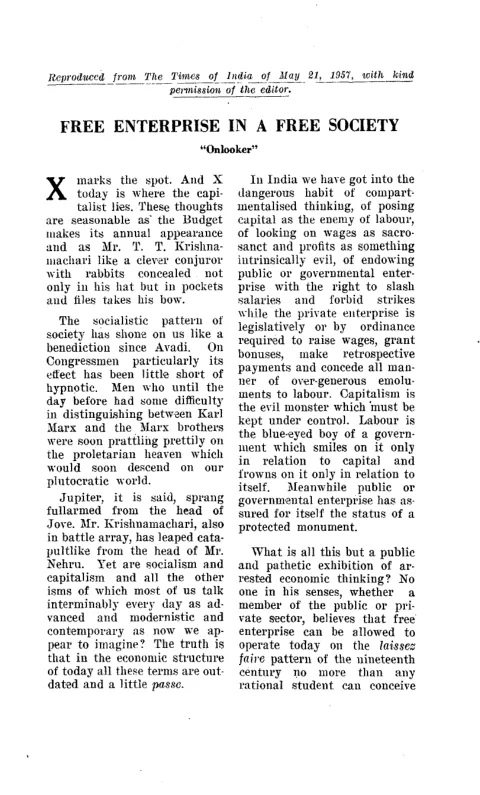
- FREE ENTERPRISE IN A FREE SOCIETY · 1957
- "Prompted by Finance Minister T. T. Krishnamachari's budget and the broader 'socialistic pattern of society' line emanating from Nehru's government" · TTK's budget named as the proximate cause of the essay, in the opening framing of the polemic
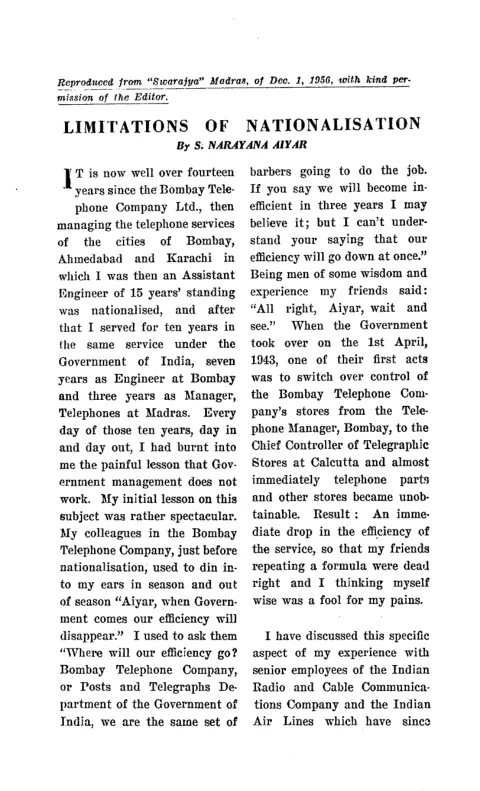
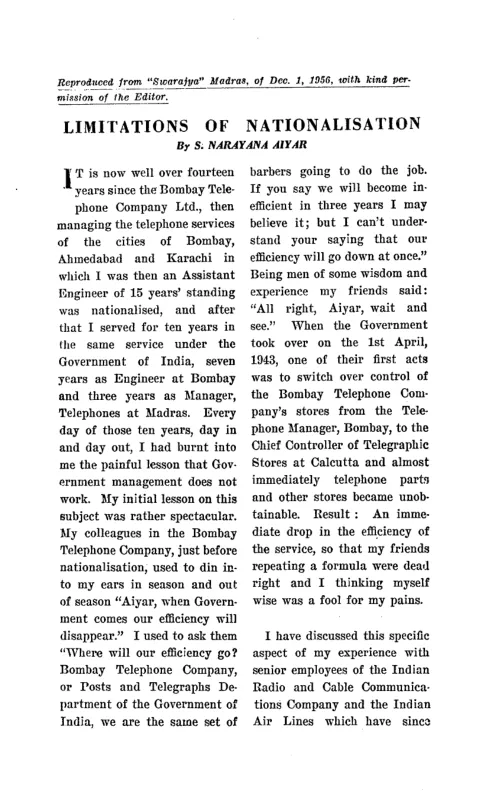
- LIMITATIONS OF NATIONALISATION · 1956
- "the report of Mr. Scaife, a tool-man invited from England under the Colombo Plan by Sri T. T. Krishnamachari to examine the Prototype Machine Tool Factory at Ambernath and the Hindustan Machine Tool Factory at Jalahalli" · Krishnamachari is named as the minister whose own consultant exposed the cost penalty of state ownership
- NEW TAXATION PROPOSALS · 1956
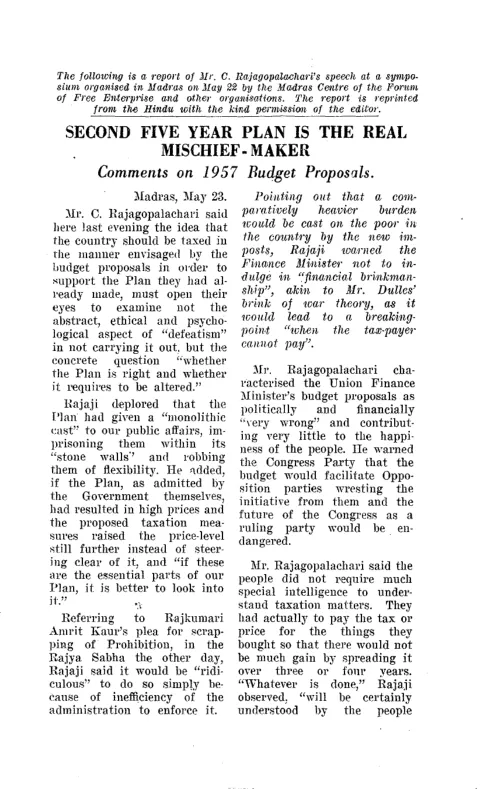
- "A. D. Shroff dissects Finance Minister T. T. Krishnamachari's mid-year tax proposals of 30 November 1956" · Krishnamachari named as the finance minister whose tax package the pamphlet attacks
- "reacting to Finance Minister T. T. Krishnamachari's mid-year tax package" · key-point restatement of Krishnamachari's role as the proximate target
- FINANCE AND INDUSTRY IN INDIA · n.d.
- "Shroff describes Indian planning as 'Planless Planning' and singles out T. T. Krishnamachari's 1957 budget as the shock that cut new capital issues from Rs. 117 crores to Rs. 98 crores and rattled investor confidence for the next year." · Krishnamachari's budget identified as the proximate cause of capital-market damage
- The Forum of Free Enterprise · n.d.
- "Shroff's response to T. T. Krishnamachari's post-Union-Budget claim of a 'capitalist strike'" · the inciting event that prompted Shroff to call a press conference
- LIMITATIONS OF NATIONALISATION · n.d.
- "He cites an episode in which T. T. Krishnamachari invited an English expert, Mr. Scaife, under the Colombo Plan to examine the Prototype Machine Tool Factory at Ambernath and the Hindustan Machine Tool Factory then under construction at Jalahalli" · Krishnamachari's own initiative is turned into a damning case against state-run industry
- MONOPOLY CAPITALISM? · n.d.
- "Prefaced by a brief statement of openness from Finance Minister T. T. Krishnamachari, the article defines monopoly narrowly" · opening editorial framing; Krishnamachari's preface lends ministerial cover to the FFE rebuttal
- "framed by an opening note from Finance Minister T. T. Krishnamachari welcoming constructive criticism" · key-points restatement; Krishnamachari named as the official voice opening the pamphlet

Opinion pieces (1)
- The Aborted Promise of Economic Liberalisation in Mid-1960s
- "the key members of the Shastri cabinet (T T Krishnamachari, C Subramaniam, Asoka Mehta) were devoid of an ideological commitment to socialism, sans the labor minister D Sanjivayya." · lists TTK among the market-oriented ministers who enabled Shastri's liberalisation push
Excerpts (4)
- Has Private Enterprise Failed?
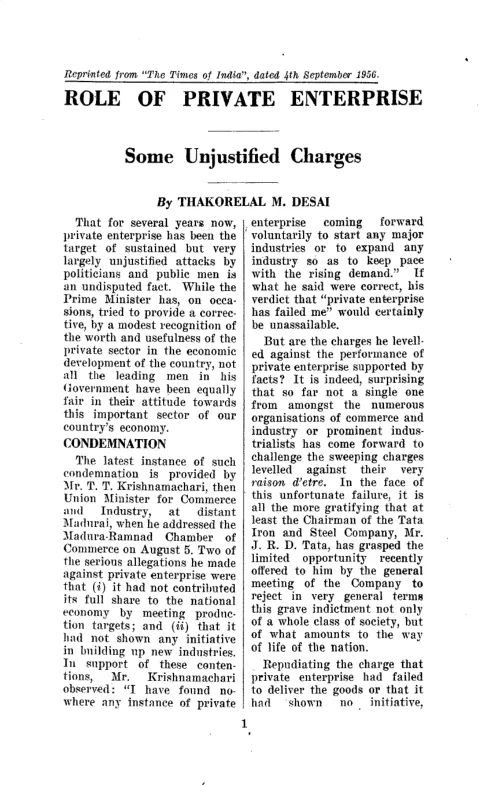
- "Mr. T. T. Krishnamachari, who was then the Union Minister for Commerce and Industry, at Madurai on 4th of August. In the course of his speech, he observed that "Private Enterprise has failed me"" · TTK's ministerial indictment of private enterprise is the specific charge Shroff's address sets out to rebut
- Is Socialism Outdated?
- "Mr. T. T. Krishnamachari announced that "nationalisation should be the last step in any effort to control banks."" · TTK's assurance against premature nationalisation is one of several ministerial statements Palkhivala marshals to show policy incoherence
- N. A. Palkhivala's Views on Socialism
- "Mr. T. T. Krishnamachari announced that "nationalisation should be the last step in any effort to control banks."" · Krishnamachari's statement cited as an inconsistent public assurance on bank nationalisation
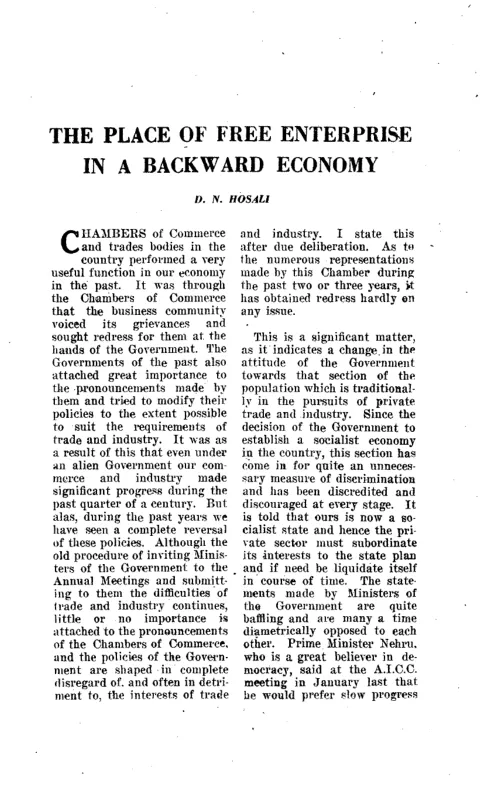
- The Place of Free Enterprise in a Backward Economy
- "Shri T. T. Krishnamachari, the Finance Minister, has declared that the Second Plan would demand sacrifice and regimentation of our economy" · Krishnamachari's statement used as evidence of the government's explicitly regimented economic programme