pamphlet
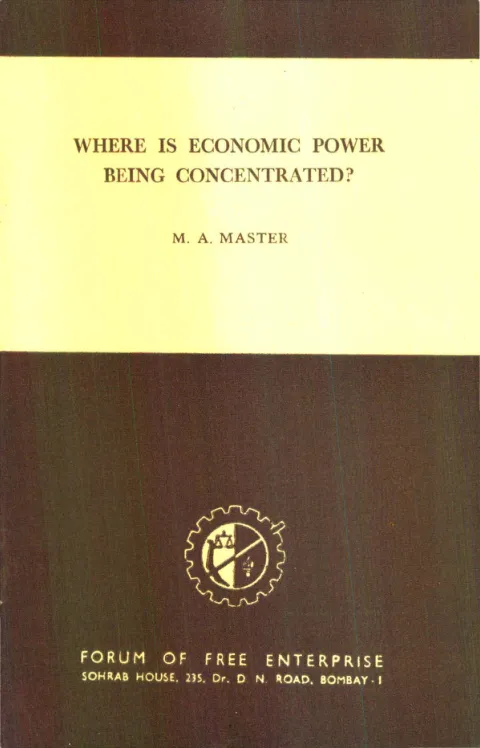
WHERE IS ECONOMIC POWER BEING CONCENTRATED?
By M.A. Master
FORUM OF FREE ENTERPRISE, SOHRAB HOUSE, 235, Dr. D. N. ROAD, BOMBAY-1 · Bombay · 1958
24 pages
WHERE IS ECONOMIC POWER BEING CONCENTRATED?
By M. A. MASTER
Summary
M. A. Master’s 1958 Forum of Free Enterprise pamphlet inverts the standard Nehruvian charge that free enterprise concentrates economic power in a few hands. Surveying the post-Independence regulatory landscape — the Industrial Development and Regulation Act, the Capital Issues Controller, exchange and licensing controls, taxation policy, the Planning Commission and the Estimates Committee’s findings — Master argues that the locus of economic power has migrated decisively from the private sector to the State, and that the constantly repeated allegation against private enterprise is empirically false.
Master builds the case sector by sector. He notes the wide shareholder bases of Tata Steel, Scindia, the Central Bank and A.C.C. to show that joint-stock ownership is already dispersed; he points to government control over finance (taxation, small savings, impounding of bank deposits, LIC investments) to show that the private sector now drinks from a pool the State has already drained; and he documents how coal, oil, electricity, railways, air services, shipping, the highway between Kandla and Ahmedabad, and the work of the State Trading Corporation have all been pulled into State monopoly or near-monopoly. He cites Estimates Committee findings that 63% of taxation raised “specifically for financing the Plan projects” was spent on non-Plan expenditure, that the STC has earned unwarranted profits on cement under the Cement Control Order, and that its monopoly over iron-ore exports has displaced private exporters.
The polemical edge is sharpened by Master’s reading of the Prime Minister’s speeches. Nehru welcomed the spirit of enterprise in individuals while charging that “free enterprise means creation of monopoly”; Master treats this as an unwarranted libel against Tata, Walchand, Birla and other industrialists who built India’s textile, jute, shipping, steel and aviation industries against heavy odds. He insists that competition among private firms, not State licensing, is the true guarantee against monopoly, and that the “Socialist Pattern of Society” is what is in fact concentrating economic power — at the cost of the legitimate activities of the people of the country.
Across the rendered pages (1–18 of printed text, of a 24-page pamphlet) Master combines administrative detail with a direct address to a Bombay business audience. His tone is grieved rather than oppositional: he repeatedly calls the situation a “tragedy of our public life” and warns that an executive empowered to amass economic power without recourse to Parliament will not stop doing so on its own.
Key points
-
Frames the pamphlet as a direct rebuttal to the Nehruvian charge that private enterprise concentrates economic power, asking which sector — private or public — has in fact acquired such power since Independence.
-
Argues that the Industrial Development and Regulation Act, Capital Issues control, licensing, price-fixing and managing-agent appointments make it structurally impossible for private firms to build monopolies under the planned economy.
-
Uses shareholder breakdowns of Tata Steel, Scindia, A.C.C. and the Central Bank to show joint-stock ownership is already widely dispersed among small investors.
-
Documents State capture of finance: taxation, the small-savings campaign, impounding of 50% of new bank deposits, and the redirection of LIC funds toward State purposes.
-
Cites the Estimates Committee finding that nearly 63% of taxation raised specifically for Plan projects was spent on non-Plan expenditure — calling this the greatest misuse of economic power.
-
Traces State monopoly across motive power (coal, oil, electricity, atomic energy), transport (railways, air, shipping, the Kandla-Ahmedabad highway) and trade (State Trading Corporation’s expanding remit over 31 commodities, iron-ore exports, cement distribution).
-
Highlights the STC’s unjustified profits under the Cement Control Order, 1956, and the Estimates Committee’s recommendation that the price be reviewed on the basis of actuals.
-
Concludes that the “Socialist Pattern of Society” is the mechanism by which economic power is being concentrated in the hands of the State, and warns that this concentration threatens the future development of private enterprise in India.
Generated by the v1.5 extraction pipeline. Awaiting editorial review.
Metadata and summary are AI-extracted from the source PDF and reviewed for editorial accuracy. The original work is available via the Read PDF tab above (where present); paragraph-level citation inside the PDF is deferred to a future engagement.