speech
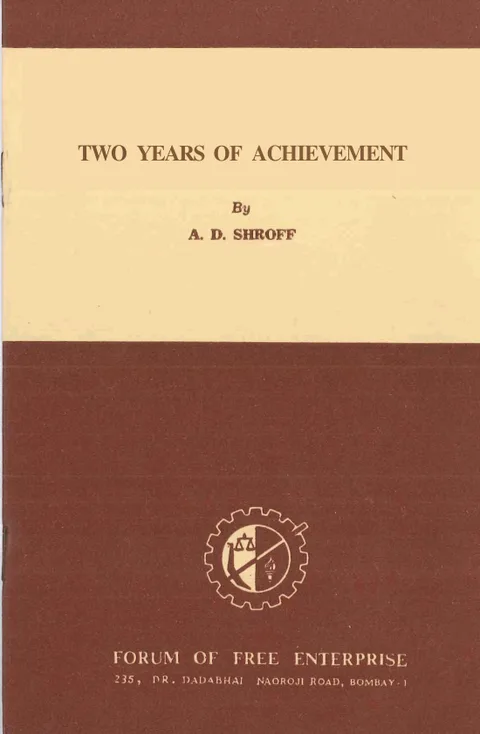
TWO YEARS OF ACHIEVEMENT
By A. D. Shroff
FORUM OF FREE ENTERPRISE, 235, DR. DADABHAI NAOROJI ROAD, BOMBAY-1 · Bombay · 1958
7 pages
TWO YEARS OF ACHIEVEMENT
By A. D. Shroff
Summary
A. D. Shroff’s presidential address at the second general body meeting of the Forum of Free Enterprise, delivered in Bombay on 16 July 1958, is an audit of the Forum’s first two years and a polemic against the economic management of Jawaharlal Nehru’s government. Shroff opens by claiming that consistent public-education work has begun to puncture the policy fog in New Delhi — most concretely, that the Forum’s campaign against the “obnoxious” compulsory deposits introduced in the 30 November 1956 budget has yielded a temporary suspension that, he predicts, will soon become permanent removal from the statute book.
From there the address widens into a sustained critique of the Second Five-Year Plan. Shroff argues that the warnings the Forum issued eighteen months earlier about the foreign-exchange and resource positions — for which it was dismissed as a “panic-monger” — have been vindicated by Finance Ministry behaviour over the preceding three or four months. He goes further: the over-ambitious nature of the Plan has, in his view, brought India “to the verge of international insolvency,” and the record of the two ex-Finance Ministers responsible — C. D. Deshmukh and T. T. Krishnamachari — makes a strong case for impeachment, an instrument he treats as legitimate but rare under parliamentary government.
Shroff then turns to the so-called “integrated pattern of taxation,” reporting on a Finance Ministry note he encountered on returning from Europe in June 1958. He contends the scheme will not, as advertised, leave capital formation and industrial enterprise untouched but will instead disintegrate the very forces that produce saving and investment. He accuses the Ministry of publishing misleading capital-issue figures — exaggerated application totals — and calls for scrutiny of how much money actually came in through new issues and how many of the floated companies ever entered production.
The address closes on a more institutional note. Drawing on the Forum’s Manifesto, Shroff diagnoses the “controlled economy” as having bred fear in the general public and especially in business, who could not speak freely lest they jeopardise licences and government dealings. He treats the recent formation of a “Socialist Forum” inside one wing of the Congress Party as oblique tribute — proof that an appetite for open economic debate is spreading even among the ruling party — and reassures supporters that the Forum, predicted at its founding to fall to “infant mortality,” has survived its first two years and intends to last many more.
Key points
-
Shroff frames the Forum’s two-year record as a public-opinion campaign that is starting to influence policy in New Delhi, citing the temporary suspension of compulsory deposits from the November 1956 budget as concrete proof.
-
He claims the Forum’s earlier warnings about the foreign-exchange situation and the over-ambitious Second Five-Year Plan have been vindicated, and that India has been pushed ‘to the verge of international insolvency.’
-
Argues that a ‘strong case’ exists for impeaching ex-Finance Ministers C. D. Deshmukh and T. T. Krishnamachari for the ‘parlous condition’ in which they left the country.
-
Attacks the proposed ‘integrated pattern of taxation’ as a measure that will disintegrate the healthy forces of capital formation and savings, despite Finance Ministry claims to the contrary.
-
Accuses the Finance Ministry of publishing exaggerated capital-issue application figures and calls for scrutiny of actual subscribed capital and how many promoted companies enter production.
-
Diagnoses the ‘controlled economy’ as having bred fear among the public and the business community, who refrain from speaking out because they depend on government licences.
-
Reads the emergence of a ‘Socialist Forum’ inside one wing of the Congress Party as a backhanded vindication of the Forum’s role in opening up economic debate.
-
Defends the Forum’s institutional survival past predictions of ‘infant mortality’ and reaffirms its educational mission for the years ahead.
Generated by the v1.5 extraction pipeline. Awaiting editorial review.
Metadata and summary are AI-extracted from the source PDF and reviewed for editorial accuracy. The original work is available via the Read PDF tab above (where present); paragraph-level citation inside the PDF is deferred to a future engagement.