
speech
THE CASE FOR SPONSORED RADIO
FORUM OF FREE ENTERPRISE · Bombay · 1957
7 pages
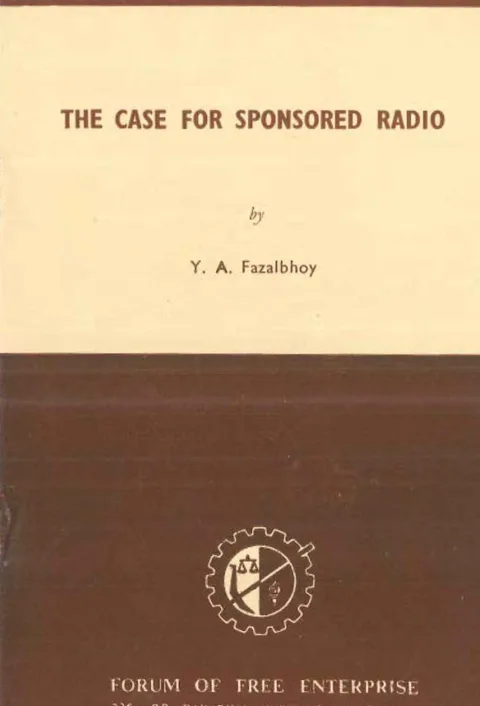
THE CASE FOR SPONSORED RADIO
By Y. A. Fazalbhoy
Summary
Y. A. Fazalbhoy’s 1957 pamphlet, drawn from an address to the Santa Cruz Rotary Club in Bombay, makes the case for permitting privately owned, advertiser-funded “Sponsored Radio” to operate in India alongside the state-run All-India Radio. Writing against the recent verdict of Dr. Keskar, the Minister for Information & Broadcasting, that commercial broadcasting would lower programme quality and let foreign industrial interests dominate the airwaves, Fazalbhoy is careful to clarify his proposal: he does not ask that AIR adopt commercial broadcasting or that its network be handed over to private enterprise, only that sponsored stations be allowed to supplement it.
The argument is structured as a pragmatic answer to each of the government’s objections. Fazalbhoy treats broadcasting as a far-reaching publicity medium that can extend market reach to villages, stimulate Indian industry, and supplement AIR’s own programming, much as advertising-funded newspapers supplement the state. He invokes the cinema as a parallel: a free, taxed, culturally vigorous enterprise that has not corrupted national taste. He dismisses the assumption that only the state can defend cultural standards, points to AIR’s twenty-five-year struggle to install 50 transmitters and 10 million licences as evidence that public finance alone cannot deliver coverage, and offers Canada’s dual system — CBC plus 157 private stations under the Canadian Association of Broadcasters — as a working model.
The closing pages quantify the prize. The United States, he notes, now hosts a billion-dollar radio and electronics industry expected to double by 1960, with over 3,000 commercial stations and $464 million spent annually on broadcast advertising; sponsored radio in India could likewise expand employment for engineers, operators, writers, actors and musicians, and accelerate the Five-Year Plan target on broadcasting ahead of schedule. The pamphlet is framed on its inside cover by an epigraph from Finance Minister T. T. Krishnamachari pledging openness to correction, and closes with a Jawaharlal Nehru epigraph on producing material goods without sacrificing the spirit — a tacit reply to the cultural-standards objection.
Key points
-
Argues that Sponsored Radio should be allowed to operate as a private enterprise supplement to All-India Radio, not as a replacement for it.
-
Directly contests Dr. Keskar’s official ruling that commercial broadcasting would lower programme quality and let foreign industrial interests dominate the airwaves.
-
Treats broadcasting as a far-reaching publicity medium that can extend advertising reach into villages, stimulate Indian industry, and complement (not corrupt) AIR.
-
Uses the Indian cinema — a taxed, profitable, privately run cultural enterprise — as the analogical proof that private operation need not lower cultural standards.
-
Argues AIR’s reliance on licence revenue is the binding constraint: in 25 years it has reached only 50 transmitters and 10 million listeners, and a sponsored sector would relieve that finance bottleneck.
-
Cites Canada’s dual system — the Canadian Broadcasting Corporation plus 157 privately owned stations organised under the Canadian Association of Broadcasters — as a successfully working model.
-
Quantifies the U.S. example: a 1,000 million dollar industry expected to grow to 2,000 million by 1960, with over 3,000 commercial stations and $464 million spent annually on broadcast advertising.
-
Concludes that broadcasting deserves higher priority in the Five-Year Plan and that private enterprise could complete the plan target ahead of schedule, while creating new employment for engineers, operators, writers, actors and musicians.
Generated by the v1.5 extraction pipeline. Awaiting editorial review.
Metadata and summary are AI-extracted from the source PDF and reviewed for editorial accuracy. The original work is available via the Read PDF tab above (where present); paragraph-level citation inside the PDF is deferred to a future engagement.
People in this work
Related across the archive
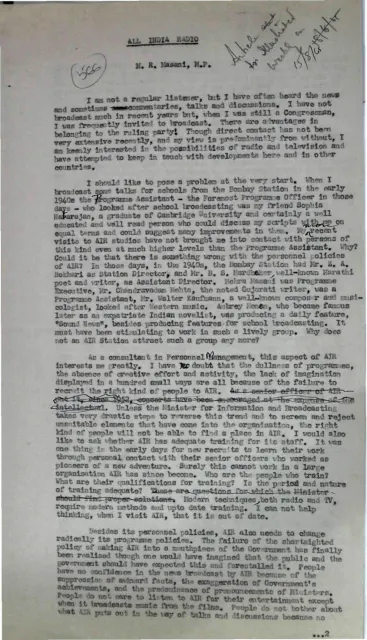 Primary workAll India Radio by Mr Minoo Masani
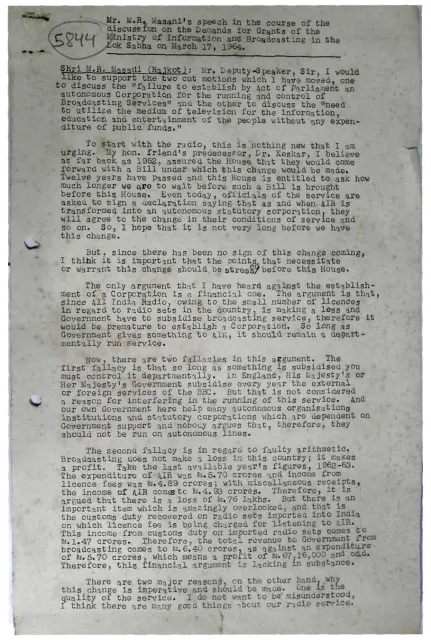 Primary workMr. M.R. Masani's speech in the course of the discussion on the Demands for Grants of the Ministry of Information and Broadcasting in the Lok Sabha on March 17, 1964.
 ExcerptLaying The Foundations For An Economic Miracle
 ExcerptTHE APPLICATION OF SCIENCE AND TECHNOLOGY TO SOCIO-ECONOMIC DEVELOPMENT