periodical issue
Freedom First
By Raman Desai, A. G. Mulgaonkar, Raman Desai, Dahyabhai V. Patel, V. B. Karnik
Edited by RAMAN DESAI and printed at Inland Printers, 55 Gamdevi Road, Bombay 7 and published for the Democratic Research Service by Raman Desai at 127 Mahatma Gandhi Road, Bombay 1. · Bombay · 1964
12 pages
Freedom First
Summary
Freedom First No. 147 (August 1964) is a slim 12-page issue of the Bombay-based liberal fortnightly, opening with Raman Desai’s alarmed survey of the Indo-China war spilling into Laos and South Vietnam and his call for India to abandon panchsheel neutrality and align openly with the U.S.-backed side. A. G. Mulgaonkar follows with a piece on the Das Commission’s findings against Punjab Chief Minister Pratap Singh Kairon, using it to argue for a constitutional mechanism — compulsory asset declaration and inquiry commissions answerable to the President or Governors — to root out ministerial corruption. The issue then reprints an interview with newly nominated U.S. Republican presidential candidate Senator Barry Goldwater from Der Spiegel, covering his views on Communism, NATO, nuclear weapons, civil rights, and foreign aid. Raman Desai returns with a shorter, sharply sarcastic column on Indian officials’ foreign travel amid tight foreign-exchange controls, and Dahyabhai V. Patel reports on a June 1964 delegation visit to South Vietnam and Taiwan, praising Taiwan’s land-reform-driven agricultural progress and appealing for India to recognise the Taiwan government. The issue closes with a book review of A. J. Fonseca’s ‘Wage Determination and Organised Labour in India,’ a short reprinted item on the deposed Brazilian president Joao Goulart’s corruption, and the regular ‘With Many Voices’ page of quotations from the period’s press.
Key points
-
Raman Desai’s “South Vietnam and Ourselves” argues Communist China has spent years fomenting civil wars around South East Asia’s seaboard, calls for India to abandon panchsheel neutrality, and urges Indian foreign policy to align openly with the U.S., Cambodia, Laos, Vietnam and Malaysia against China.
-
A. G. Mulgaonkar’s “After The Das Report” treats the Das Commission’s findings against Punjab Chief Minister Pratap Singh Kairon as a turning point, proposing mandatory asset declarations for all political officeholders and referral of corruption findings to the President or Governors and statutory Commissions of Inquiry.
-
“Goldwater On Goldwater” reprints excerpts of Senator Barry Goldwater’s Der Spiegel interview after his Republican nomination, in which he frames the Cold War as a struggle between “godless people and the people of God,” claims Communists have broken 51 of 52 postwar agreements, and states the U.S. is already fighting “World War III… in Southeast Asia.”
-
Raman Desai’s sarcastic “Is Your Travel Necessary?” contrasts foreign-exchange privations on ordinary citizens with hospitality-funded foreign trips taken by officials like Bombay Chief Minister Naik, and calls for Indians to be allowed to retain pre-independence foreign-currency balances held abroad.
-
Dahyabhai V. Patel’s “A Visit To Free China (June 1964)” reports on a delegation tour of South Vietnam and Taiwan, crediting Taiwan’s land-reform programme with a claimed 369% rise in agricultural production since 1946 and urging Indian recognition of the Taiwan government.
-
V. B. Karnik reviews A. J. Fonseca’s “Wage Determination and Organised Labour in India,” crediting it with showing trade unions influence wage levels but exert no control over prices or employment, while noting Fonseca’s inattention to wage-setting shifting from collective bargaining to tribunals.
-
The closing “With Many Voices” column includes Barry Goldwater’s acceptance-speech line that “moderation in the pursuit of justice is no virtue” and William F. Buckley Jr.’s remark that under federal encroachment “States today are merely eunuchs.”
Essays
South Vietnam and Ourselves
By Raman Desai
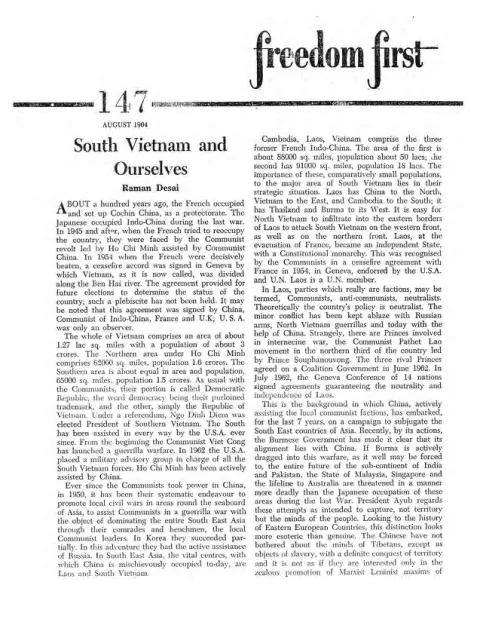
Raman Desai lays out the historical background of the partition of Vietnam at the 1954 Geneva accords and argues that Communist China has spent the years since systematically fomenting civil wars around the South East Asian seaboard, with Laos and South Vietnam its current targets. He contends that any U.S. withdrawal from South Vietnam would hand China the region’s rice, coal, tin, and rubber, and argues that a further, Korea-scale U.S. military commitment is preferable to a negotiated settlement, which he dismisses as merely a breathing space for Communist regrouping. He closes by urging that Indian foreign policy abandon its “hypnotic trance” of panchsheel and side openly with the U.S., Cambodia, Laos, Vietnam and Malaysia against China, invoking the analogy of Munich-style appeasement.
- Traces Vietnam’s partition to the 1954 Geneva ceasefire, which divided the country along the Ben Hai river pending elections that were never held.
- Frames Chinese support for Communist insurgencies in Laos and South Vietnam as a seven-year campaign to dominate South East Asia.
- Warns that a U.S. withdrawal would surrender the region’s rice, coal, tin, rubber, and cotton/oil-seed supplies to China.
- Argues a UN army for South East Asia is impractical because communist members of the Security Council would veto it.
- Criticises India’s ‘panchsheel’ policy toward China as naive goodwill that has yielded nothing in return.
- Calls for Indian foreign policy to actively support the U.S., Cambodia, Laos, Vietnam and Malaysia against Chinese-backed communism, likening the moment to pre-war appeasement of Hitler.
After The Das Report
By A. G. Mulgaonkar
A. G. Mulgaonkar treats the Das Commission’s report on Punjab Chief Minister Pratap Singh Kairon as a turning point against ministerial corruption in India, opening with Robert Clive’s brazen defence against corruption charges in Parliament and England’s own historical reckoning with ministerial graft (the South Sea Bubble, John Aislabie’s expulsion). He argues that colleagues should never be trusted to investigate a fellow minister — contrasting the Kairon case, in which repeated complaints to Nehru were waved off, with the British Profumo affair, where senior ministers were merely ‘willing to be hoodwinked.’ He proposes a six-point legislative scheme: mandatory asset declarations by anyone holding political office, elimination of informal complaint-vetting, prima facie findings entrusted to the President or Governors with a small secretariat, referral of prima facie cases to statutory commissions of inquiry, automatic penalties (including property confiscation, extendable posthumously) for non-declaration, and expansion of the Indian Penal Code’s offences against the state to cover ministerial and official corruption.
- Treats the Das Commission report on Kairon as marking a historic ‘turn of the tide’ against seventeen years of ministerial corruption in India.
- Argues a minister’s own party colleagues should never be entrusted with investigating charges against him, citing Kairon’s case where Nehru repeatedly accepted his private explanations.
- Contrasts this with Britain’s Profumo affair, where senior ministers and law officers examined Profumo yet were still misled.
- Details how Master Tara Singh and others petitioned the President directly in 1963, which led to the Das Commission being convened.
- Proposes compulsory asset declaration for all who have held political office, verifiable via income-tax returns and including foreign investments.
- Recommends prima facie corruption findings be entrusted to the President (nationally) and Governors (state-level), backed by a small secretariat, with cases referred to statutory Commissions of Inquiry and automatic property-forfeiture penalties for non-declaration.
Goldwater On Goldwater
This piece reprints, per an editor’s note, excerpts of Senator Barry Goldwater’s interview with the German magazine Der Spiegel shortly after his nomination as the Republican presidential candidate, presented so Indian readers can learn about the man and his positions. Goldwater discusses Eastern financial interests’ historic control over Republican candidate selection, rejects the ‘far right’ label while calling himself a constitutional radical, and frames the Cold War as an irreconcilable struggle between ‘godless people and the people of God’ rather than a matter for peaceful coexistence. He describes 51 of 52 postwar agreements with Communists as having been broken by the Communists, discusses tactical nuclear weapons and NATO reform, defends his vote against the civil-rights bill on constitutional grounds, opposes foreign aid outright, and states the U.S. is already engaged in ‘World War III… in Southeast Asia,’ begun when it failed to help France in Indo-China in the late 1950s.
- Reprinted via U.S. News & World Report from an unpublished Der Spiegel interview text, framed by Freedom First’s editor as background on the newly nominated Republican candidate.
- Goldwater denies being ‘far right,’ defining that label as fascism and insisting he is merely a constitutional radical with a small following.
- Frames the Cold War as a struggle between ‘godless people’ and ‘the people of God,’ between slavery and freedom, rather than a matter suited to negotiated coexistence.
- Claims the Communists have broken 50 or 51 of 52 formal postwar agreements with Western powers.
- Supports NATO’s supreme commander having latitude to use small tactical nuclear weapons without recourse to Washington.
- Opposes foreign aid ‘period,’ arguing Europe now stands on its own feet and the U.S. gets nothing in return.
- States he voted against the civil-rights bill purely on constitutional grounds, and claims the U.S. is already fighting ‘World War III… in Southeast Asia.‘
Is Your Travel Necessary?
By Raman Desai
In a sharply sarcastic column, Raman Desai contrasts the foreign-exchange privations imposed on ordinary Indian citizens with the ease with which well-connected officials — Mr. K. P. S. Menon, Mr. Naik (Chief Minister of Bombay) and his family — have obtained hospitality-funded trips abroad even as ordinary applicants are denied exchange to visit family. He argues Indian public administration should be studied through the lens of indigenous tradition (citing the idea of the son’s ritual duty to the father) rather than merely imported models, and separately argues that Indian citizens should be allowed to retain foreign-currency balances held abroad since before independence, drawing a parallel to how the U.S. and U.K. treated each other’s citizens’ balances during the World Wars.
- Criticises Mr. Naik, Chief Minister of Bombay, for accepting a hospitality-funded European tour from businessman Mr. Chowgule while ordinary citizens face onerous foreign-exchange restrictions.
- Notes that under current rules a father was denied exchange to visit his own daughter in the UK despite her providing the exchange herself.
- Argues Indian public administration should be studied through indigenous tradition, citing the idea that a son secures a father’s salvation after death.
- Calls for Indian nationals to be allowed to retain pre-independence foreign-currency balances abroad rather than being forced to convert them to rupees.
- Draws a comparison to the U.S. and U.K.’s wartime treatment of each other’s citizens’ overseas assets during the World Wars.
- Closes with pointed mockery of retired I.C.S. officers like Mr. K. P. S. Menon publishing travel diaries.
A Visit To Free China (June 1964)
By Dahyabhai V. Patel
Dahyabhai V. Patel recounts a June 1964 tour through South Vietnam, Hong Kong, and Taiwan as part of a non-official Indian opposition-party delegation. In Saigon he finds daily life calm despite ongoing conflict, and reports on Sindhi refugees who moved on from Bombay to Hong Kong. The bulk of the report praises Taiwan’s rapid postwar development: land-ceiling reform that converted cultivators into land-owners while compensating former landlords in bonds, a claimed 369% rise in agricultural production since 1946, universal compulsory education and a large expansion of colleges and schools, and profitable state-run railways, bus routes, fertiliser and sugar factories. The delegation met senior Taiwanese officials and was received by Chiang Kai-shek and Madam Chiang, and the piece closes urging that the Indian government recognise Taiwan given its 15 years of stable governance, while noting that South East Asian countries increasingly sympathise with Taiwan yet are troubled by India’s own conciliatory stance toward Communist China.
- Describes Saigon as outwardly calm and functioning despite an ongoing guerrilla war, with women active in daily commerce and travel.
- Notes Sindhi refugees from the Partition, having first settled in Bombay, are now emigrating onward to Hong Kong for its faster industrial growth.
- Credits Taiwan’s land-ceiling law — compensating both cultivators-turned-owners and displaced landlords via bonds — with driving a claimed 369% rise in 1963 agricultural production over a 1946 baseline of 100.
- Reports Taiwan’s education expansion: from 5 colleges/universities in 1944 to 35, and from 73 middle-schools to 481, with 98% literacy claimed.
- Describes state-run railways, fertiliser and sugar factories as profitable, having been purchased from private owners via bonds.
- Recounts a reception with Chiang Kai-shek and Madam Chiang, and closes by urging Indian recognition of Taiwan’s government.
Review: Wage Determination and Organised Labour in India (A. J. Fonseca, Oxford University Press)
By V. B. Karnik
The Review section carries V. B. Karnik’s assessment of A. J. Fonseca’s ‘Wage Determination and Organised Labour in India’ (Oxford University Press), which credits the book with showing that trade unions have become an established influence on wage levels but have failed to keep real wages rising in line with earnings, and have no control over prices or employment; Karnik also flags Fonseca’s inattention to the shift of wage-setting from collective bargaining toward courts, tribunals and wage boards. This is followed by an uncredited, Time-sourced item on the ousted Brazilian president Joao ‘Jango’ Goulart, detailing his redistribution of roughly 19 lac acres of land to himself while in office and his successor’s pointed public declaration of assets, alongside notes on Communist-aligned unions and state-oil-company funds bankrolling leftist student groups under Goulart.
- Karnik’s review credits Fonseca’s book with concluding that Indian trade unions can lever wages upward in prosperity and restrain declines in depression, but exert no control over prices or employment.
- Notes Fonseca’s finding that real wages have lagged behind money wages and earnings, only reaching pre-war levels in recent years.
- Flags as a gap that Fonseca does not address the shift of wage determination away from collective bargaining toward courts, tribunals, and wage boards.
- The Brazil item reports that ousted president Joao Goulart redistributed about 19 lac acres of land to himself and was about to acquire more when he fled.
- Notes Goulart’s successor Humberto Castello Branco publicly declared his modest personal assets to the Senate on assuming office, the first time a Brazilian president had done so.
- Describes Communist-aligned labour unions and the state oil monopoly Petrobras as having funded leftist student and other extremist groups under Goulart.
To Be Or Not To Be — Corrupt
The closing ‘With Many Voices’ page is a compilation of short quotations drawn from the contemporary press (Time, Swarajya, Organiser, New Age, Hindustan Times, Times of India) on Cold War politics, Indian federalism, and civil rights, framed by an epigraph from Tennyson. Quoted figures include Khrushchev, Mao Tse-tung, C. Rajagopalachari, Kamaraj, Salvador de Madariaga, William F. Buckley Jr., George Meany, and Barry Goldwater, touching on themes from world government and Kashmir to Cold War brinkmanship and race and states’ rights in America. The page closes with a subscription coupon for Freedom First and the issue’s imprint line naming Raman Desai as editor and publisher for the Democratic Research Service, Bombay.
- Compiles short press quotations under the Tennyson epigraph ‘Tis not too late to seek a newer world.’
- Includes C. Rajagopalachari on world government, Kashmir self-determination, and the limits of dissent as treason.
- Includes Barry Goldwater’s acceptance-speech line that ‘moderation in the pursuit of justice is no virtue’ alongside another quote on the necessity of confronting Communism.
- Includes William F. Buckley Jr. on states’ rights (‘federal harem… States today are merely eunuchs’) and on mob-deployment as a dangerous resort.
- Includes George Meany’s comparison of doing business with Stalin versus his ‘de-Stalinized successors.’
- Closes the issue with a subscription form and the standard imprint naming Raman Desai as editor/publisher, printed at Inland Printers, Bombay, for the Democratic Research Service.
Generated by the v1.5 extraction pipeline. Awaiting editorial review.
Metadata and summary are AI-extracted from the source PDF and reviewed for editorial accuracy. The original work is available via the Read PDF tab above (where present); paragraph-level citation inside the PDF is deferred to a future engagement.