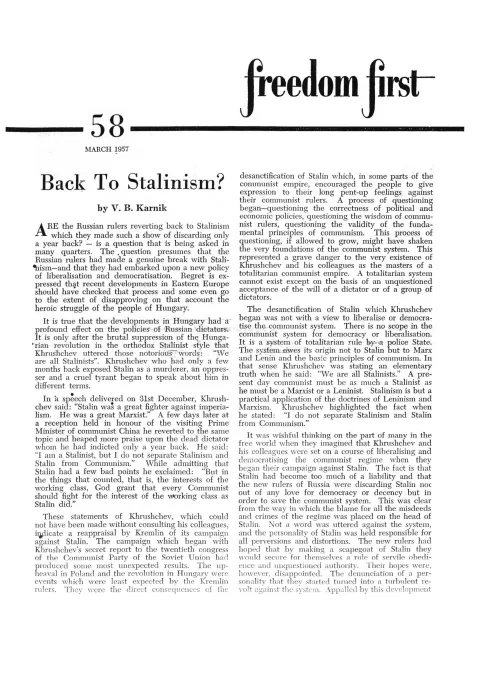
periodical issue
Freedom First
Edited, printed & published for the Democratic Research Service by V. B. Karnik at The Kanada Press, 109 Parsi Bazar Street, Bombay 1. · Bombay · 1956
12 pages
Freedom First
Summary
This is the complete 12-page issue of Freedom First, No. 51 (August 1956), published by the Democratic Research Service and edited by V. B. Karnik. The issue is dominated by the shockwaves of Khrushchev’s secret speech denouncing Stalin at the Twentieth Congress of the CPSU, read through a classical-liberal, anti-communist lens. V. B. Karnik’s lead essay, ‘The Indictment of Stalin,’ surveys global reactions to the revelations (Togliatti, Howard Fast, the Indian thinker ‘Adib’) and argues Khrushchev has confirmed decades of anti-communist charges while still concealing the full truth. K. K. Sinha’s ‘The Guilty Men and Their System’ goes further, arguing that Stalin’s crimes were not personal aberrations but the structural product of Leninist party dictatorship, and that Stalin’s associates share moral guilt for their two decades of silence. M. A. Venkata Rao’s ‘The Poznan Portent’ covers the June 1956 Poznan workers’ uprising in Poland as proof of the bankruptcy of Soviet-style planning and the suppression of Polish national feeling, followed by a page of solidarity statements from European intellectuals (Camus, Jaspers, Koestler, Silone, and others) and from prominent Indian public figures. The unsigned ‘Notes’ section comments on domestic Indian politics (Morarji Desai’s July 4th speech, C. D. Deshmukh’s resignation, U. N. Dhebar’s remarks on loyalty to Nehru, C. Rajagopalachari’s critique of a subservient press) and on publishing policy (a proposed National Book Trust). The issue closes with ‘With Many Voices,’ a column of topical quotations from Indian and international public figures, a subscription form, and an advertisement for the pamphlet edition of Khrushchev’s speech with a foreword by Karnik.
Key points
-
V. B. Karnik’s ‘The Indictment Of Stalin’ surveys global reaction to Khrushchev’s secret speech, arguing the condemnation is self-serving since it excuses earlier purges of Trotsky and Bukharin and offers no pledge of civil liberties or habeas corpus.
-
K. K. Sinha’s ‘The Guilty Men And Their System’ argues Stalin’s crimes were the structural product of Leninist party dictatorship, predicting reverence will simply transfer to a new ‘Great Pupil of Lenin.’
-
M. A. Venkata Rao’s ‘The Poznan Portent’ treats the June 1956 Polish workers’ revolt as proof of Soviet planning’s failure, tracing the unrest to bread shortages, suppressed nationalism, and the retention of roughly two million Poles in Soviet labour camps.
-
Solidarity statements from European intellectuals including Albert Camus, Karl Jaspers, Arthur Koestler and Ignazio Silone, and from prominent Indians including Sophia Wadia and B. R. Shenoy, demand an end to repression of the Poznan workers’ leaders.
-
A ‘Notes’ section criticises Congress President U. N. Dhebar’s remark equating loyalty to Nehru with not opposing his wishes, links it to C. D. Deshmukh’s resignation speech, and endorses C. Rajagopalachari’s warning about an uncritically adulatory Indian press.
-
‘With Many Voices’ quotes K. M. Munshi lamenting that no university teaches Gandhi’s or Ramakrishna’s philosophy, and Frank Moraes warning Soviet strategy is shifting from coexistence to popular fronts.
Essays
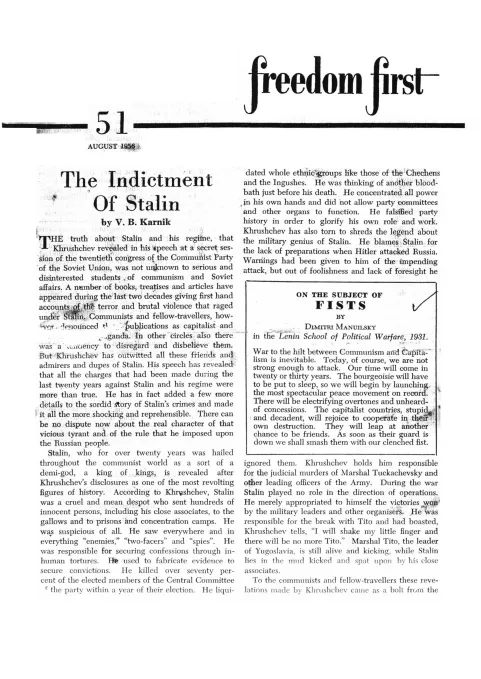
The Indictment Of Stalin
By V. B. Karnik
V. B. Karnik’s lead article surveys the global reaction to Khrushchev’s secret 1956 speech exposing Stalin’s crimes, arguing that the speech confirmed what serious anti-communist observers had said for two decades, while communists and fellow-travellers had dismissed such reports as capitalist propaganda. Karnik catalogues Stalin’s purges, fabricated confessions, liquidation of Central Committee members, persecution of ethnic groups, and military incompetence before Hitler’s invasion, and surveys reactions from Togliatti, the CPI, Howard Fast, and the Indian columnist ‘Adib.’ The essay (continued from page 2 to pages 10-11) goes on to argue that Khrushchev’s condemnation is incomplete and self-serving: it excuses the early purges of Trotsky, Zinoviev, and Bukharin, offers no pledge of civil liberties or habeas corpus, and blames only Stalin’s ‘cult of personality’ rather than the Leninist system that produced him. Karnik concludes that Khrushchev and his colleagues were willing accomplices, not passive witnesses, and that the speech nonetheless renders a service to freedom by shattering the faith of loyal communists worldwide.
- Khrushchev’s speech confirmed two decades of anti-communist reporting on Stalin’s terror, purges, and fabricated confessions.
- Stalin killed over seventy percent of elected Central Committee members within a year of their election and liquidated whole ethnic groups.
- International reactions ranged from Togliatti’s admission of shock to novelist Howard Fast’s public break with communism.
- The Indian columnist Adib, writing in the Times of India, asked how a whole system could produce total silence for twenty years.
- Khrushchev’s condemnation is judged half-hearted: it excuses Stalin’s earlier purges of Trotsky, Zinoviev, Bukharin and others as directed against ‘enemies of the party,’ objecting only to methods used later against Stalin’s own faction.
- No pledge of civil liberties, habeas corpus, or public trials appears anywhere in the speech or the Twentieth Congress proceedings.
- Karnik indicts Khrushchev and his colleagues as willing accomplices in Stalin’s crimes, not passive victims, given their continued public praise of Stalin for two years after his death.
- Despite its limits, the speech is credited with destroying the faith of loyal communists worldwide, which the author frames as a service to the cause of freedom and democracy.
Notes
The unsigned ‘Notes’ section comments on a range of contemporary Indian and international political developments. It welcomes the reported dissolution of the Kremlin-backed World Peace Congress as vindication of long-standing suspicions that it was a communist front, and notes Khrushchev’s own admission that the Peace Councils had failed to win over ordinary people. It reports on Bombay Chief Minister Morarji Desai’s July 4th speech praising American ideals of equality of opportunity, and takes issue with the notion that criticising India’s foreign policy of non-alignment amounts to hostility toward America, arguing India’s own ‘neutrality’ has been one-sided in favour of the Soviet bloc. A further note criticises Congress President U. N. Dhebar’s remark that people who truly loved the Prime Minister should not act against his wishes, framing this as an invitation to totalitarian conformity, and links it to reactions against C. D. Deshmukh’s resignation speech attacking Nehru. Another note discusses two government proposals for a National Book Trust and a booksellers’/publishers’ conference in Madras, cautioning against the state becoming a dominant publisher and recommending grants-in-aid instead. Further notes cover a list of Trade Unionists and Social Democrats imprisoned in Soviet Russia and other communist countries, and the July centenaries of Bal Gangadhar Tilak and Gopal Ganesh Agarkar. A final segment praises C. Rajagopalachari’s warning about the Indian press’s excessive deference toward Nehru and the erosion of critical public discourse, and closes with a barbed item on Richard Nixon’s remark that Soviet aid comes ‘with a rope attached,’ tracing the metaphor back to a 1931 Lenin quotation on tactical alliances.
- Welcomes the reported dissolution of the Kremlin’s World Peace Congress as confirmation that it was a communist front organisation.
- Reports Morarji Desai’s July 4th speech linking American ideals of equality of opportunity to Indian aspirations, while criticising India’s ‘one-sided neutrality’ favouring the Soviet bloc.
- Criticises Congress President U. N. Dhebar’s statement equating loyalty to Nehru with not opposing his wishes, calling it a step toward totalitarianism.
- Links this to the wider controversy over C. D. Deshmukh’s resignation speech criticising Nehru.
- Reviews two publishing-sector developments: a proposed government National Book Trust and a booksellers’/publishers’ conference in Madras backed by Ford Foundation funding, warning against state dominance of publishing.
- Notes a Freedom First supplement listing Trade Unionists and Social Democrats imprisoned in the USSR and other communist states, and a new New York committee for their release.
- Marks the birth centenaries of Bal Gangadhar Tilak and Gopal Ganesh Agarkar.
- Endorses C. Rajagopalachari’s warning that the post-independence Indian press has become uncritically adulatory of the Prime Minister, and criticises Richard Nixon’s ‘aid with a rope attached’ remark as itself derived from a 1931 Lenin quotation on tactical alliances.
The Guilty Men And Their System
By K. K. Sinha
K. K. Sinha’s essay argues that Khrushchev’s condemnation of Stalin at the Twentieth Congress does not go far enough, because it blames a single ‘cult of personality’ rather than the structural features of Leninist communism that produced Stalin. Sinha contends that the entire international communist movement’s decades of silence about Stalin’s crimes proves communists everywhere are authoritarian by temperament and psychologically dependent on Moscow as a ‘father-image.’ He traces the roots of Stalinism to Lenin’s own theory of a centralised, disciplined party and a coercive one-party state, arguing there is little ideological difference between Lenin and Stalin. Sinha predicts that reverence is simply being transferred from Stalin to ‘Comrade X,’ the new ‘Great Pupil of Lenin,’ and that the underlying social base — a bureaucratic party-state apparatus with a monopoly on political and economic power — makes the rise of another dictator, benevolent or malevolent, inevitable unless the system itself changes. He closes by framing the true test as whether communist parties outside Russia will begin independent, self-respecting thought or continue to await the ‘Voice from Moscow.’
- Argues that blaming only Stalin’s ‘cult of personality’ is an insufficient, unmarxist explanation for decades of terror across the entire world communist movement.
- Communists’ universal silence about Stalin’s crimes across many countries shows they are authoritarian by nature and psychologically dependent on Moscow.
- Traces the roots of Stalinist dictatorship to Lenin’s own theories of the centralised party, one-party state rule, and suppression of criticism.
- Argues there is little ideological difference between Lenin’s and Stalin’s forms of dictatorship, only a matter of degree.
- Predicts that party loyalty is simply being transferred from Stalin to a new ‘Great Pupil of Lenin’ rather than genuinely reformed.
- Concludes the underlying social base — bureaucratic party-and-state monopoly on power — will keep producing new dictators, benevolent or malevolent, unless fundamentally altered.
- Frames the real test as whether communist parties worldwide will think independently or continue awaiting instructions from Moscow.
The Poznan Portent
By MA Venkata Rao
M. A. Venkata Rao’s essay treats the June 28, 1956 workers’ revolt in Poznan, Poland, as a revealing portent of conditions inside the Soviet bloc. The riots broke out after a workers’ delegation seeking wage and living-condition improvements returned from Warsaw disappointed; the government dismissed the responsible minister but ruthlessly suppressed the revolting workers with troops. Venkata Rao attributes the unrest to a bread famine and broader consumer-goods scarcity caused by the Soviet planning model’s overwhelming emphasis on heavy and armament industries, compounded by suppressed Polish nationalism, the retention of about two million Poles in Soviet labour camps, the Katyn Wood massacre of 10,000 Polish officers, and the betrayal of the Warsaw uprising. He frames Poland’s near-total economic integration with the USSR as reducing Poles to ‘hewers of wood and drawers of water,’ and argues the regime faces a dilemma between liberalising and intensifying terror, since none of communism’s declared goals — equality of income, a classless society — have been realized. The piece is illustrated by a four-panel cartoon, ‘Slight Interruption,’ satirising a fat Soviet-style official interrupted mid-boast about denouncing Stalin.
- The Poznan revolt of June 28, 1956 erupted after a workers’ delegation seeking wage and living-condition improvements returned from Warsaw disappointed.
- The responsible minister, Julian Tokarsky, was dismissed, but the revolting workers were ruthlessly suppressed by troops and tanks.
- Root cause identified as a bread famine and broader scarcity of consumer goods, driven by the Soviet planning model’s emphasis on heavy and armament industries.
- Suppressed Polish nationalism compounds the economic grievance, citing roughly two million Poles retained in Soviet labour camps, the Katyn Wood massacre of 10,000 Polish officers, and the betrayal of the Warsaw rising.
- Poland’s near-total economic integration with the USSR is described as reducing Poles to ‘hewers of wood and drawers of water.’
- None of communism’s declared goals — equality of income, a classless society, contribution according to capacity — have been realised; trade unions can no longer champion workers’ interests.
- The regime is described as facing a dilemma between liberalising and intensifying terror in the aftermath of Stalin’s dethronement.
Reactions To Poznan Riots
This page reproduces two solidarity statements on the Poznan riots. The first, signed by European intellectuals including Albert Camus, Karl Jaspers, Arthur Koestler, Ignazio Silone, and Stephen Spender, declares solidarity with the Poznan workers, demands an end to executions and public trials with democratic-Western observers present, and calls for an international fund-raising effort on their behalf. The second, signed by a group of prominent Indian writers, journalists, trade unionists and public figures (including Sophia Wadia, B. R. Shenoy, Nissim Ezekiel, and K. K. Sinha among others), similarly demands a halt to repression, a public judicial trial for workers’ leaders, and frames the Poznan revolt as revealing the true conditions of workers under communist rule. A closing passage (continuing Venkata Rao’s Poznan Portent essay) argues that the Soviet bloc since Stalin’s dethronement remains a country of mutual distrust rather than a solid front, and that after forty years neither ‘bread’ nor ‘freedom’ has been secured for the common man in the Soviet system.
- European intellectuals (Camus, Jaspers, Koestler, Silone, Spender, and others) issued a joint statement of solidarity with Poznan workers, demanding an end to executions and public trials before democratic-Western observers.
- The European statement calls for an international fund-raising campaign to support Polish workers.
- A separate statement signed by prominent Indian writers, journalists and trade union leaders demands a halt to repression and a public judicial trial for the Poznan workers’ leaders.
- Both statements frame the Poznan revolt as exposing the real conditions of workers in communist-ruled countries.
- The closing passage argues the Soviet sphere remains riven by mutual distrust rather than presenting a united front, quoting Vice-President Radhakrishnan’s characterisation of it as a ‘nightmare.‘
With Many Voices
The closing ‘With Many Voices’ column, prefaced by an epigraph from Tennyson, collects brief topical quotations from Indian and international public figures on current affairs, including K. M. Munshi on the neglect of Gandhi’s and Ramakrishna’s philosophy in universities, Malayan Chief Minister Tengku Abdul Rehman’s amnesty offer to communist terrorists, T. T. Krishnamachari on austerity in planning, Acharya Vinoba Bhave on greed as the ‘parent of theft,’ Guy Mollet’s remark on unpopularity, Richard Nixon on Khrushchev’s continuity with Stalinist behaviour, Jagjivan Ram on the incompatibility of caste and socialism, and Frank Moraes on Soviet strategy shifting from coexistence to popular fronts. The page also carries a subscription form addressed to the Editor of Freedom First and the publication’s closing masthead naming V. B. Karnik as editor, printer and publisher at The Kanada Press, Bombay.
- A column of brief topical quotations from Indian and international figures, framed by an epigraph from Tennyson’s ‘Ulysses’ (‘The deep moans round with many voices…’).
- K. M. Munshi laments that no university teaches the philosophy of Gandhi or Swami Ramakrishna Paramahamsa.
- T. T. Krishnamachari argues planning in a democracy must prioritise the daily needs of the mass of people, since austerity is a luxury only the prosperous can afford.
- Acharya Vinoba Bhave is quoted calling greed and miserliness the ‘parents of theft.’
- Richard Nixon remarks that Khrushchev will have no effect on the Far East until he and his followers stop acting like Stalin.
- Jagjivan Ram states that the caste system and a socialistic society go ill together.
- Frank Moraes (quoting Encounter) warns that Soviet strategy aims to move from peaceful coexistence between nations to a popular front strategy within countries.
- The issue closes with a subscriber form and the masthead: edited, printed and published for the Democratic Research Service by V. B. Karnik at The Kanada Press, Bombay.
Generated by the v1.5 extraction pipeline. Awaiting editorial review.
Metadata and summary are AI-extracted from the source PDF and reviewed for editorial accuracy. The original work is available via the Read PDF tab above (where present); paragraph-level citation inside the PDF is deferred to a future engagement.