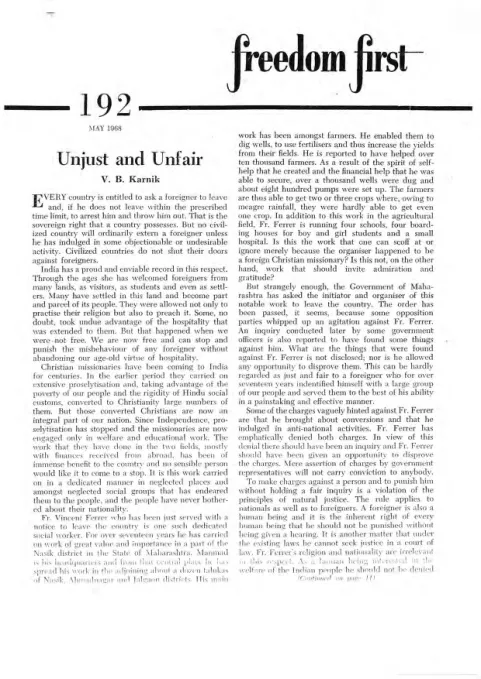
periodical issue
Freedom First
By M. R. Masani, M.P., A. G. Mulgaokar, K. Vedamurthy, P. S. Sridhara Murthy, M. D. Kini, (Contributed)
Printed at Inland Printers, 55 Gamdevi Road, Bombay 7 and Edited and published for the Democratic Research Service by [name illegible] at 127, Mahatma Gandhi Road, Bombay 1. · Bombay · 1968
12 pages
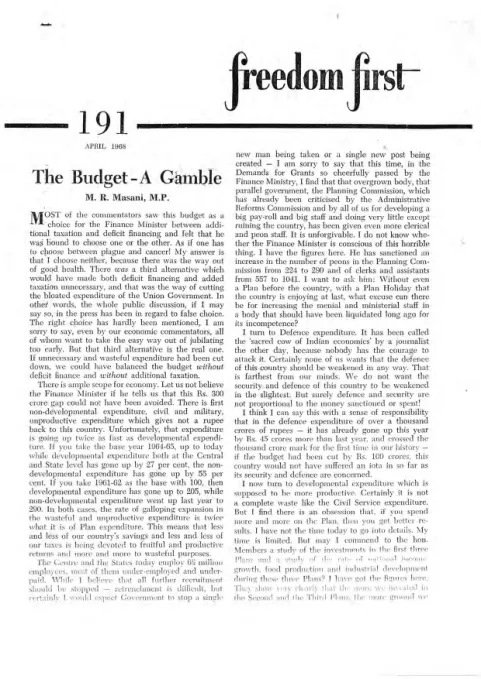
Freedom First
Summary
Freedom First issue 191 (April 1968) is a full twelve-page number of the Bombay classical-liberal monthly, rendered here in its entirety. The lead piece is M. R. Masani’s parliamentary speech “The Budget – A Gamble,” which attacks the Union Budget’s reliance on deficit financing and additional taxation, arguing that curbing wasteful non-developmental expenditure (bloated Planning Commission staff, loss-making public-sector giants like Bokaro and Hindustan Steel, and defence overruns) could have avoided both. A. G. Mulgaokar’s “The Speaker’s Role” reflects on the erosion of parliamentary conventions protecting the Speaker’s impartiality, citing recent controversies in Punjab and Bengal. The issue’s largest block is a three-way exchange on “Towards Understanding Madras Politics,” in which readers K. Vedamurthy and P. S. Sridhara Murthy rebut an earlier article by M. D. Kini on the DMK government’s first year, and Kini replies at length, with the debate ranging over the Hindi agitation, the rice subsidy scheme, and the Second World Tamil Conference. A contributed report, “Unrest in Poland,” covers the March 1968 Warsaw student demonstrations and the wider crackdown on writers and intellectuals following the banning of “Dziady.” The issue closes with “With Many Voices,” a page of press quotations on Indian and world politics.
Key points
-
M. R. Masani’s “The Budget – A Gamble” rejects deficit financing versus taxation as a false choice, calling Bokaro a “White Elephant,” comparing Hindustan Steel’s poor capital efficiency against Tata Steel’s, and proposing dual pricing so subsidised rations reach only the genuinely poor.
-
A. G. Mulgaokar’s “The Speaker’s Role” traces the erosion of the Speaker’s impartiality to Nehru’s failure to have G. V. Mavalankar resign his Congress membership, using recent Punjab and Bengal controversies over gubernatorial powers to argue Speakers cannot rule on constitutional legality.
-
A boxed item reproduces John Chamberlain’s Freeman review of James Burnham’s “The War We Are In,” summarising Burnham’s thesis that communists of every persuasion cooperate in practice to hasten the West’s collapse despite their mutual rivalries.
-
“Towards Understanding Madras Politics” carries rebuttal letters from K. Vedamurthy and P. S. Sridhara Murthy defending the DMK government’s rice scheme and crediting C. Rajagopalachari, not the DMK, as leader of the anti-Hindi movement, with M. D. Kini’s reply maintaining his sceptical view of the DMK’s substantive record.
-
A contributed report describes the March 1968 Warsaw student demonstrations against secret-police rule and censorship, sparked by the banning of “Dziady” and Leszek Kolakowski’s expulsion from the Communist Party, and the regime’s subsequent purge of twelve intellectuals.
-
The closing “With Many Voices” column quotes R. K. Narayan on “Stone Age and Glass Age” coexisting in India and Weekend Review warning India is “not many mid-term elections” from public weariness with democracy.
Essays
The Budget - A Gamble
By M. R. Masani, M.P.
M. R. Masani’s “The Budget – A Gamble,” based on a speech in Parliament, rejects the framing that the Finance Minister had to choose between deficit financing and additional taxation, insisting a third path — cutting wasteful non-developmental expenditure — was available and ignored. He details ballooning Planning Commission staff, criticises Bokaro and Hindustan Steel as “White Elephants” compared to Tata Steel’s efficiency, invokes Kenneth Galbraith’s disillusionment with Indian planning, and calls the year’s deficit finance of Rs. 590 crores (Rs. 1,200 crores over two years) a reckless gamble with the country’s security and welfare. He closes with proposals to reform agricultural pricing and rationing, including abolishing zonal trade barriers and introducing dual pricing so subsidised rations reach only the genuinely poor.
- Argues the real choice was not deficit finance vs. taxation but curbing wasteful non-developmental expenditure
- Cites Planning Commission peon and clerical staff increases (224 to 290; 557 to 1,041) as proof of bureaucratic bloat
- Calls Bokaro a ‘White Elephant’ that could have been dropped from the budget without harm
- Compares Hindustan Steel’s poor capital efficiency (Rs. 14 crores sales per Rs. 100 crores invested) against Tata Steel’s (Rs. 63-66 crores)
- Cites Lee Kuan Yew and John Kenneth Galbraith as witnesses against Indian-style socialist planning
- Calls the budget’s deficit financing ‘legalised counterfeiting’, quoting Acharya Kripalani’s ‘pick-pocketing’ line
- Proposes abolishing zonal trade barriers to create an internal Indian common market
- Proposes replacing universal rationing with dual pricing so only the poor and landless receive subsidised grain
The Speaker’s Role
By A. G. Mulgaokar
A. G. Mulgaokar’s “The Speaker’s Role” argues that the erosion of conventions protecting the Speaker’s impartiality — beginning, in his account, with Jawaharlal Nehru’s failure to have the first Speaker (G. V. Mavalankar) resign his Congress membership on election — has fed a broader constitutional crisis in India’s legislatures. Using contemporary controversies over the Punjab and Bengal Speakers’ rulings on gubernatorial powers, he contends that Speakers cannot decide questions of constitutional legality (that is for the courts) but retain authority over points of order, and warns that without restoring healthy conventions, Indian parliamentary democracy risks descending into chaos.
- Frames the crisis in state legislatures as legislators and Speakers themselves undermining parliamentary process
- Traces the erosion of the convention that the Speaker becomes non-partisan upon election, faulting Nehru for not insisting Mavalankar resign Congress membership
- Discusses the Punjab Speaker’s ruling that the Governor’s proroguing and summoning of the Assembly was ‘illegal, unconstitutional and void’
- Discusses a parallel Bengal Speaker controversy over whether the Chief Minister was legally appointed by the Governor
- Holds that questions of constitutionality are reserved to the courts (ultimately the Supreme Court), not to a Speaker’s ruling
- Cites Article 166(2) of the Constitution as negating the Punjab Speaker’s reasoning
- Calls for educated public opinion to unite around clear constitutional lines to prevent democratic collapse
Towards Understanding Madras Politics
By K. Vedamurthy / P. S. Sridhara Murthy (writing in response to M. D. Kini’s earlier article), with reply by M. D. Kini
“Towards Understanding Madras Politics” collects two rebuttal letters and a lengthy reply to an earlier Freedom First article by M. D. Kini on the DMK government’s first year in office. K. Vedamurthy accuses Northern and Hindi-belt commentators of bias against Madras and the DMK, defends the party’s one-measure-of-rice scheme and its handling of the Second World Tamil Conference and Kumbakonam Mahamagham festival, and frames C. Rajagopalachari (not the DMK) as the real leader of the anti-Hindi movement. P. S. Sridhara Murthy separately credits the DMK with pragmatic, non-ideological governance, ministerial austerity, industrial licensing gains, and fulfilling its two-language poll pledge. In his reply, M. D. Kini concedes some factual corrections (on the Tamil Conference’s sponsorship and the promised rice ratio) but maintains his sceptical view of the DMK’s substantive record, disputing claims about subsidy figures and defending his original ‘circus’/‘carnival’ characterisation of the Tamil Conference.
- K. Vedamurthy charges that Hindi- and English-language commentary on Madras habitually mislabels Tamil Nadu politics through an anti-DMK lens
- Defends the DMK’s one-rupee-per-measure rice scheme as constrained by the Centre’s refusal to subsidise rice while subsidising wheat
- Credits the DMK government’s handling of the Second World Tamil Conference and the Kumbakonam Mahamagham festival despite the ministers’ personal rationalism
- Identifies C. Rajagopalachari, not the DMK, as spearheading the anti-Hindi agitation in the South
- P. S. Sridhara Murthy lists DMK achievements: double-crop cultivation, reopened textile mills, ministerial austerity, and industrial licences
- M. D. Kini’s reply corrects his account of the Tamil Conference’s sponsors but defends his ‘circus’ characterisation and cites Weekend Review and Hindu data on rice/wheat subsidy figures
- Kini reiterates that his sole criterion for judging any government is its handling of India’s economic problems
Unrest In Poland
By (Contributed)
“Unrest in Poland,” a contributed report, describes the March 1968 student demonstrations in Warsaw as a broader protest against secret-police rule and censorship, sparked by the banning of Adam Mickiewicz’s play “Dziady” and the expulsion of philosopher Leszek Kolakowski from the Communist Party. It details clashes between students and riot police, mass arrests (300 people on March 11, only 30 of them students), a Polish Writers’ Union petition and meeting demanding reinstatement of the play, competing party-line and progressive resolutions among the writers, and the regime’s subsequent purge of twelve prominent intellectuals, including Stefan Zolkiewski and former UN delegate Julius Katz-Suchy, branded as ‘reactionary elements, Zionists and demagogues.’
- Frames the unrest as directed against the whole system of secret police rule and censorship, modeled aspirationally on the Czechoslovak liberalisation
- Traces the trigger to the withdrawal of Adam Mickiewicz’s 19th-century play ‘Dziady’ (Forefathers’ Eve) from the Warsaw National Theatre
- Reports clashes on March 8-11 including baton charges, tear gas, about 50 arrests on March 9, and 300 arrests (30 students) by March 11
- Covers the Polish Writers’ Union petition and February 29 meeting demanding discussion of Leszek Kolakowski’s expulsion and censorship of ‘Dziady’ and other plays
- Notes competing resolutions at the writers’ meeting: a party-aligned motion versus a progressive motion that ultimately passed, backing the students
- Reports Gomulka’s regime removing twelve prominent intellectuals from posts, branding them ‘reactionary elements, Zionists and demagogues’
- Names Stefan Zolkiewski and Julius Katz-Suchy (former Polish ambassador to India and UN delegate) among those purged
Without Comment
A boxed “Without Comment” item reproduces, from Swarajya (March 9, 1968), John Chamberlain’s Freeman review of James Burnham’s book The War We Are In, summarising Burnham’s view that communist policy is not an inscrutable riddle but a clear commitment among communists of every persuasion, whatever their mutual rivalries, to hasten the collapse of the West, while communist states themselves have so far avoided the internecine wars that historically weakened capitalist Europe.
- Reproduces a press excerpt with no original editorial commentary, framed by the recurring ‘Without Comment’ feature
- Summarises James Burnham’s thesis that communists internationally cooperate in practice to undermine Western capitalism despite internal ‘polycentric’ disputes
- Notes Burnham’s observation that communist states have avoided the kind of self-destructive wars that battered capitalist Europe in 1914-18 and 1939-45
- Flags the US as the common target of both Moscow and Beijing, cited via Dominican Republic, Cuba, and Vietnam
With Many Voices
The back page, “With Many Voices” (headed by a Tennyson epigraph), is the magazine’s recurring column of unglossed press quotations on current politics, drawn from Hindu, Weekend Review, Swarajya, Janata, The Indian Express, Current, Thought, and The Observer Review, touching on Indian democracy’s fragility, the Congress-opposition standoff, communism, English versus Hindi, Kashmir, and Raj Kapoor’s tax arrears. A subscription coupon for Freedom First (annual Rs. 3.00, payable to the Democratic Research Service) appears alongside the quotes, and the issue’s printer/publisher colophon (Inland Printers, Bombay, edited and published for the Democratic Research Service) closes the page.
- Compiles unglossed quotations from Hindu, Weekend Review, Swarajya, Janata, Indian Express, Current, Thought, and The Observer Review
- Includes R. K. Narayan on ‘Stone Age and Glass Age’ coexisting paradoxically in India
- Includes Weekend Review warning India is ‘not many mid-term elections’ from public weariness with democracy
- Includes C. Rajagopalachari quotes on Congress living on opposition’s stupidity, and on retaining English for national unity
- Includes Salvador de Madariaga on Western market features being reintroduced piecemeal in Communist states
- Includes Kenneth Tynan’s line that censorship is unnecessary because free speech is impotent
- Carries the Freedom First subscription coupon and the issue’s Inland Printers/Democratic Research Service colophon
Generated by the v1.5 extraction pipeline. Awaiting editorial review.
Metadata and summary are AI-extracted from the source PDF and reviewed for editorial accuracy. The original work is available via the Read PDF tab above (where present); paragraph-level citation inside the PDF is deferred to a future engagement.