periodical issue
Freedom First
By M. R. Pai
Edited by Raman K. Desai and printed at Inland Printers, 55 Gamdevi Road, Bombay 7 and published for the Democratic Research Service by Adam Adil at 127 Mahatma Gandhi Road, Bombay 1. · Bombay · 1963
12 pages
Freedom First
Summary
Freedom First No. 131 (April 1963), the Bombay-based monthly of the Democratic Research Service edited by Raman K. Desai, opens with S. Natarajan’s account of press-government relations under the post-1962 “national emergency,” arguing that the revived Defence of India Rules governing the press are an unnecessary and potentially harmful imitation of wartime regulations, and that the deeper problem is a press too accommodating of government rather than one under real legal threat. M. R. Masani attacks the Union Budget’s Super Profits Tax as a mortal blow to joint-stock enterprise that plays into a Marxist agenda under cover of the China emergency. Raman K. Desai surveys corruption and tax evasion in Indian business and the government’s selective, hypocritical response to the Santhanam/Vivian Bose Commission findings. V. B. Karnik’s “The Myth Of Non-Alignment” argues that the Chinese invasion exposed non-alignment as a policy without moral foundation, now overtaken by India’s practical alignment with the West. Harvard’s Samuel P. Huntington, in a reprinted or syndicated piece, analyses the diffusion of power in world politics and the fraying of both the Sino-Soviet and Atlantic blocs. M. R. Pai’s “The Perquisitive Society” documents the scale of government perquisites — water, electricity, housing, travel privileges — enjoyed by ministers and legislators even as ordinary citizens are asked to bear new wartime taxes. Adam Adil (the issue’s printer and publisher) reports on the repression of China’s Muslim minority under Communist rule. The issue closes with the regular “With Many Voices” digest of press quotations on the emergency, non-alignment, and the budget, followed by the annual statutory Statement About Ownership and Other Particulars of Freedom First. All twelve rendered pages appear to constitute the complete issue.
Key points
-
S. Natarajan’s “Emergency And The Press” argues no genuine press emergency justifies the revived Defence of India Rules, tracing a history of successful press self-regulation and criticising Nehru’s claim that press freedom is compromised chiefly by “the power of money.”
-
M. R. Masani’s “A Lethal Budget” denounces the Super Profits Tax as an attack on joint-stock enterprise dressed up as a defence measure, defending free enterprise via Gandhi’s trusteeship concept and Ludwig Erhard’s “Social Enterprise.”
-
Raman K. Desai’s “This World Of Murky Business” surveys the Vivian Bose Commission’s findings against the Tatas, Mafatlal and Ambica Mills, and warns that government hypocrisy and business malpractice together risk pushing India toward communism or military dictatorship.
-
V. B. Karnik’s “The Myth Of Non-Alignment” argues the Chinese invasion exposed non-alignment as a pragmatic policy rather than a moral principle, since India rushed to accept Western arms once China attacked.
-
Harvard professor Samuel P. Huntington’s “Alliances And Tensions” analyses the shift from a bipolar to a diffuse, multipolar world order and the fraying of both the Sino-Soviet and Atlantic blocs.
-
M. R. Pai’s “The Perquisitive Society” documents lavish government perquisites, including Union Ministers’ average monthly water and electricity bills of Rs. 13,489, and calls for their elimination in favour of transparent, adequately paid public service.
-
Adam Adil’s “Fate Of Muslims In Communist China” reports on the repression of China’s roughly sixty million Muslims, including closed schools, suppressed Arabic instruction, and continuing revolt in Sinkiang.
-
The issue closes with a “With Many Voices” digest and the statutory Statement About Ownership naming Adam Adil as printer/publisher and Raman K. Desai as editor.
Essays
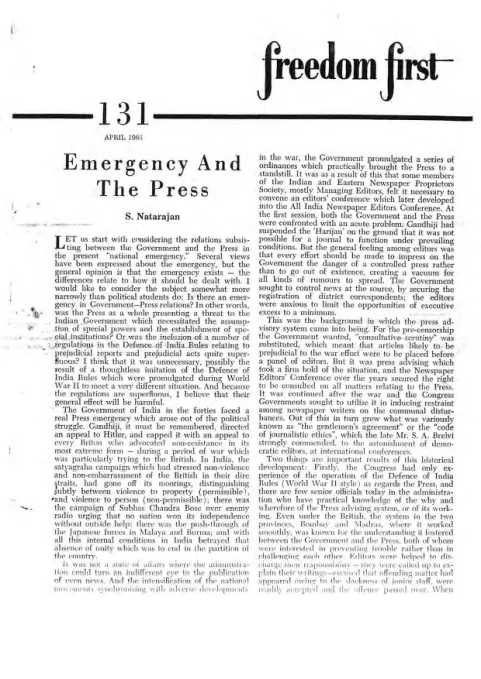
Emergency And The Press
By S. Natarajan
S. Natarajan examines whether a genuine emergency exists in government-press relations following the 1962 China war, concluding that the Defence of India Rules provisions touching the press are a largely unnecessary and possibly harmful copy of wartime-era regulations. He traces the history of press self-regulation from the World War II press advisory system through the postwar “gentlemen’s agreement” and the All India Newspaper Editors Conference, arguing that Indian editors and government developed informal, workable understandings that made heavy-handed legal powers superfluous. He is sharply critical of Nehru’s public remarks equating press freedom with the “power of money,” arguing Nehru evades the real charge — that the Indian press’s actual performance, not its ownership, is the problem — and suggests the press has become “emasculated” partly because Nehru himself prefers editors without firm convictions. The essay closes by noting the government’s 1953 constitutional amendment restricting free expression in the interest of “friendly relations with other powers,” calling this an unproven, merely lucky policy rather than a principled one.
- Argues no genuine press emergency exists requiring special wartime-style powers after the 1962 China conflict.
- Traces history of press self-regulation: WWII press advisory system, the ‘gentlemen’s agreement’, and the All India Newspaper Editors’ Conference.
- Criticizes Nehru’s claim that a free press is compromised by ownership concentration (‘the power of money’), calling it confused thinking.
- Contends the deeper problem is a weak, self-suppressing press rather than government interference.
- Criticizes the 1953 constitutional amendment permitting restriction of free expression for ‘friendly relations with other powers’.
A Lethal Budget
By M. R. Masani
M. R. Masani denounces the 1963 Union Budget, and particularly its Super Profits Tax, as a deliberate attack on joint-stock enterprise dressed up as a measure to fund defence against Chinese aggression, which he argues in effect serves a ‘Marxist mind’ and advances a state-capitalist monopoly. He defends joint stock enterprise as a cooperative institution connecting savers and entrepreneurs to meet community needs efficiently and profitably, invoking Gandhi’s trusteeship concept as compatible with enlightened free enterprise and citing Ludwig Erhard’s notion of ‘Social Enterprise’ as a model reconciling profit with social purpose. Masani calls for business to reform itself (helping small entrepreneurs, opposing crony excess), to place its case before the public more assertively, and cites American ‘Business In Politics’ initiatives (GEC, Ford, the U.S. Chamber of Commerce) as models of organized civic engagement business should emulate in India.
- Calls the Super Profits Tax a ‘lethal attack’ on joint stock enterprise exploiting the China emergency.
- Frames the budget as advancing a state-capitalist, quasi-Marxist agenda.
- Defends joint stock enterprise as a cooperative mechanism serving both investors and the community.
- Invokes Gandhi’s trusteeship concept and Ludwig Erhard’s ‘Social Enterprise’ as reconciling profit and social purpose.
- Urges Indian business to organize politically along the lines of American ‘Business In Politics’ programmes.
This World Of Murky Business
By Raman K. Desai
Raman K. Desai surveys pervasive tax evasion, black-marketeering, and financial malpractice in Indian business, contrasting an ‘expert legal advice’ school that evades restraint through technicalities with a minority that abides by law in letter and spirit. He discusses the Vivian Bose Commission’s findings against major business houses (Tatas, Mafatlal, Ambica Mills), noting some firms resigned from FICCI in response while others resisted accountability, and criticizes government ministers for railing against business misdeeds while doing nothing structural (e.g., a social boycott of known offenders) and while implicated themselves, citing revelations of gold hoarding by a tycoon and remarks by Finance Ministers T. T. Krishnamachari and G. L. Mehta. Desai warns that continued government complicity and business malpractice risk pushing India toward either communism or military dictatorship if honest leadership does not reassert itself.
- Describes two competing business ethics: technical evasion of law versus abiding by its spirit.
- Discusses Vivian Bose Commission findings against Tatas, Mafatlal, and Ambica Mills business houses.
- Criticizes government ministers for hypocrisy in condemning business malpractice while remaining complicit.
- Cites a gold-hoarding scandal involving a business tycoon and remarks by Finance Ministers T. T. Krishnamachari and G. L. Mehta.
- Warns that eroding public confidence in business and government could open the door to communism or army dictatorship.
The Myth Of Non-Alignment
By V. B. Karnik
V. B. Karnik argues that non-alignment, the cornerstone of India’s foreign policy, was the first casualty of the Chinese invasion, since India abandoned its stated aversion to military blocs and rushed to accept Western arms and aid to preserve its freedom. He contends non-alignment was always a pragmatic policy rather than a moral principle, and that having judged China to be the aggressor, India has no right to parade continued non-alignment as a moral virtue while in practice deepening its alignment with the West. Karnik surveys how the diffusion of military power makes individual-nation neutrality increasingly untenable, and cites Chinese Communist rhetoric (Mao Tse-tung, Peking Review) branding Nehru a ‘representative’ of imperialism precisely because India has tilted toward Western military assistance.
- Argues the Chinese invasion exposed non-alignment as an unrealistic guarantee against aggression.
- Frames non-alignment as a pragmatic policy adopted for results, not a moral principle demanding equal treatment of good and evil.
- Notes India accepted substantial Western military aid despite Nehru’s earlier warnings against ‘begging’ for outside help.
- Cites Mao Tse-tung’s doctrine that neutrality is a camouflage and a ‘third road does not exist’.
- Cites Peking Review’s denunciation of Nehru as having ‘joined the enemy’ after India accepted Western aid.
Alliances And Tensions
By Samuel P. Huntington, Professor of Government, Harvard University
Harvard professor Samuel P. Huntington analyses the shift from a bipolar to a diffuse, multipolar world, arguing this diffusion of power differentiates national interests, multiplies (but also moderates) conflicts through cross-cutting cleavages, and is driven partly by uneven nuclear development among allies. He traces how the Sino-Soviet split moved from empirical policy disagreement to ideological rupture, while the Atlantic alliance remains bound by shared values and pragmatic ad hoc conflict resolution (e.g., 1956 Suez) rather than shared ideology, allowing it to withstand internal disputes over nuclear deterrents (British/French desire for independent forces versus the American preference for a collective NATO deterrent). Huntington closes by noting the common but qualified sympathy of both superpowers for India against China, and argues the era of simple foreign-policy slogans — Stalinism, containment, non-alignment — has ended.
- Frames world politics as shifting from bipolarity to a diffuse, multipolar distribution of power.
- Argues diffusion of power differentiates national interests and multiplies conflicts but also moderates them via cross-cutting alliances.
- Contrasts the ideologically fractured Sino-Soviet split with the pragmatic, ad hoc conflict management within the Atlantic alliance.
- Discusses divergent nuclear postures: British/French preference for independent deterrents versus the American preference for a collective NATO deterrent.
- Concludes that simple foreign policy dogmas — Stalinism, containment, non-alignment — are all now outdated.
The Perquisitive Society
By M. R. Pai
M. R. Pai documents public outrage at disclosures of large water and electricity bills paid from public funds for Union Ministers, and broadens the critique into a wider indictment of perquisites enjoyed at nearly every level of Indian public life — MPs’ free rail travel, proposed hostels, state legislators’ honoraria and free transport, and a bloated and increasingly costly central bureaucracy. He argues that perquisites are dangerous in a democracy because they conceal from the public the real cost of maintaining public servants, undermining honest accounting for the sacrifices demanded of ordinary citizens amid new wartime taxation, and calls for the elimination of unwarranted perquisites in favour of transparent, adequately paid public service with full accountability.
- Reports Union Ministers’ average monthly water and electricity expenditure of Rs. 13,489, funded publicly.
- Notes reactions from Lal Bahadur Shastri (offered to pay his own bills) and A. K. Sen’s criticism of the Works and Housing Ministry.
- Extends the critique to MPs’ free rail travel, proposed new hostels, and state legislators’ perquisites (e.g. Maharashtra MLAs’ free transport).
- Cites rising central administration costs, from Rs. 7.73 crores to Rs. 18.47 crores over ten years.
- Argues perquisites conceal the true cost of public servants from citizens and calls for their elimination alongside honest, adequate salaries.
Fate Of Muslims In Communist China
By Adam Adil
Adam Adil (the issue’s publisher and printer) reports on the deteriorating condition of China’s roughly sixty million Muslims under Communist rule, describing historic Muslim concentration in strategic border regions such as Sinkiang and Manchuria and the erosion of their traditional religious, educational, and commercial autonomy. He details Communist efforts to disperse Muslim populations, close Muslim schools, suppress Arabic-language religious instruction, and indoctrinate Muslim youth in Party offices, alongside propaganda distorting Islamic history (citing Soviet claims that the Prophet was ‘an agent of exploiting landlords’). Despite severe repression, the piece reports continuing Muslim resistance and revolt, particularly in Sinkiang, and calls for greater world awareness of and support for Chinese Muslims’ struggle against Communist oppression.
- Estimates nearly sixty million Muslims live in China, concentrated in strategic border regions including Sinkiang and Manchuria.
- Describes Communist policies dispersing Muslim populations, seizing land, and closing Muslim schools and educational institutions.
- Reports Communist efforts to replace Arabic religious instruction with the official Chinese language and indoctrinate Muslim youth.
- Cites Soviet propaganda claiming the Prophet of Islam was ‘an agent of exploiting landlords and merchants.’
- Documents continued Muslim revolt, especially in Sinkiang, since the 1949 Communist takeover, met with severe reprisals.
With Many Voices
The issue closes with ‘With Many Voices,’ a regular digest of quotations from the Indian and international press on the emergency, non-alignment, and the Union Budget, featuring remarks from Rajaji, Khrushchev, Morarji Desai, Nehru, Ayub Khan, Rammanohar Lohia, Tunku Abdul Rahman, and others. Following this is the annual statutory ‘Statement About Ownership and Other Particulars of Freedom First,’ identifying Adam Adil as printer and publisher, Raman K. Desai as editor, and the Democratic Research Service (127 Mahatma Gandhi Road, Bombay 1) as the owning entity, with the magazine printed at The Inland Printers, Bombay.
- Compiles press quotations on the emergency, the Union Budget, and non-alignment from Indian and foreign sources.
- Includes remarks attributed to Rajaji, Khrushchev, Morarji Desai, Nehru, President Ayub Khan, Dr. Rammanohar Lohia, and Tunku Abdul Rahman.
- Publishes the statutory Statement About Ownership, naming Adam Adil as printer/publisher and Raman K. Desai as editor.
- Confirms the Democratic Research Service, 127 Mahatma Gandhi Road, Bombay 1, as the periodical’s owning organisation.
Generated by the v1.5 extraction pipeline. Awaiting editorial review.
Metadata and summary are AI-extracted from the source PDF and reviewed for editorial accuracy. The original work is available via the Read PDF tab above (where present); paragraph-level citation inside the PDF is deferred to a future engagement.