classical liberal
Ludwig Erhard
1897–1977
How Ludwig Erhard is discussed in this archive
Referenced in 11 other works , including IS THERE A MIDDLE WAY? , Indian Planning and the Common Man , and FREE ENTERPRISE—THE KEY TO PROSPERITY .
In IS THERE A MIDDLE WAY? : Mehta cites Ludwig Erhard's 'socially oriented' market — alongside Bismarck's German capitalism, Sweden, and Thatcher/Reagan-era public spending — as historical evidence that mutually complementary Free Enterprise plus Welfare State is the actual working pattern, not the laissez-faire vs.
In Economic Growth with Social Justice : Shenoy invokes Erhard's West Germany as a successful counter-example to Indian socialism, placing it among the Asian 'mini-Japans' as proof that the U-turn he advocates can deliver economic progress.
In Is Socialism Outdated? : Masani holds up West Germany under Erhard as evidence that free economies — not 'Etatisme' — lift wages and living standards fastest, using Erhard's record as the empirical case against Indian planning orthodoxy.
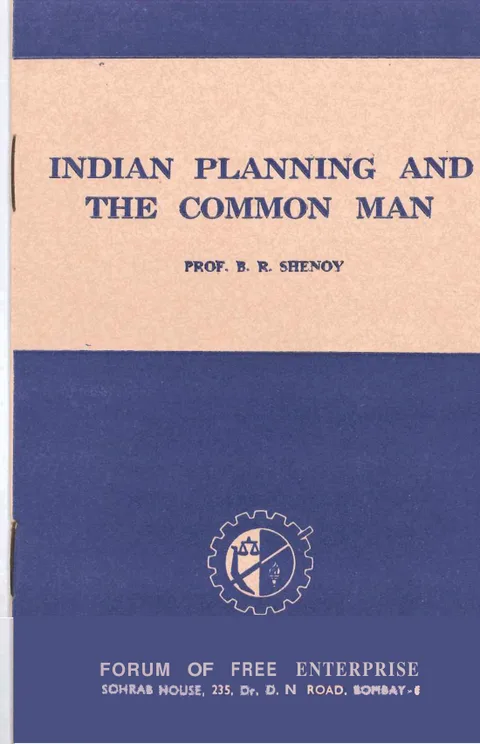
In Indian Planning and the Common Man : Erhard — the architect of the West German Wirtschaftswunder Shenoy elsewhere holds up as the model — is named in the closing reading list as one of the classical-liberal authors who define Shenoy's canon.
In CRISIS OF CONTROLS : Vaidya cites Ludwig Erhard's West German reform — where abolishing foreign-exchange controls caused shortages to vanish almost overnight — as the empirical proof of concept that dismantling controls releases productive energy rather than causing chaos.
Mentioned in (37)
Primary works (33)
- IS THERE A MIDDLE WAY? · 1995
- "Otto von Bismarck on 'oiling' German capitalism, Ludwig Erhard's 'socially oriented' market, Roosevelt and Keynes on state intervention" · Erhard sits in Mehta's catalogue of Middle-Path historical exemplars
- "Free Enterprise and the Welfare State are presented as mutually complementary, with Sweden, Thatcher- and Reagan-era public spending, and Bismarck/Erhard cited as evidence that 'socially oriented' markets are the actual historical pattern." · key-points line restating Erhard's role as a Middle-Path exemplar
- Economic Growth with Social Justice · 1980
- "West Germany under Ludwig Erhard, Spain, Japan and the "mini-Japans" of Asia as success cases, and India, Burma, Sri Lanka, Pakistan and Bangladesh as classic socialist failures." · Shenoy's comparative case for his nine-point liberalisation programme
Show all 33
- Is Socialism Outdated? · 1966
- "Holds up West Germany under Erhard, Japan, France, Britain, the Scandinavian countries, the US, Australia, and New Zealand as evidence that free economies — not 'Etatisme' — lift wages and living standards fastest." · Erhard's West Germany leads Masani's catalogue of free-economy success stories
- Indian Planning and the Common Man · 1962
- "The pamphlet closes with an appendix listing twenty-one recommended works — Hayek, Mises, Robbins, Roepke, Erhard, Bauer, Hazlitt and others — that constitute Shenoy's classical-liberal canon." · Erhard appears in Shenoy's reading list, paired with the German growth-and-low-inflation evidence
- "The appendix's 21-item reading list — Hayek (multiple), Mises, Robbins, Roepke, Erhard, Colin Clark, P. T. Bauer, Henry Hazlitt — anchors the polemic in the Mont Pelerin/classical-liberal tradition." · key-points restatement: Erhard named in the canon
- CRISIS OF CONTROLS · 1960
- "The Ludwig Erhard miracle in West Germany — where removing foreign-exchange controls caused shortages to vanish almost overnight — is held up as the proof of concept." · the positive counter-model to India's retained wartime controls; Erhard's Germany is Vaidya's template for what liberalisation can achieve
- ENLIST CO-OPERATION OF PRIVATE ENTERPRISE · 1959
- "the Beveridge-style Welfare State that Congress invokes has, in fact, been substantially built in Britain, the United States, and Erhard's West Germany 'without any departure from' capitalist and individualistic foundations" · Erhard's model used to rebut the socialist premise underlying the Avadi resolution
- For Freedom, Farm And Family · 1959
- "Masani ends with Ludwig Erhard's slogan "Let the men and the money loose"" · Erhard's slogan used as the positive economic manifesto for the non-socialist opposition Masani calls for
- Central Economic Planning · n.d.
- "East Germany versus West Germany shows what the free market and Ludwig Erhard's 1948 currency-and-price liberalisation produced relative to a walled, grey command economy" · core comparative case-study section; Erhard's reform is the Friedmans' primary European proof-point for markets over planning
- FREE ENTERPRISE—THE KEY TO PROSPERITY · n.d.
- "credits Ludwig Erhard's bold decision to remove controls — taken in the face of predicted chaos — with unleashing the individual initiative that produced the so-called German economic miracle" · Erhard as the empirical proof of concept for Dahanukar's free-enterprise argument
- "Invokes Erhard's 1958 New Delhi address to attack imitative planning, insisting that economic life is shaped 'not at the draft-board, but by human beings'" · Erhard's own words brought to bear on Indian planners
Excerpts (2)
- B.R. Shenoy on Economic Growth with Social Justice
- "In the contemporary world, West Germany (under Professor Ludwig Erhard), Spain, Japan and the several mini-Japans in Asia are outstanding examples." · Erhard's West Germany is the flagship case study Shenoy uses to show that market economics delivers social justice outcomes superior to socialism
- National Priorities for 1970
- "We agree with Dr Ludwig Erhard, the maker of the German miracle, when he said, "Let the men and the money loose; and they will make the country strong."" · Erhard supplies the operational slogan for Swatantra's liberalisation creed