speech
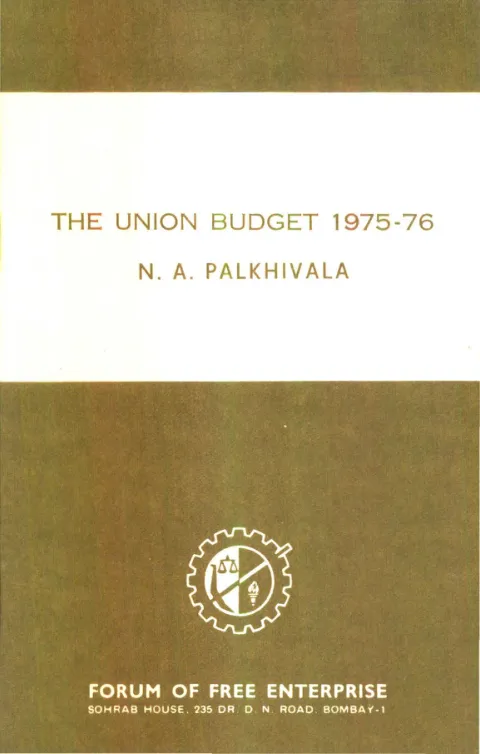
The Union Budget 1975-76
Published by M. R. PAI for the Forum of Free Enterprise, 235, Dr. Dadabhai Naoroji Road, Bombay-400 001, and printed at TATA PRESS Ltd. · Bombay · 1975
18 pages
Part of The Union Budget
The Union Budget 1975-76
By N. A. Palkhivala
Summary
Palkhivala’s Forum of Free Enterprise address on the Union Budget for 1975-76, delivered in Bombay on 6 March 1975, observes that ‘all omens were propitious’ — inflation had been tamed and tax revenues had over-shot estimates, vindicating the previous year’s personal-tax cut — yet the Finance Minister ‘failed to grasp the golden opportunity to pull this country out of stagflation’. He calls it once again a ‘bullock-cart Budget’: an ancient vehicle, but not for reaching one’s destination expeditiously. The shaping of every budget, he argues, is the work of an ‘aggressively conservative’ North Block bureaucracy that resists change in proportion to its boldness.
Much of the address is comparative and historical. Palkhivala holds up Ludwig Erhard’s 1948 German currency-and-tax reform (‘The only rationing coupon is the Mark’) as the model of vision and courage India lacks, and quotes Aneurin Bevan on the unsolved problem of reconciling parliamentary popularity with sound economic planning. He contrasts India’s feeble incentives with the generous tax holidays of Brazil and Malaysia, cites Dr. Bruno Hake on the failure of India’s duty-free export zones, and laments that the 5% corporate surcharge introduced for the Bangladesh war survives while real incentives wither. India’s export share is a ‘paltry’ 0.5% of world trade; the rupee has lost 43% of its purchasing power in four years.
The heart of the speech is three ‘most disturbing’ features. First, the Budget shows ‘unconcealed scorn for the judicial process’, proposing to override Supreme Court and High Court judgments (on the City Compensatory Allowance and on gratuity deductions) with retrospective effect — ‘never in the history of India has any Budget shown such total contempt for the rule of law’. Second, the new 1% excise on unspecified factory articles squanders the nation’s most perishable resource, the time and man-hours of its citizens, on collecting trivial levies. Third, the Budget deals ‘a calculated blow to free enterprise’, concentrating resources in ‘the monolithic State’ (public-sector Plan outlay up 23% while private new-asset formation is stuck at 5%) and discouraging public deposits with companies. He closes by endorsing Sir Richard Clarke and Patrick Jenkin on ending budget secrecy, contrasting Canada’s advance-announced corporate rates with India’s ‘hugger-mugger budgetary practices’, and concluding that the best that can be said is that the Budget ‘will not aggravate’ India’s depression. The rendered pages cover the full address and the FFE colophon dated 25 March 1975.
Key points
-
Despite propitious omens (tamed inflation, revenue over-shooting estimates vindicating the prior tax cut), the Budget fails to break stagflation — another ‘bullock-cart Budget’.
-
Budget-making is blamed on an ‘aggressively conservative’ North Block bureaucracy that resists change in proportion to its boldness.
-
Ludwig Erhard’s 1948 German currency-and-tax reform is held up as the model of vision and courage; Aneurin Bevan is quoted on reconciling popularity with sound planning.
-
India’s incentives are feeble next to Brazil and Malaysia; the war-time 5% corporate surcharge survives while real incentives wither; export share is a ‘paltry’ 0.5% and the rupee has lost 43% of its value in four years.
-
First disturbing feature: ‘unconcealed scorn for the judicial process’ — retrospectively overriding Supreme Court / High Court judgments, ‘total contempt for the rule of law’.
-
Second: a new 1% excise on unspecified factory articles wastes citizens’ man-hours and spawns bogus small-scale units.
-
Third: a ‘calculated blow to free enterprise’ — public-sector Plan outlay up 23% while private new-asset formation is stuck at 5%, plus disincentives to public deposits in companies.
-
Closes endorsing Sir Richard Clarke and Patrick Jenkin on ending budget secrecy; the best verdict is that the Budget ‘will not aggravate’ India’s depression.
Generated by the v1.5 extraction pipeline. Awaiting editorial review.
Metadata and summary are AI-extracted from the source PDF and reviewed for editorial accuracy. The original work is available via the Read PDF tab above (where present); paragraph-level citation inside the PDF is deferred to a future engagement.